Nature Is Not Efficient. That May Be the Point.
By Conny Lazo
Agentic Engineer. Project Manager. Shipping software with AI agents.
A workshop question, not a nature lesson
When a friend asked me to think about a workshop on how the ways of nature might apply to societal problems, my first reaction was caution. Nature is one of those words that can make a serious room drift toward metaphor: cooperation, harmony, balance, a forest photograph on the opening slide. My friend and I wanted the opposite. Systems thinking. Critical thinking. No kumbaya!
That warning matters because nature can be made to endorse almost anything. Competition and cooperation both exist. Redundancy and ruthless selection both exist. If we go looking for moral permission, we will always find it. The useful question is narrower: which physical mechanisms keep living systems viable under fluctuation, what do those mechanisms cost, and where does the analogy fail?
There was a second reason for caution, and it was personal. I have spent most of my working life managing programmes, and a large share of that job is taking slack out of things. Shorter lead times. Fewer handovers. One supplier instead of three. I have been rewarded, for years, for exactly the behaviour I was about to go and question.
The workshop proposal led me through the work of Olivier Hamant, Charlène Descollonges, Serge Zaka and Jean-Marc Jancovici, and, as their counterweight, Arthur Keller. They disagree about nuclear power, prediction, climate framing and even the meaning of resilience. That disagreement is not a defect in the material. It is the reason to use it.
There is also a reason this matters now rather than in some abstract future. Reducing emissions is one part of the story. The other part is that a good deal of warming is already committed, and a Europe that runs its food, its transport and its farms on imported oil has to learn to be robust against the heat and the shortages that are coming whether or not the emissions curve bends. Both jobs have to be done at once.
The proposition is simple: many living systems remain robust not because they are perfectly efficient, but because they keep capacity in reserve. They tolerate variation. They duplicate functions. They move more slowly than the theoretical maximum. They carry what our dashboards, the way we currently count things, would call waste.
The systems we admire are optimized for a world that holds still
Plant biologist Olivier Hamant puts the trade-off bluntly in Quantitative Plant Biology: "high robustness is incompatible with high efficiency." He is a research director at the Institut national de recherche pour l'agriculture, l'alimentation et l'environnement (INRAE), in a plant biology lab in Lyon, and he is not inventing the sentence: he rests it on two older results, one from ecosystems and one from the biophysics of living things, and both say that a system tuned to squeeze out every bit of output has nothing left when the input changes. His own microscope adds the picture: a leaf gets its reliable shape from cells that grow at different, sloppy, redundant rates. Precision is not what produces the reliable result. Variation is. The sentence is uncomfortable because it challenges a reflex most of us have been trained to trust. If a process can be faster, leaner or more precise, improving it feels almost morally correct.
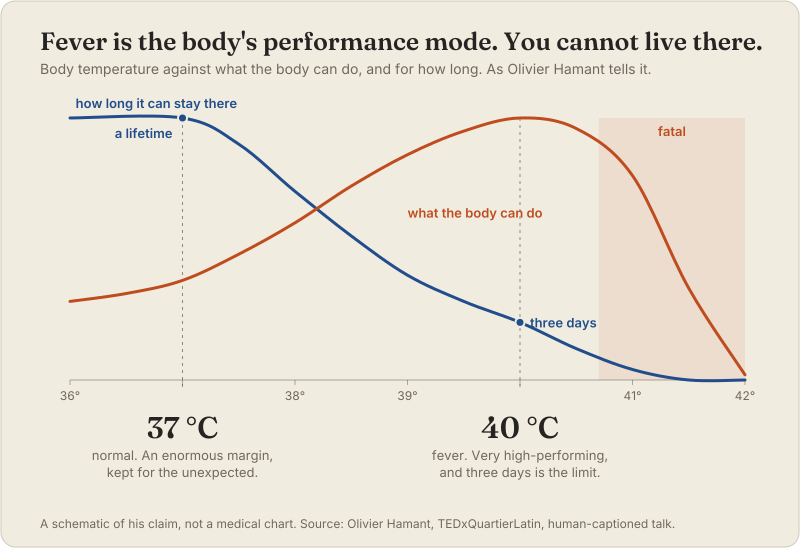
Our bodies offer a simple example. At normal temperature, the system is not operating at biochemical maximum. Fever temporarily accelerates activity, but peak performance is an emergency mode, not a sustainable baseline. Hamant's version, from a TEDx talk:
« At 37 degrees, we have kept an enormous margin for manoeuvre, to guard against an unpredictable fluctuation. At 40 degrees, we are very high-performing. But it has to be temporary. Forty degrees is three days; after that, it is fatal. »
Performance has a place. The mistake is building the entire organism, company or city as if the emergency should last forever. Hamant's line for living things is short:
« They are not high-performing and robust. They are robust because they are not high-performing. »
Project management has its own version. We remove slack, fill every calendar, reduce suppliers, make each role essential and celebrate utilization. Then one absence, one delayed component or one broken interface stops the whole plan. Margin looks wasteful until the day it becomes the only reason the work continues. A team running at 40 °C is a team in launch week, and some organisations I have been part of have treated launch week as the standard they would like to reach permanently.
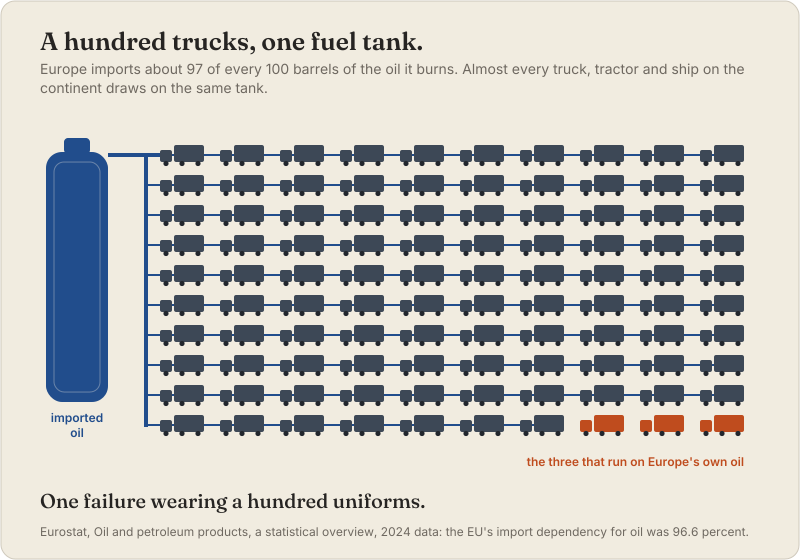
Europe's food system has the same shape, at a scale that matters more. Europe imports about 97 percent of its oil and roughly 90 percent of its gas. Almost every tractor, every truck and every fertiliser plant on the continent runs on the same imported molecule, and Jancovici's arithmetic, which I laid out in Europe's Next 25 Years, is that the countries supplying it will see their own production roughly halve by 2050 and will serve their own people first. That is not redundancy. A hundred trucks with the same fuel tank are one failure wearing a hundred uniforms.
This is not an argument against performance. A surgeon must be precise during an operation. A firefighter must optimize inside the fire. The surrounding hospital, supply chain, training system and recovery time, however, must be robust. Performance should be a temporary permission inside a system designed to survive it.
Security is not the same as control
Security challenges another comfortable equation: more control equals more safety. Controls matter, of course. Two-factor authentication is better than a password alone. A flood barrier may be necessary. A locked door is useful. But controls can also change behavior. Once a system appears protected, people outsource vigilance to it.
Hamant tells that story on a podcast, and his example is the bank. The more control a system puts on display, the less carefully the person inside it looks, so the fake banker on the phone is more credible, not less, when the real bank has elaborate security. His conclusion, in effect: we design security as control, when what we actually want from it is serenity, and serenity is the opposite of control. I did not want that to be true, because control is measurable and serenity is not.
That creates a strange possibility: a safeguard can quietly remove the options you would need once it fails. A farm protected by one reservoir becomes dependent on the reservoir. A great deal of Europe's winter vegetables come from the greenhouses of Almería, in the south of Spain, tens of thousands of hectares under plastic that harvest from December to March and then travel north by road. The system is a marvel of control, and it has one input it does not control: diesel.
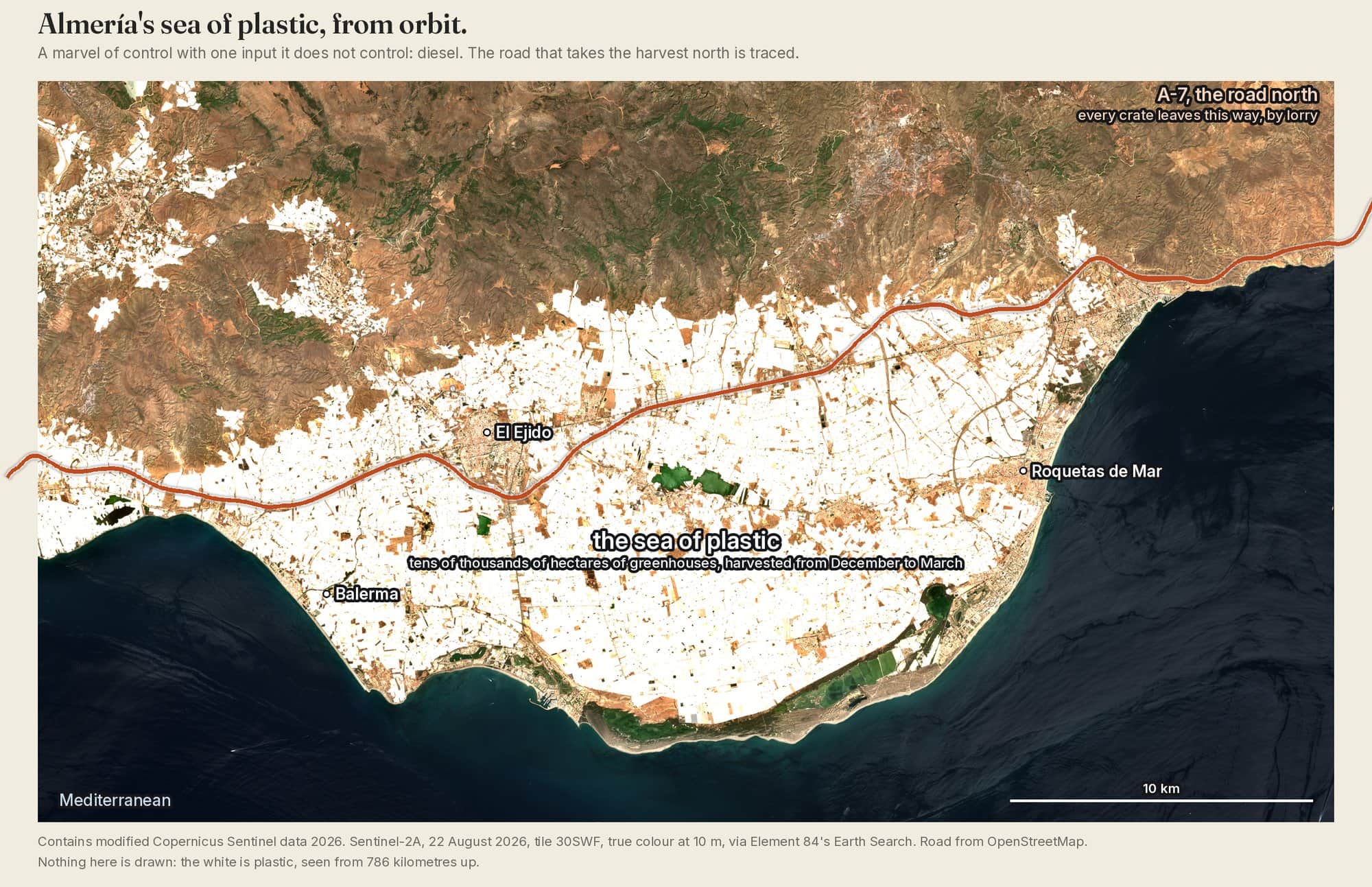
In early 2022 parts of Spain and Portugal lost 60 to 80 percent of their crops to drought, and Spain's olive oil harvest in 2022–23 came in at about half a normal year. In February 2023 British supermarkets were rationing tomatoes and cucumbers, not because the trucks stopped but because there was nothing to load them with: winter harvests in southern Europe and North Africa had failed at the same time, and there was no further south to send for.
That is the fragility in one image.
The arrangement holds while the fuel is cheap and the bad years are scattered, and it breaks when a whole region has the same bad winter at once. As the heat rises, a bad year in the south of Spain stops being an exception and becomes the pattern, and the diesel that carries the harvest north is the part of the arrangement a fuel shortage removes first.
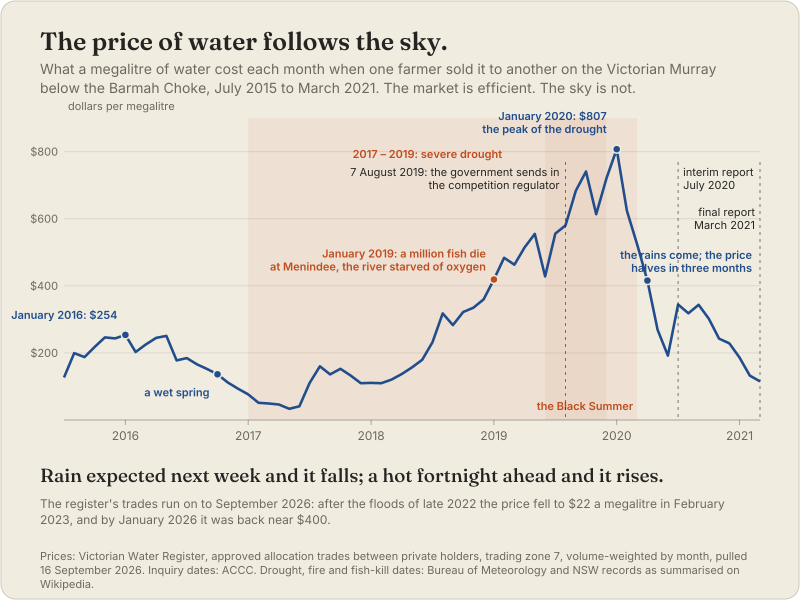
Adelaide offers the water version, and a French documentary, released in English as Lords of Water, tells it in the city itself. Adelaide is the capital of the driest state on the driest inhabited continent, much of its household water comes from the River Murray, and during the Millennium drought of the 2000s reduced flows brought harsher restrictions every year and, in the end, a A$ 1.83 billion desalination plant. It is also, the film says, where the idea of trading water was conceived, at the university; it calls the economist Mike Young the founding father of the Australian water markets. His starting point was honest: in some years the river gives you zero, so the state can no longer hand out more, and people will have to find a way to share what there is.
South Australia had already separated the right to water from the ownership of land in 1983, the country unbundled the two nationally in 1994, and a market was the answer to the sharing problem. It is a very efficient way to move water to whoever pays most. The price now moves with the weather forecast: rain expected next week and it falls, a hot fortnight ahead and it rises. Large investors buy water, one farmer in the film says, and it is going back to the days of landlords and peasants, with the peasants buying water at whatever the landlord says it is worth.
An Aboriginal elder from the lower Murray, speaking for his people, puts it more shortly: part of it is madness and most of it is greed, and you cannot drink money.
By 2019 the federal government had sent its competition regulator to inquire into how the basin's water markets were operating, how transparent they were and who was regulating them. Control was added at every step. Options were removed at every step.
Nature's version of security looks less like a wall and more like margin, reserve and connection. It is a hidden stock that is not spent in normal operations. It is a backup that fails differently from the primary: Hamant's example is a hospital on an unreliable grid, which should not have only electric ambulances but diesel ones too and, at the limit, animals that can pull a cart. He is not the only one to say it. Yves Cochet, who was France's environment minister in 2001 and 2002, has been telling ministers for years that Renault and Peugeot should be preparing to build carriages, that France has about a hundred thousand draught horses and might need millions by the mid-2030s, and that a horse needed in 2035 cannot be born in 2034, so the breeding is a fifteen-year policy that has to start now.
He bought horses and carriages himself.
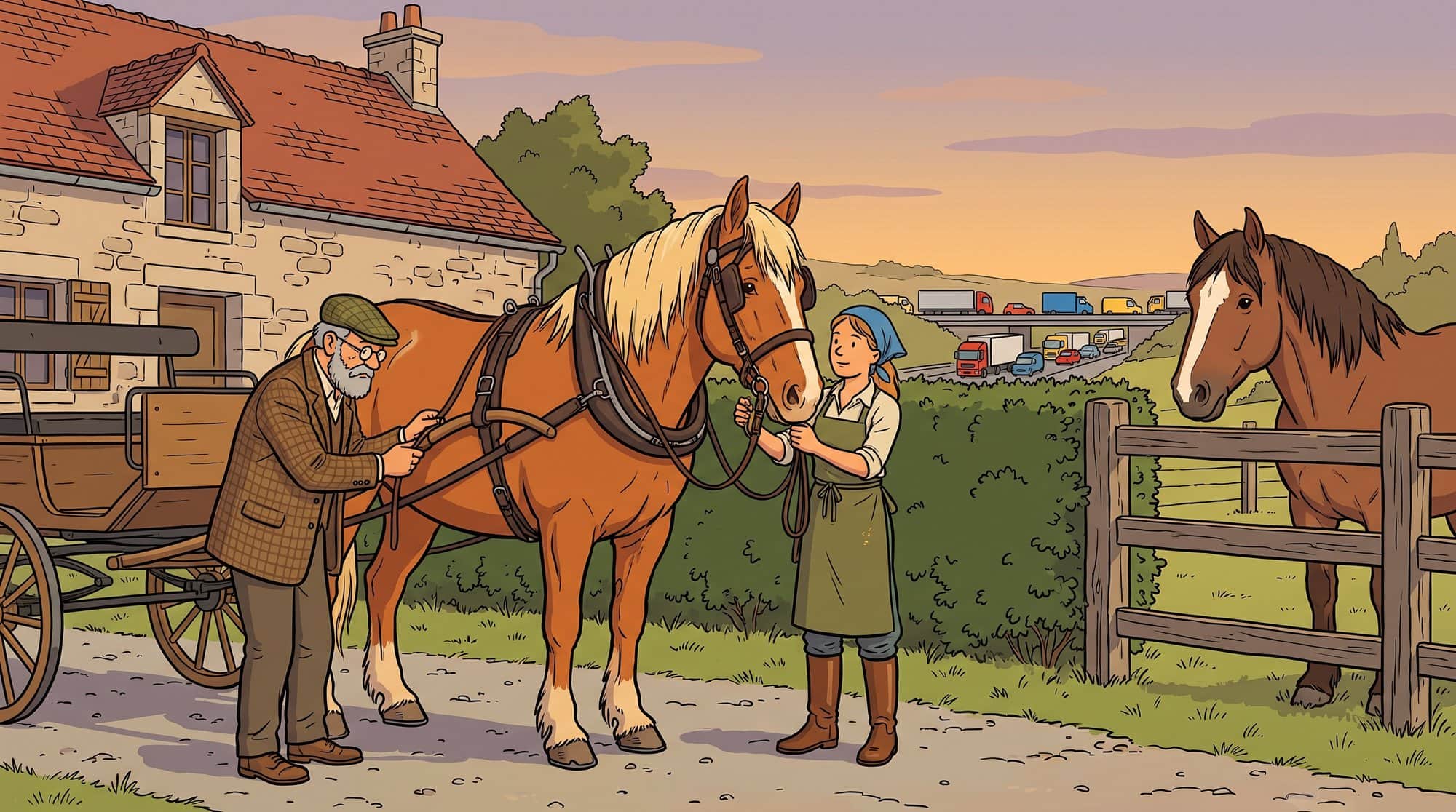
The institutions he says this to treat him as a crank, and that reaction is worth studying, because it tells you how far a serious backup sits outside what a modern administration can imagine. It is, finally, a network of relationships that still functions when the central mechanism is gone. The parachute in a fluctuating world, Hamant says, is the social fabric.
I would have rolled my eyes at that ten years ago. Then I watched who actually got through the last few crises, and it was not the households with the best locks.
Arthur Keller, who teaches and consults on systemic risk in France, gave the state-scale version to a parliamentary committee in 2021, and it is on the official record:
« The will to optimise everything, and the elimination of stocks, have removed our last margins for manoeuvre when things go wrong. »
In the same hearing he put a number on French cities: an average food autonomy of about 2 percent. Ninety-eight percent of what a city eats comes from somewhere else. That is a very efficient supply chain. It is not a secure one. His question for any town, region or company is the one I would put at the top of a security review: in a prolonged interruption of food, fuel or farm inputs, how long do we hold? Most places have never asked it, and the ones that have do not like the number.
I do not think this produces a simple choice between the bunker and the social fabric. Sometimes the bunker wins.
The exercise is to identify the scenario in which it does, then ask what happens in the second and third crisis, when power, fuel, communications or staffing have also failed. Real security is not the first barrier. It is the number of viable options left after the barrier breaks.
Resilience is built on ordinary days
Resilience is one of those words that has been stretched until it can mean almost anything and nothing. Bounce back. Adapt. Endure. Transform. The thinkers do not agree on the definition, and that is useful. Hamant was so irritated by the socio-ecological version that in late 2024 he called it a scam on a live broadcast, hardened that to a toxic word a year later, and by this summer had dropped the fight altogether. Their operational agreement is stronger than their vocabulary: the capacity must exist before the event, and on the day it is built it will look inefficient.
Consider the hidden stock inside a tree.
Hamant describes stores in the trunk that are not consumed to improve ordinary growth. They are held for injury, and when lightning takes the crown the tree spends them on new buds, then replenishes them before expansion resumes. Notice the order. The institutional translation is demanding: a named reserve, a named custodian, a clear condition for breaking the seal, and a budget for maintaining something that may produce nothing for years. Most institutions I know would spend the reserve, declare victory, and put the refill on next year's budget.
We used to know how to do this. The Seine that runs through Paris is a managed river. Four reservoir lakes upstream, on the Yonne, the Seine, the Marne and the Aube, were built between 1949 and 1990 to hold back the winter and spring floods and to feed the river through summer and autumn, and together they store more than 800 million cubic metres. The great flood of 1910 carried about four billion, so the lakes are a margin, not a wall, and everyone who built them knew it. The public body that runs them was created in 1969 and is still filling and emptying them on a calendar most Parisians have never heard of.
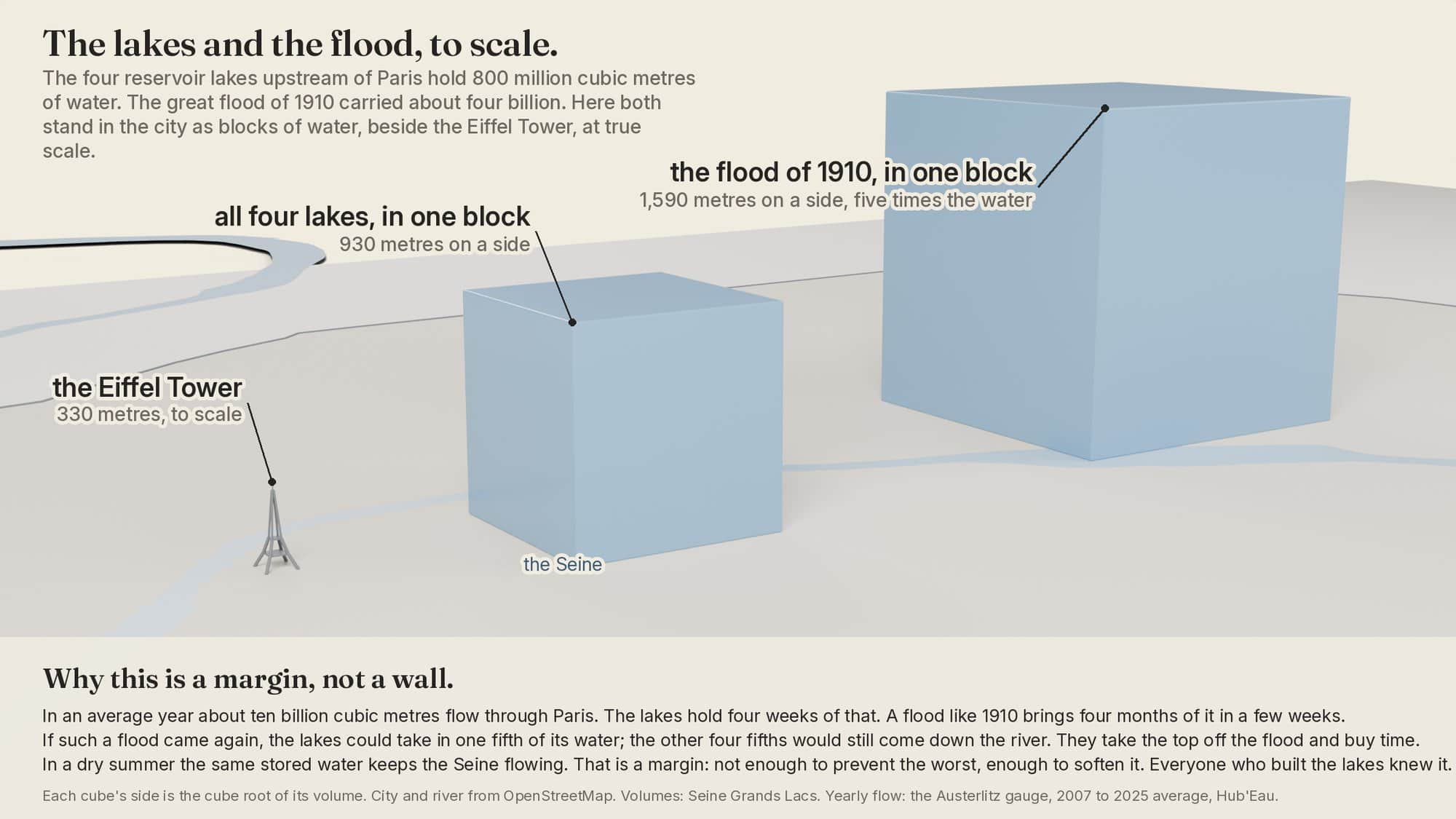
That is what long-term value looked like: a project that outlives the people who decided it, paid for by generations that would never see the flood it was built against.
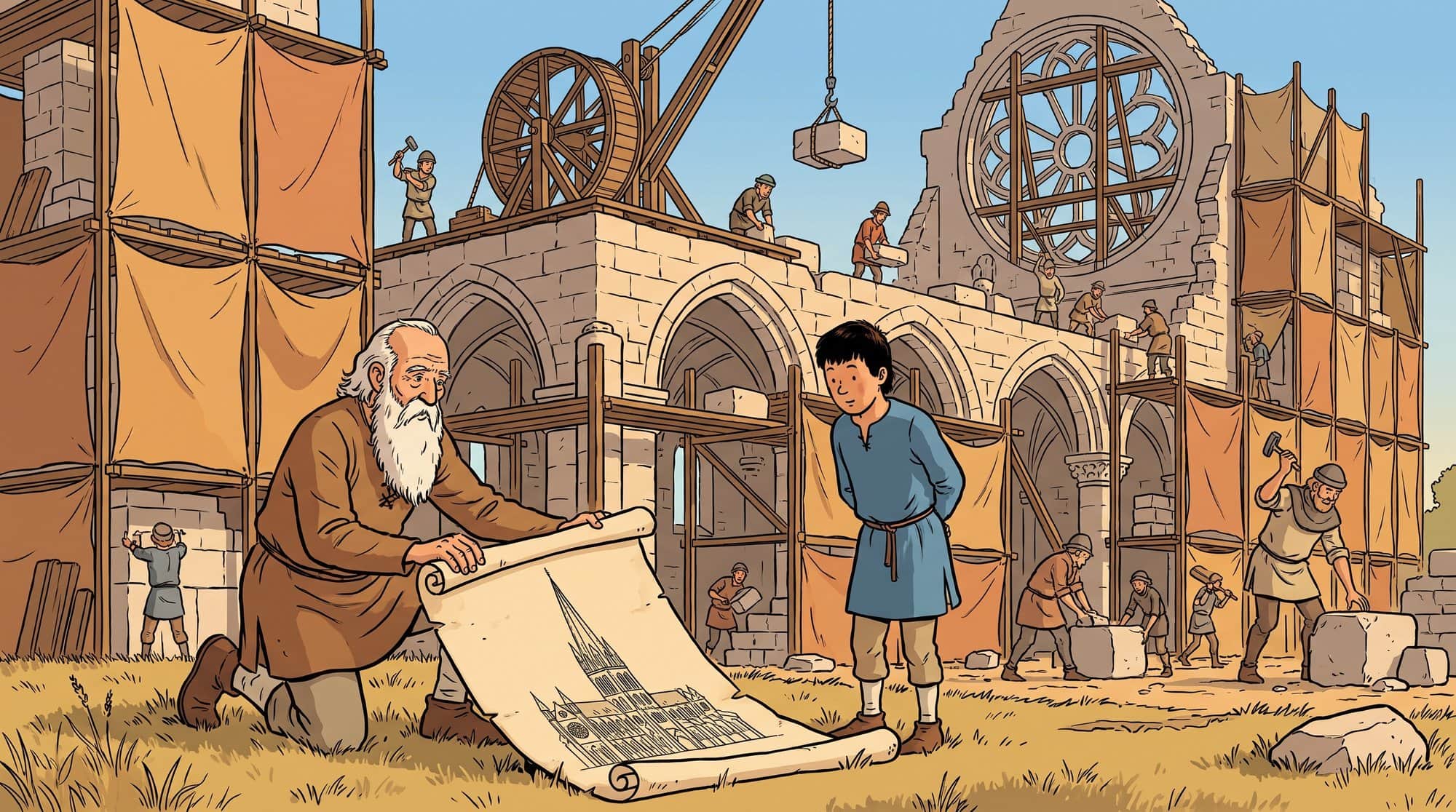
Our ancestors planned in centuries. Cathedral builders started work they knew they would not see finished. The motto of free-market capitalism mixed with neoliberal deregulation is the next quarter, and a reservoir lake does not fit in a quarter.
Redundancy is equally misunderstood. Two suppliers are not redundant if both depend on the same port, the same refinery, the same seed company or the same specialist. A backup that shares the primary system's failure mode is not a backup. Heterogeneous redundancy is expensive because it requires different skills, parts, contracts and maintenance. That expense is exactly why it survives the failure the cheaper design cannot.
The most practical idea may be degraded mode, which is Keller's term. Before a crisis, decide which essential functions must continue, which service levels can fall, and which activities will stop.
He names seven systems that qualify as essential: food, drinking water, energy, health, security, crisis management and transport. For those, he argues, the first criterion of public investment and public procurement should stop being performance and become reliability in degraded mode. If everything is declared essential, nothing is. A resilience plan that refuses to name what will be sacrificed is not a plan. It is a hope that the crisis will make the decision kindly. I have rarely seen that list in a company.
Charlène Descollonges makes this visible at landscape scale. She is a hydrologist who spent five years inside a river syndicate advising elected officials on who gets the water, and now co-leads a movement for what it calls regenerative hydrology. Drought, flood, fire and erosion, she argues, are managed as separate files even though they are expressions of one damaged cycle.
The practical response, in the words of the movement's manifesto, is « Ralentir, Infiltrer, Stocker, favoriser l'Évapotranspiration et Diversifier la végétation »: slow water, infiltrate it, store it in soils, let the plants breathe it back out, diversify what grows.
It looks less dramatic than a giant piece of infrastructure. It also requires land, coordination, time and someone willing to pay before the result is obvious. The store is the soil, not a reservoir. It is built years before the drought, and it is invisible when it is working.
The measured side is not reassuring, and it is worth saying how it is measured, because the instrument is strange.
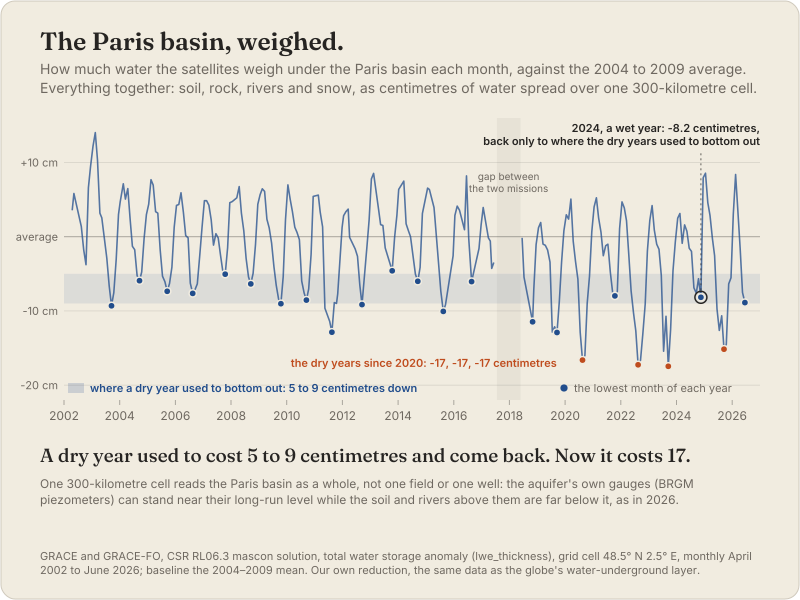
Since 2002 a pair of identical satellites, GRACE and then its successor GRACE-FO, have flown one behind the other about 220 kilometres apart and 500 kilometres up, doing nothing but measuring the distance between themselves, with a microwave link precise enough to catch a change of ten micrometres, a tenth of the width of a hair. When the leading satellite passes over something heavy, a mountain range, a full aquifer, a winter snowpack, gravity pulls it forward first and the gap opens; over something lighter the gap closes.
Month by month, those tiny changes are turned into a map of where mass has moved, and on land, over a few years, mass that moves is almost always water: in the soil, in the aquifers, in lakes and snow, all of it together. The resolution is coarse, about 300 kilometres, so it reads regions, not fields.
Heat you feel. A flood you can film. This layer is silent.
Under the Paris basin, the wheat country that feeds the city, the water table used to fall 5 to 9 centimetres in a dry year and come back. In the dry years since 2020 it falls 17 centimetres, and 2024, a wet year, only got it back to where the dry years used to be.
Nothing above it looks different. The tap runs, the wheat is green, the supermarket is full, and the reserve that makes all three possible is leaving from underneath, through a million pumps, each one reasonable, each one somebody's harvest.
It is the tree's hidden stock, the one a living thing keeps and never touches, being spent with no plan to refill it.
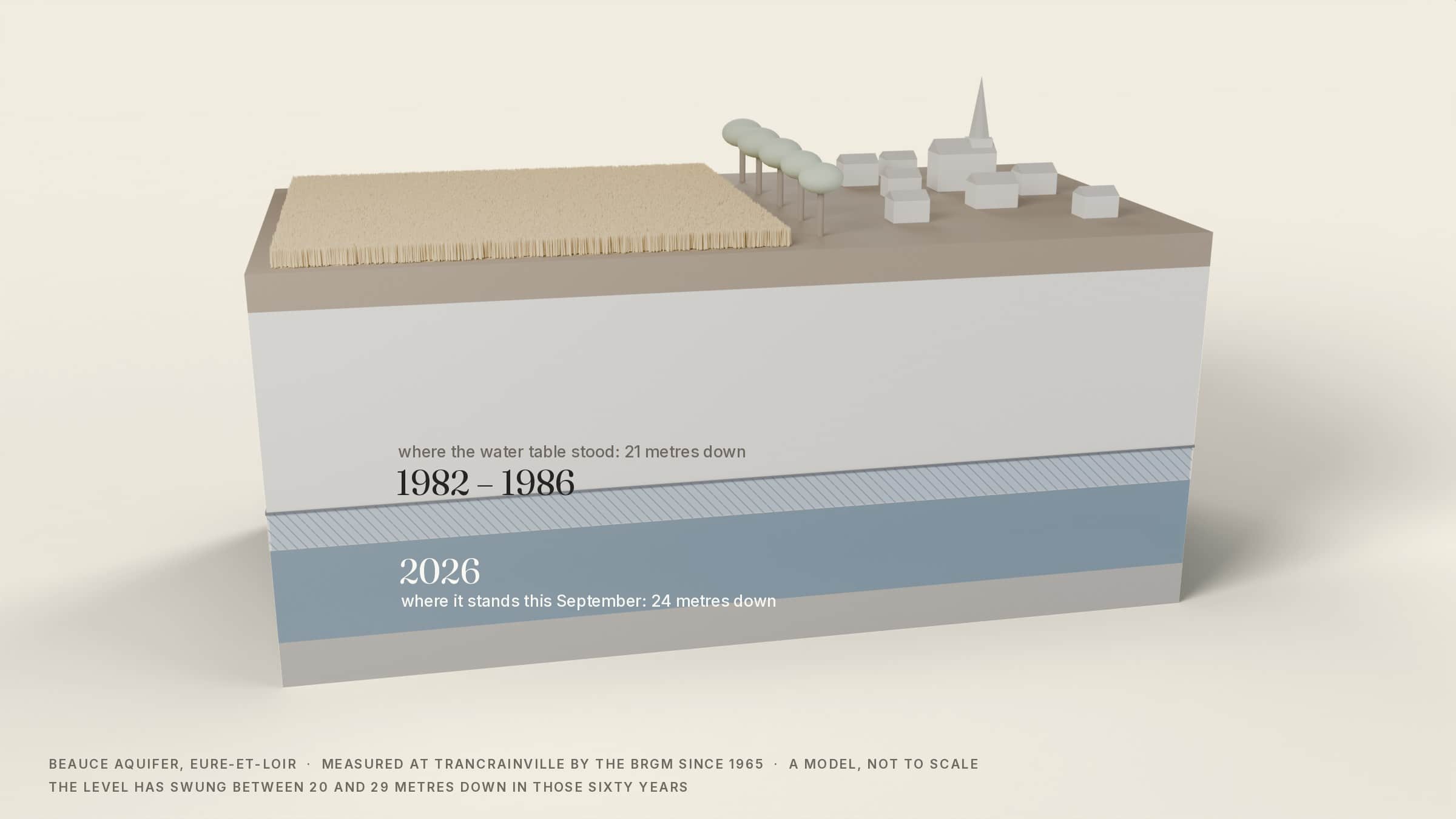
The satellites can see it because they weigh the ground.
By mid-2026, 28 percent of the land they measure weighs at least 5 centimetres of water less than it did 20 years ago. In 2004 it was 3 percent. Nobody has a model for where this stops, because nobody planned to spend the reserve. The satellites just keep weighing the ground, and every year it weighs less.
The fastest team can still answer the wrong question
The third workshop question is the one that connects most directly to how I work: why put philosophers and scientists on the same project team? The answer is error detection. A homogeneous team can move quickly because its members share assumptions, vocabulary and incentives. It can also produce an excellent answer to a question nobody should have asked.
On this point, Hamant's biology is more than metaphor. His research describes local variability between neighboring plant cells as part of the mechanism that produces reproducible form. Difference is not noise to be removed; it carries information. His own phrasing, from a podcast, is that a homogeneous team delivers the best possible answer to the wrong question, and that the friction of a mixed one is what forces the question to be rewritten. The published version is stricter.
Quantitative plant biology produces robust results, he writes, "because it is rooted in creative, interdisciplinary and intercultural approaches." That is a claim about rigour, not about inclusion.
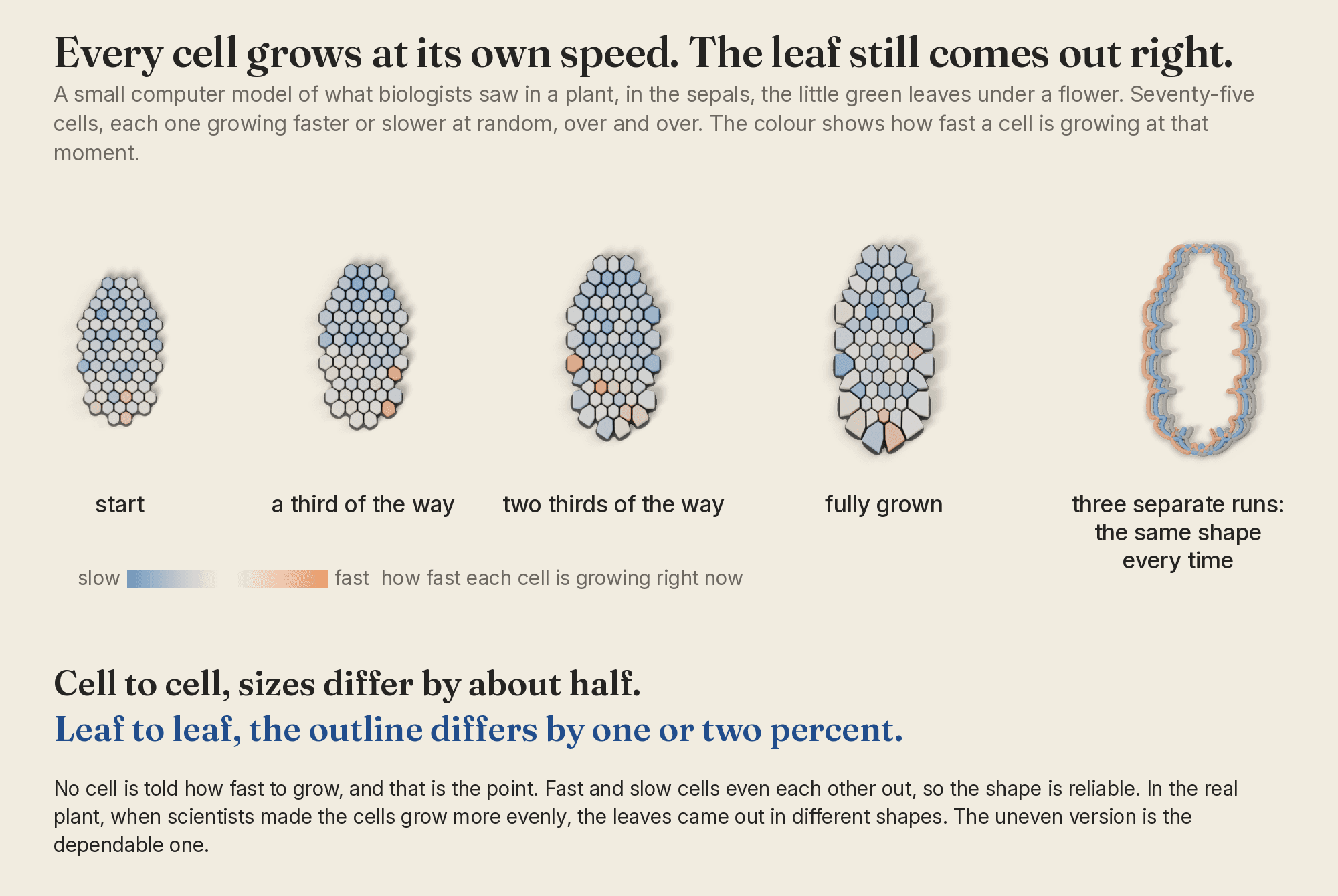
The best example I know is not from biology.
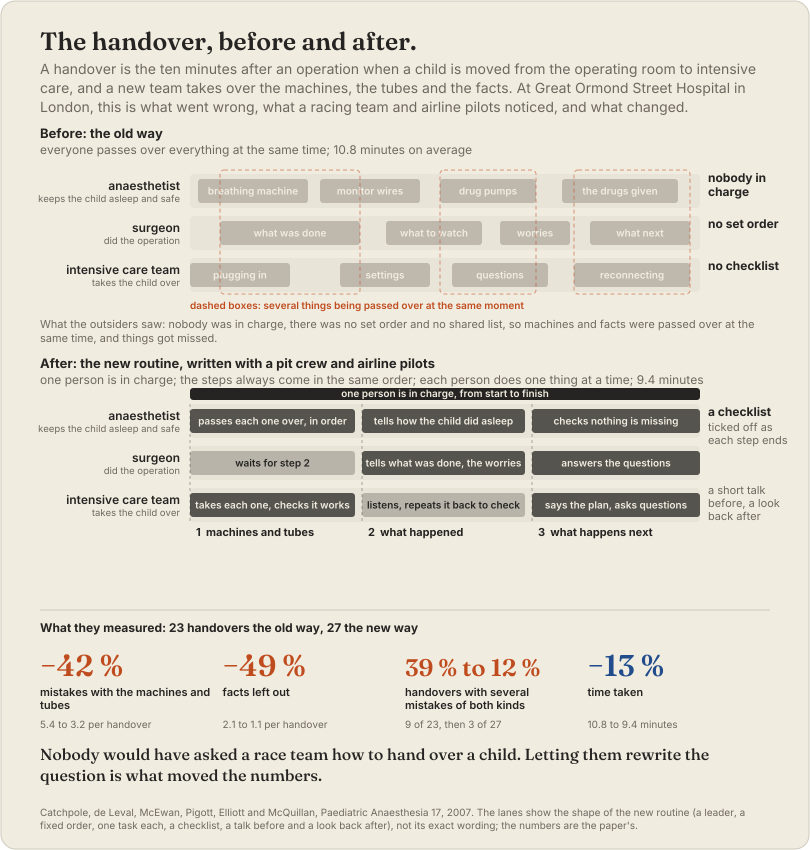
In the early 2000s the paediatric heart surgeons at Great Ormond Street Hospital in London had a problem in the minutes after surgery, when a child was moved from the operating theatre to intensive care: equipment, lines, drugs and information all changed hands at once, and things went wrong in that handover that the best surgeons in their field could not seem to fix. So two of them went outside their own field entirely, holding detailed discussions with a Formula 1 racing team and with aviation training captains, people whose whole craft is moving fast through a fixed sequence without anyone shouting.
What those outsiders saw was invisible from inside medicine: the handover had no one leading the sequence and no shared checklist.
Together they wrote a new protocol, with a named leader, defined roles and a checklist, and measured it. Technical errors per handover fell from 5.4 to 3.2, and information omissions from 2.1 to 1.1. Nobody would have thought to ask a race team or an airline captain how to hand over a child, and that is the point. Letting them rewrite the question is what moved the numbers.
Hamant also runs the existence proof. He directs an institute in Lyon named after the philosopher Michel Serres, whose roster puts philosophers, lawyers, artists, a farmer, a volunteer firefighter, a nurse and a vice-chair of the IPCC alongside the biologists, and whose charter commits it to going beyond « une bio-inspiration superficielle ».
That clause is my friend's precondition, written by the people doing the work. The price is time: the formative case Hamant describes, an Anthropocene campus in Berlin with a third artists, a third scientists, a third civil society, ran ten days instead of the usual three or four, with, in his words, some boredom. Nobody puts boredom in a project plan. It is where the reformulation happens.
In an organization, the equivalent is not simply adding different job titles. It is giving people enough authority to alter the proposal. A philosopher who can only make the slide more thoughtful is decoration. An artist invited to observe but not change the decision also decoration. A lawyer whose concerns arrive after the design is complete is a compliance gate, not a team member. The non-scientist's role needs a deliverable, an acceptance criterion and something they can veto.
Scientists need a boundary too. One of the most credible habits among these thinkers is the willingness to say where expertise ends and personal conviction begins. Mixed teams work when each person can contribute knowledge and expose the limits of that knowledge.
The objective is not consensus. It is a better question, a visible disagreement and a decision that has survived both.
Jancovici's team at The Shift Project has built the same instrument from the energy side, and he and Hamant agree on almost nothing else, nuclear power included.
Their plans are built with one person per sector, each owing two things: how their sector could improve, and a check that their improvement does not quietly eat a resource another sector is counting on. Biomass is the worked example. Aviation wants it for fuel, farmers want it for biogas, builders want timber, and people would like to eat. Stack the requests and see whether they add up to more than the country's photosynthesis. If they do, everyone rewrites their plan. Their published plan this spring runs that check four ways: carbon, energy, copper, and jobs. Nobody on the team is expected to hold every sector in their head. They are expected to be able to talk to each other.
There is a trap here. Disciplinary variety is not the same as independence. A biologist, lawyer and philosopher employed by the same institution may still share the same incentives and the same forbidden conclusions.
Heterogeneity across expertise does not automatically create heterogeneity across interests.
Every robustness move sends an invoice
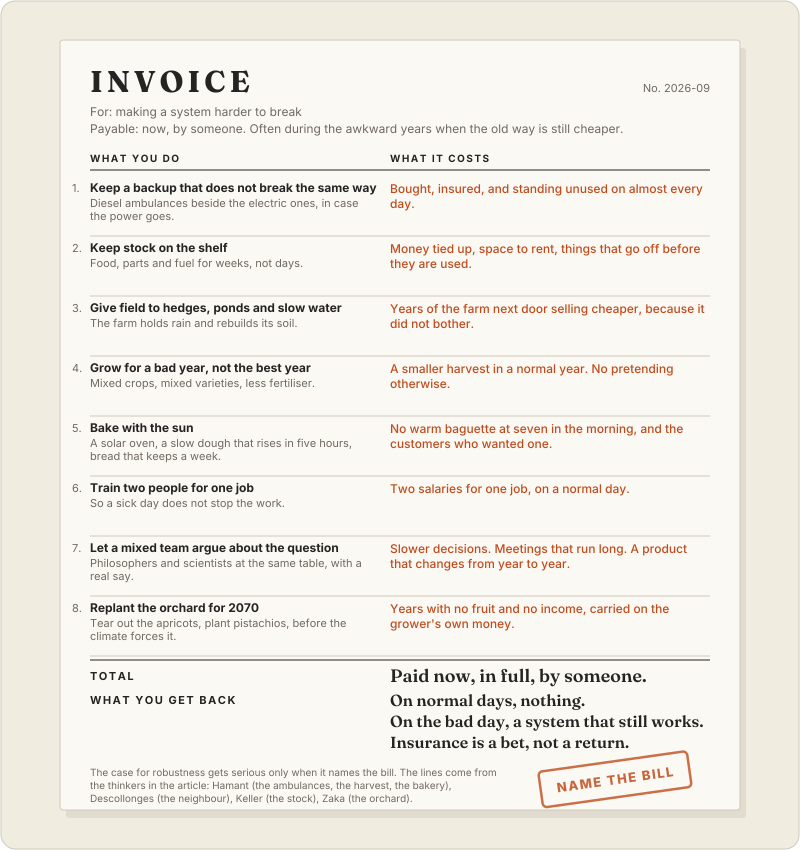
I like projects that deliver. I like clear owners, short feedback loops and visible progress. I am not interested in turning slowness, duplication or disagreement into virtues by themselves. The case for robustness becomes serious only when it names the bill.
The bill can be lower short-term output, idle capacity, duplicated skill sets, stock carrying costs, slower decisions, a product that changes from year to year. These costs do not disappear because the long-term argument is persuasive. Someone pays them, often during an awkward transition when the old system is still cheaper and the new one has not yet proved itself.
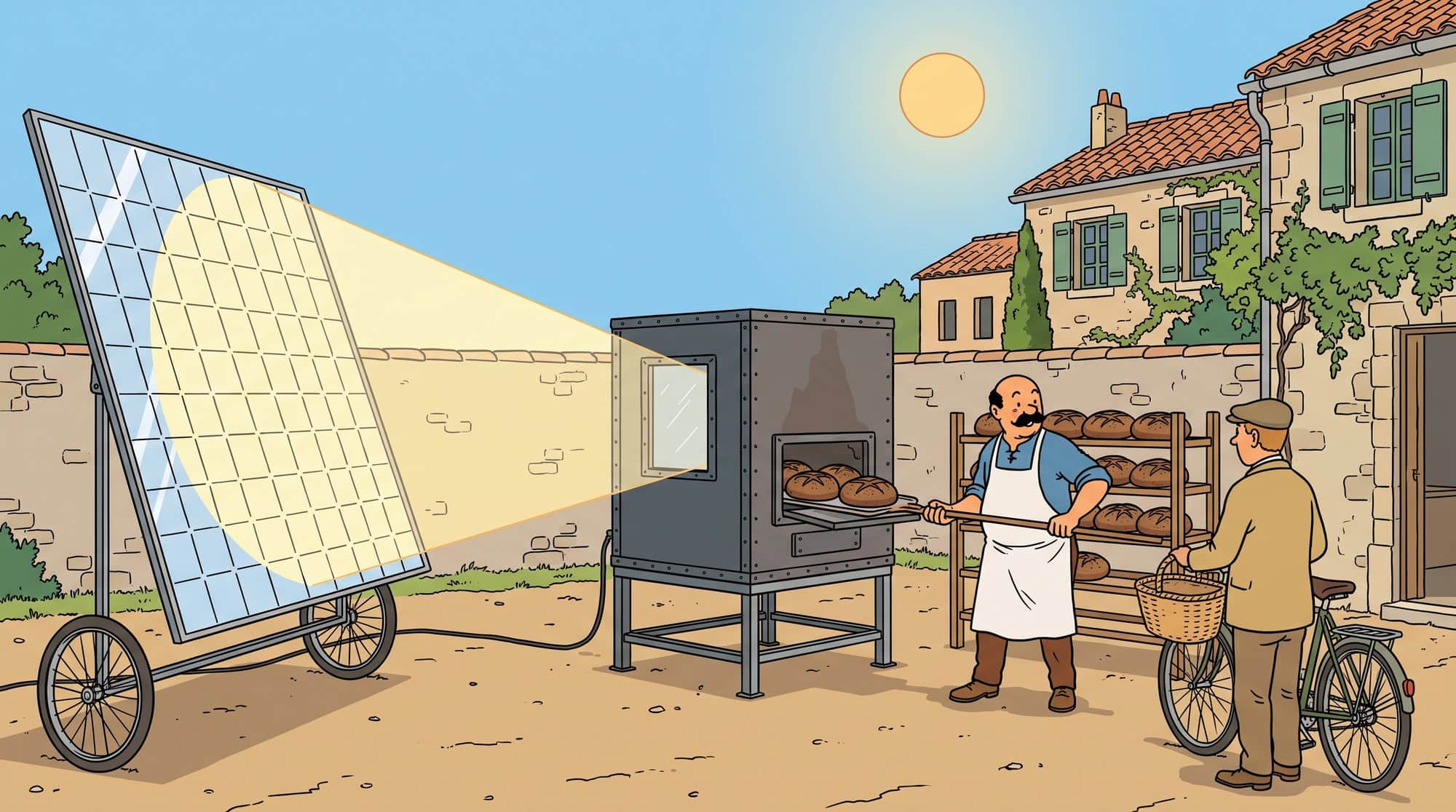
Hamant does not hide the yield cost: yields will be lower, he says, and we should not lie to ourselves about it. His worked example for the speed cost is a bakery that bakes in a solar oven. It cannot bake at night and cannot count on sun every day, so it cannot sell a loaf that is stale in a day, so it has to sell bread that keeps a week, which means a slow leaven that takes five hours to rise instead of ninety minutes, at which point the gluten develops on its own and nobody kneads anything.
The bakery's weak point, the cost of energy, has been removed. It has built a business on fluctuation. It has also given up every customer who wants a warm baguette at seven in the morning.
The neighbour cost comes from Descollonges' own side, in print. A farmer who gives up surface to slow water and rebuild soil is, for a while, undercut by the farm next door that did not. The argument for doing it anyway is an insurance argument, and insurance is a bet, not a return.
And then there is the transition nobody has accounted.
Serge Zaka, an agro-climatologist who maps which crops will still grow where in France, says it in one line about orchards: planting the tree is the easy part, getting people to eat the fruit is harder, and adapting the supply chain takes the longest. A fruit tree takes years to bear and decades to pay back, so a suitability map for 2070 is not a forecast; it is a purchase order in 2035. The growers near Cavaillon who tore out failing apricot trees to plant pistachios carried that risk alone, on their own balance sheets, while the apricot income stopped.
Which brings the bill to the table, literally.
Our diets are going to change, in France, in Austria where I live, and across most of the world, and not accepting that is itself a risk.
A country that keeps eating what it can no longer grow ends up importing it from wherever it still grows, and wheat is the clearest case: Russia has been the world's largest wheat exporter since 2016.
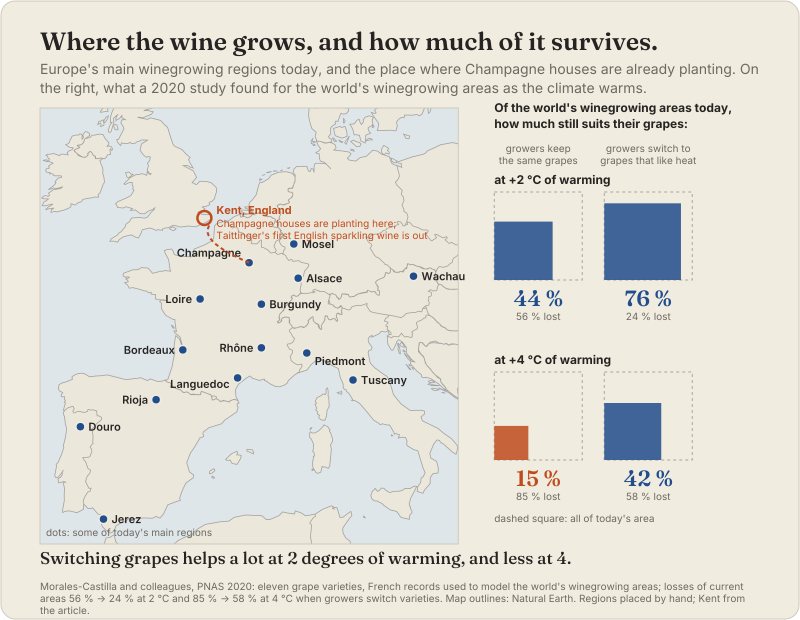
Champagne houses are already planting in Kent; Taittinger's English vineyard released its first sparkling wine there. Zaka expects the olive and the kaki to carry Bordeaux labels by the end of the century, and the grapes that make a great Bordeaux today will be planted further north, while the wines of the south-west may come to taste more like those of the Danube plain. The wheat belt is moving north-east. Maize and wheat will be sown in other places or not at all. None of this is a catastrophe if it is planned, and all of it is one if the plan is to keep the menu and import the difference.
A useful example of both halves comes from winegrowing research published in PNAS in 2020. Under a 2 °C warming scenario, cultivar diversity reduced projected losses of current winegrowing areas from 56 percent to 24 percent. Under 4 °C, the benefit remained, but losses were still 58 percent rather than 85 percent. Diversity worked. It worked less as the disturbance intensified. Both halves belong in the story.
This is the discipline I want for the workshop: every mechanism must answer four questions. What is the physical process? What does it become in an institution? What is the price? Where does the transfer fail? If an idea has no price and no failure case, it is not a mechanism. It is a wish.
Some thresholds cannot be managed down
Robustness is built for fluctuation. Serge Zaka's work is the reminder that not every disturbance is a fluctuation. Biological systems have thresholds. Under extreme heat, crops do not merely become less productive along a smooth curve; proteins denature, reproductive processes fail and losses can become irreversible.
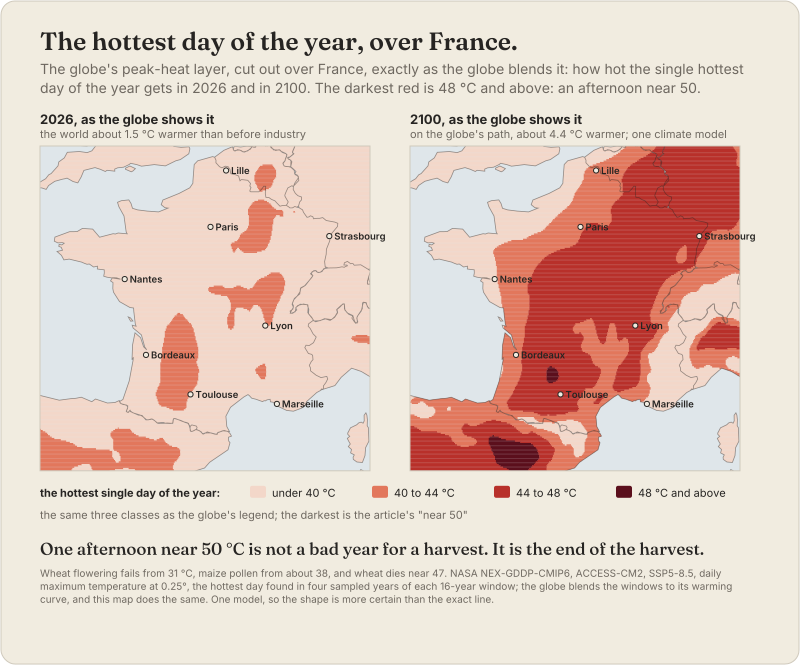
Wheat starts to fail at flowering around 31 °C. Maize pollen that germinates at 40 percent at 35 °C germinates at under 10 percent at 45. Zaka's own observation, from a June afternoon in 2019 in the hills behind Montpellier, was 46 °C and, within four hours, the olives, the laurels and the vines, the toughest plants on the slope, dropping their leaves.
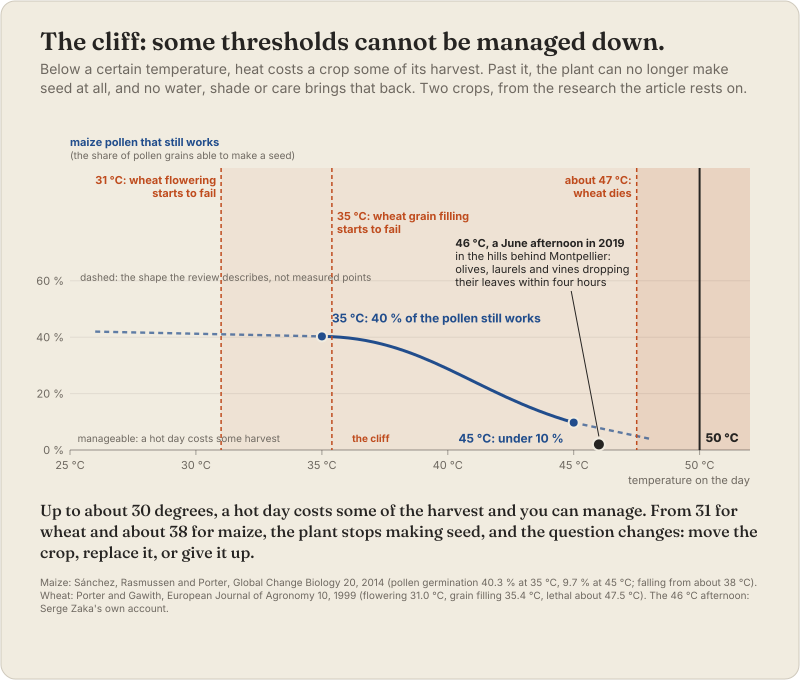
His conclusion is not a design recommendation. At those temperatures there is no adaptation left, and the only one remaining is to emit less.
This changes the question. Below a threshold, we can widen the viable space with diversity, soil, shade, water, reserve and preparation. At the threshold, the design problem becomes whether the system should be moved, replaced or abandoned. Beyond it, adaptation language becomes a way of avoiding the physical boundary.
The globe I have been building has a layer for the hottest day of the year, and the reason it exists is that one afternoon near 50 °C is not a bad year for a harvest. It is the end of the harvest.
Keller draws the same line at the scale of a society, and he drew it for parliament in writing: our emergency plans are calibrated for crises limited in space and time, « et non des crises systémiques prolongées, potentiellement définitives, qui remettent en question nos sociétés ». Prolonged systemic crises, potentially permanent, that call our societies themselves into question. Robustness, in his view, is worth building right up to that line, and past it the system you were maintaining stops existing and you have to become something else.
Hamant and he have argued this in public, and it is the disagreement I would most want in the workshop.
This may be the most important divide for the workshop: are we preparing for fluctuation, or for rupture? Robustness can keep a system functioning through disturbance. It cannot guarantee that the system still exists after a boundary condition has changed. The answer will determine whether we reinforce the current design or prepare to become something else.
Robustness is not a moral purpose
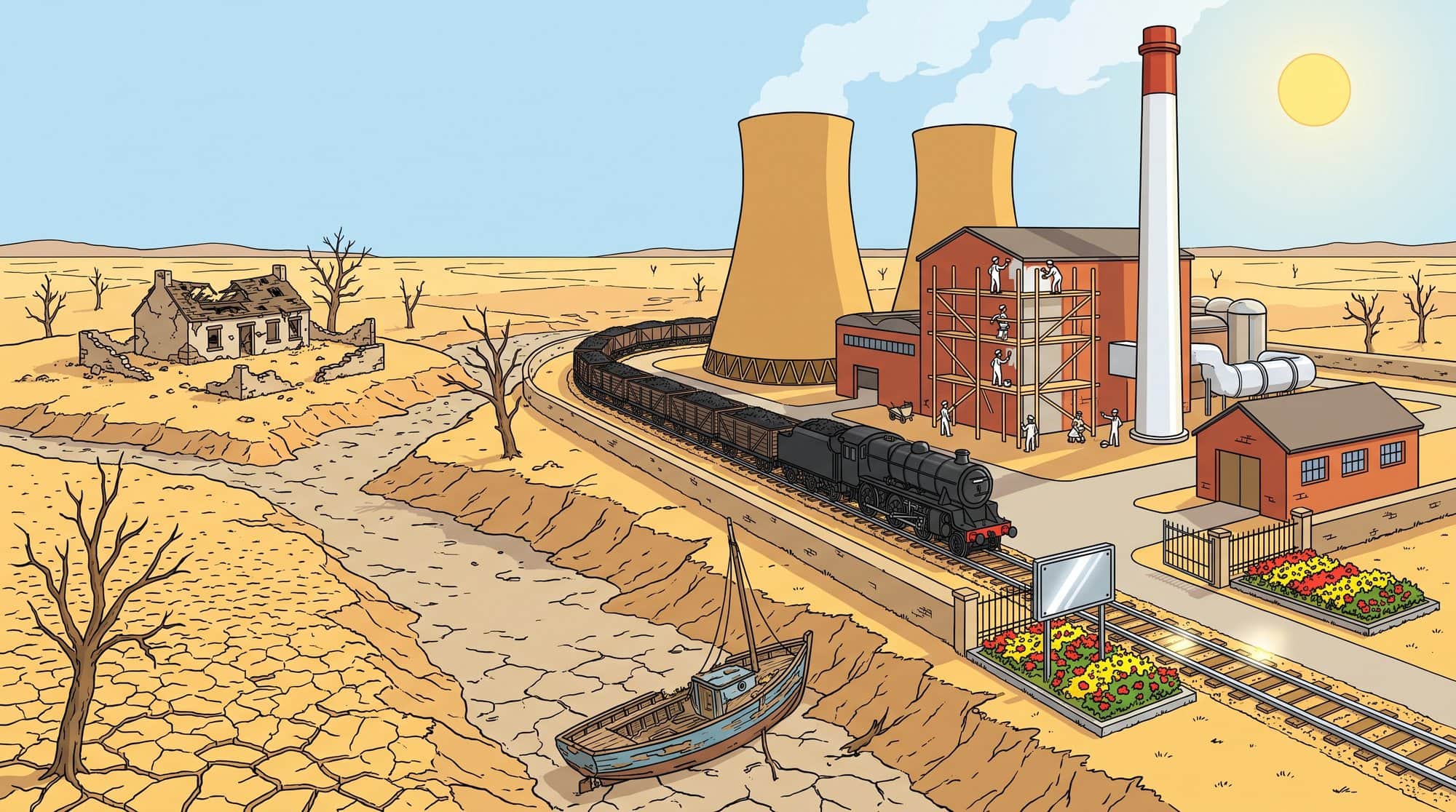
There is a final problem nature cannot solve for us: robustness is a property, not a purpose. A coal plant can be robust. A motorway network can be robust. An extractive business model can become extremely good at surviving criticism, regulation and leadership changes. Endurance does not make a system legitimate.
Three authors made that case in July, and one of them, the philosopher Alexandre Monnin, sits on the roster of Hamant's own institute. Robustness, they write, rehabilitates margins, stocks and slowness, « mais elle ne dit rien de ce qui mérite d'être prolongé ». It says nothing about what deserves to be prolonged. Some durable systems are just « ruines en fonctionnement », working ruins, deepening their ecological debt every time they are repaired. And the question they leave on the table: « derrière cette quête de robustesse, que cherche-t-on à faire durer ? » Behind this quest for robustness, what are we trying to make last?
This is where the philosophers belong. What should be allowed to fail? What must be transformed rather than protected? Who benefits from continuity, and who pays for it?
That a philosopher inside the Institut Michel Serres published a serious critique of the institute director's central concept is not institutional disloyalty. It is evidence that the mixed-team idea is working. The purpose of heterogeneity is not to decorate the institution with difference. It is to make the central idea answer an objection it could not generate alone.
The companion question I want to carry into the workshop is brutally practical: what did we give up on purpose, and who paid? It is the same question I keep asking of the cities I am writing about for the Long Landing series. It prevents robustness from becoming another management slogan. It forces every attractive mechanism back into politics, budgets and consequences.
What my friend and I should put in the room
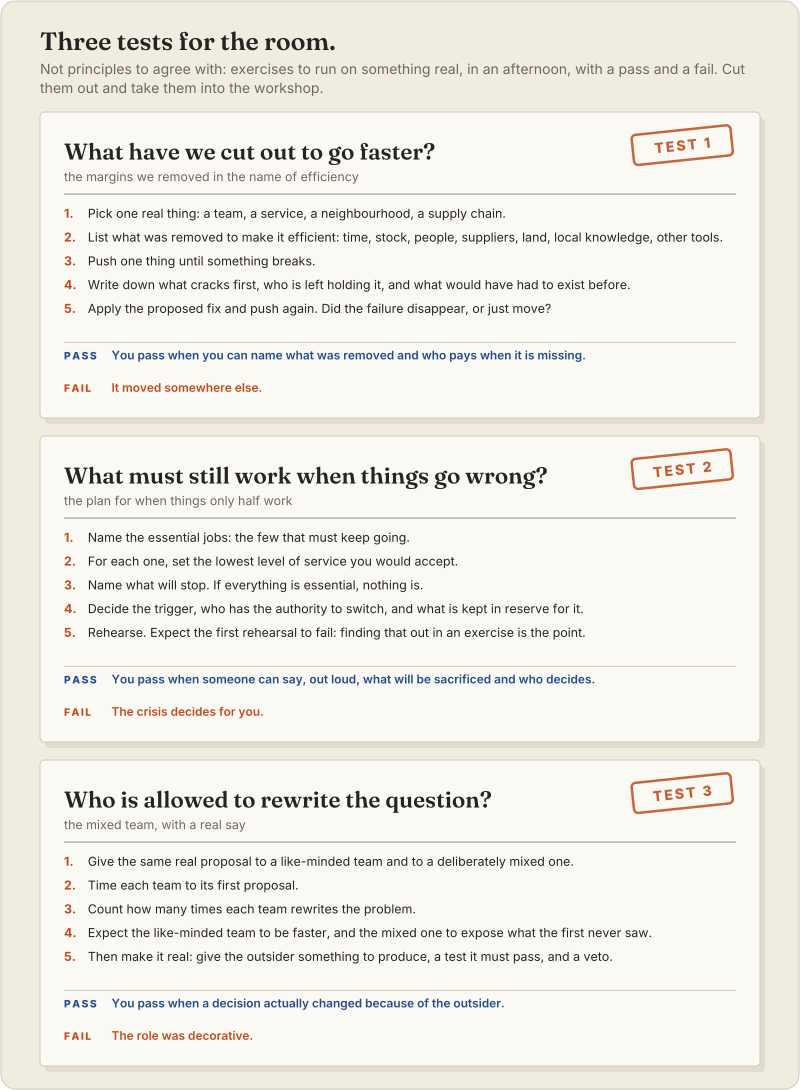
I do not want the workshop to end with a list of principles. I want participants to leave with a changed decision. The article can therefore become the workshop's opening argument, followed by three practical tests.
What have we optimized out? Take one real organization, service, neighborhood or supply chain. List the margins that have been removed in the name of efficiency: time, stock, people, suppliers, land, local knowledge or alternative tools. Stress one parameter until something breaks. Record what cracks first, who is left holding the failure and what would have needed to exist beforehand. Then run the test again with the proposed fix and see whether the failure disappeared or merely moved.
What must still work in degraded mode? Name the essential functions, the minimum acceptable service level and the activities that will stop. Define the trigger, the authority to switch modes and the resources reserved for it. Then rehearse. The first rehearsal should be expected to fail, because discovering the failure during an exercise is the point.
Who is allowed to rewrite the question? Give the same real proposal to a homogeneous team and a deliberately mixed one. Measure time to the first proposal, then count how many times each team reformulates the problem. The first team will probably be faster. The second should expose assumptions the first never saw. Then make the exercise real: give the non-scientist a deliverable, an acceptance criterion and a veto. If no decision changes, the role was decorative.
The point is not to imitate nature
I began this work suspicious of the phrase ways of nature. I still am. Nature is not a policy, and biology does not contain a ready-made constitution. I still like fast teams and one supplier, and I still reach for a spreadsheet when someone says "vigilance." What changed is that I now think of those as fevers: fine for a while, for a reason, with a date on them.
But nature does provide mechanisms tested under fluctuation: margin, diverse redundancy, stored reserve, delayed response, local variation, feedback and thresholds. The serious move is not to copy their surface. It is to ask what institutional rule would reproduce the function, what it costs and where it stops.
My friend asked how nature might enhance security, build resilience and help philosophers and scientists work on the same team. My answer now is that all three questions point to the same discipline: keep more than one option alive, let disagreement alter the design, and decide in advance what matters when performance is no longer available.
And then add the question nature cannot answer for us: what deserves to survive?
Sources
- Debunking the idea of biological optimisation: quantitative biology to the rescue — Olivier Hamant, Quantitative Plant Biology 5:e3, 2024. (The "high robustness is incompatible with high efficiency" line and the interdisciplinarity claim, in a peer-reviewed journal.)
- Quantifying sustainability: Resilience, efficiency and the return of information theory — Robert Ulanowicz, Sally Goerner, Bernard Lietaer and Rocio Gomez, Ecological Complexity 6, 2009. (The ecosystem result Hamant's sentence rests on.)
- Morphological evolution through complex domains of fitness — Karl Niklas, PNAS 91, 1994. (The biophysics result, the second of the two Hamant's sentence rests on.)
- Variable Cell Growth Yields Reproducible Organ Development through Spatiotemporal Averaging — Lilan Hong et al., Developmental Cell, 2016. (The microscope result: reproducible shape from variable cells.)
- La révolution de la robustesse — Olivier Hamant, TEDxQuartierLatin, 2024. (The fever passage and the "robust because they are not high-performing" line, translated here from the human-reviewed TED captions.)
- Performance, turbulences et robustesse — Olivier Hamant with Julien Devaureix, Sismique, July 2024. (The homogeneous-team argument and the draught-animal ambulances; paraphrased from captions.)
- Survie dans le Chaos : La robustesse à l'épreuve ? — Olivier Hamant, Thinkerview, October 2024. (The tree's hidden reserves, the social-fabric parachute, the Berlin campus, and the "scam" line as first stated; paraphrased from captions.)
- Habiter le monde fluctuant : robustesse vs. performance — Olivier Hamant, leçon inaugurale, École nationale des ponts et chaussées, October 2025. (The solar bakery and the "toxic word"; paraphrased from captions.)
- The Optimization Trap: Why Too Much Efficiency Makes Us Fragile — Olivier Hamant with Nate Hagens, The Great Simplification 230, August 2026. (Security as control versus serenity, and the bank example; paraphrased.)
- « ON A PERDU LE CONTRÔLE ! » Survivre à l'effondrement grâce à la robustesse — Olivier Hamant, ÉLUCID, June 2026. (Where the "scam" line had gone by this summer; the lower-yields admission.)
- À propos — Institut Michel Serres. (The roster and the charter's line on superficial bio-inspiration.)
- Faire durer n'est pas rendre soutenable — Émile Hooge, Alexandre Monnin and Jérôme Tougne, AOC, 21 July 2026. (The "working ruins" critique; the quoted passages are from the public part of a paywalled piece.)
- Mission d'information sur la résilience nationale, compte rendu n° 4 — Assemblée nationale, hearing of 22 July 2021 with Arthur Keller. (The official written record: optimisation and the elimination of stocks, the 2 percent food autonomy, prolonged systemic crises; the first quotation is translated here.)
- Intervention à la CEC Pays Basque, 22 avril 2026 — Arthur Keller. (The seven essential systems, degraded mode as the first criterion of procurement, and "how long do we hold?"; paraphrased from captions.)
- Manifeste Eaux Vives, pour une hydrologie régénérative en 12 points — Pour une Hydrologie Régénérative, 2026. (The five verbs, in the association's own wording.)
- Contre la sécheresse, la solution de l'hydrologie régénérative — Nolwenn Jaumouillé, Socialter 66, 6 December 2024. (The short-run unfair-competition cost, stated by the movement's own people.)
- 50°C en France : ce qui attend réellement nos agriculteurs — Serge Zaka, Greenletter Club, July 2026. (The 2019 defoliation, the orchard lead times, the pistachio growers, olives and kaki with Bordeaux labels, the wheat belt moving north-east; paraphrased from captions.)
- Temperatures and the growth and development of wheat: a review — John Porter and Megan Gawith, European Journal of Agronomy 10, 1999. (The wheat flowering threshold.)
- Temperatures and the growth and development of maize and rice: a review — Berta Sánchez, Anton Rasmussen and John Porter, Global Change Biology 20, 2014. (Maize pollen germination against temperature.)
- Diversity buffers winegrowing regions from climate change losses — Ignacio Morales-Castilla et al., PNAS 117, 2020. (Cultivar diversity at 2 °C and 4 °C.)
- Plan robuste pour l'économie française — The Shift Project, 19 March 2026. (The four closures: carbon, energy, copper, jobs and training.)
- Le monde en 2050 : avec Jean-Marc Jancovici — Jean-Marc Jancovici, Balade Mentale, October 2025. (The one-person-per-sector method and the biomass closure, as he describes it; paraphrased from captions.)
- Patient handover from surgery to intensive care: using Formula 1 pit-stop and aviation models to improve safety and quality — Ken Catchpole, Marc de Leval, Angus McEwan, Nick Pigott, Martin Elliott, Annette McQuillan, Carol Macdonald and Allan Goldman, Pediatric Anesthesia 17, 2007. (Technical errors per handover 5.42 to 3.15, information omissions 2.09 to 1.07.)
- POURQUOI NOTRE SOCIÉTÉ VA S'EFFONDRER — Yves Cochet, Greenletter Club, April 2020. (Renault and Peugeot as carriage builders, a hundred thousand draught horses, "they do not even listen"; paraphrased from captions.) His record as a deputy: Yves Cochet — Assemblée nationale; minister for regional planning and the environment from July 2001 to May 2002, per Wikipédia (pointer).
- Présentation de l'EPTB Seine Grands Lacs — Seine Grands Lacs. (The four reservoir lakes and their capacities, Pannecière 1949 to Aube 1990, more than 800 million cubic metres in all; the institution created in 1969.)
- De nouveaux barrages à l'étude pour protéger Paris des inondations — Les Échos, 28 December 1993. (A 1910-type flood carries about four billion cubic metres against the lakes' 800 million.)
- Mar de plástico, Spain and El Ejido, Spain — European Space Agency, 2011 and 2021. (The sea of plastic from orbit; "a large number of Europe's fruit and vegetables are produced" there.) Area under plastic: Intensive farming in Almería — Wikipedia (pointer; the Junta de Andalucía's greenhouse survey is the primary to trace).
- Climate change-induced extreme winter drought devastates crops in Spain and Portugal — Euronews, 13 February 2022. (Rain-fed crops in the drought zones stood to lose 60 to 80 percent of their production.)
- Spanish growers say weather, rising costs and Brexit caused UK salad shortages — The Guardian, 23 February 2023. (UK supermarkets rationing fresh vegetables in late February 2023 after the cold snap in southern Spain.)
- Las previsiones de producción de aceite de oliva en España se sitúan en 765.300 toneladas para la campaña 2023/24 — Ministerio de Agricultura, Pesca y Alimentación, 9 October 2023. (The 2022–23 harvest of 664,000 tonnes.)
- Water Trading Overview — South Australian Department of Water, Land and Biodiversity Conservation, archived 2006. ("South Australia led the nation when permanent water trading was first introduced in this State in 1983… the first time in Australia that water access entitlements were separated from land title.") The 1994 national unbundling: Water trading — Wikipedia (pointer; the COAG 1994 water reform framework is the primary to trace).
- Desalination plant delivers water security for Adelaide — Premier of South Australia, media release, 26 March 2013 (archived). ("The driest State on the driest inhabited continent"; the plant's approved budget of A$1.824 billion; up to half of Adelaide's drinking water.) Water sources — SA Water, archived 2016. ("Most of our water comes from the River Murray.")
- Murray–Darling Basin water markets inquiry 2019–21 — Australian Competition and Consumer Commission. (The 2019 direction to inquire into the operation, transparency, regulation, competitiveness and efficiency of the basin's markets for tradeable water rights.)
- The Water Crisis | The Rise of the Water Market — the English-language cut of the French documentary released as Main basse sur l'eau / Lords of Water, uploaded September 2026. (Adelaide as the birthplace of water trading, Mike Young, prices that follow the forecast, the landlords-and-peasants line, the Aboriginal elder of the lower Murray; paraphrased from machine captions. The elder's nation is not named here: the captions garble it, and audio would be needed to confirm it as Ngarrindjeri.)
- Domaine Evremond — Taittinger and Patrick McGrath's English sparkling wine estate in Kent.
- Russia has emerged as an agricultural powerhouse — The Economist, 1 December 2018. (Russia became the world's largest wheat exporter in 2016.)
- GRACE-FO mission overview — NASA Jet Propulsion Laboratory, archived 2023 (the mission's current home is science.nasa.gov/mission/grace-fo). (Twin satellites about 220 kilometres apart, measuring the distance between them with a microwave ranging system; GRACE measured that distance to within a micron, so a change of ten micrometres is a conservative figure.)
- CSR GRACE and GRACE-FO RL06.3 Mascon Solutions — University of Texas Center for Space Research. (The water-underground record behind the Paris-basin chart and the globe's water-underground layer: grid cell 48.5° N 2.5° E, baseline 2004 to 2009; the 28 percent figure is the globe layer's counter at mid-2026.)
- Europe's Next 25 Years: Why the Old Rules Are Breaking, and What Comes Next — Conny Lazo, 27 July 2026. (Europe's 97 percent oil and 90 percent gas import dependence, and Jancovici's supply arithmetic, with their sources.)
- Narration read by Conny Lazo, recorded in September 2026, unedited apart from level. Background: a dawn chorus recorded at Shipton Gorge, West Dorset, by Silas S. Brown, released into the public domain and published on Wikimedia Commons.
- Oil and petroleum products - a statistical overview — Eurostat, 2024 data. (The 96.6 percent oil import dependency behind the hundred-trucks figure.)
- Allocation trade prices — Victorian Water Register, allocation trading data to September 2026. (Every trade behind the Murray price chart: trading zone 7, private to private, volume-weighted by month.)
- Murray-Darling Basin water markets inquiry 2019-21 — ACCC. (The inquiry's dates: announced 7 August 2019, interim report released 30 July 2020, final report 26 March 2021.)
- Sentinel-2 Level-2A on Earth Search — Copernicus and ESA, distributed by Element 84. (The Almería scene: Sentinel-2A, 22 August 2026, tile 30SWF, true colour. Contains modified Copernicus Sentinel data 2026.)
- OpenStreetMap — OpenStreetMap contributors. (The A-7 traced on the Almería scene.)
- Investigation of the causes of mass fish kills in the Menindee Region NSW over the summer of 2018–2019 — Australian Academy of Science, 2019. (Three major fish kills in the Darling near Menindee in December 2018 and January 2019, the third killing millions of fish.)
- Annual climate statement 2019 and Annual climate statement 2018 — Australian Bureau of Meteorology. (2019 Australia's driest and warmest year on record; 2018 "a year of protracted drought and persistent warmth", the warmest on record for New South Wales. The drought shading on the Murray chart.)
- Hydrométrie: observations élaborées, station F700000103, La Seine à Paris - Austerlitz — Hub'Eau, Eaufrance, monthly mean flow 2006 to 2026, pulled 17 September 2026. (The ten billion cubic metres a year behind the lakes figure; July 2026 the lowest month in the station's record.)
- Natural Earth — public domain map data. (Country outlines on the wine map.)
- NASA NEX-GDDP-CMIP6 — NASA Center for Climate Simulation. (Daily maximum temperature, ACCESS-CM2, SSP5-8.5, 0.25°, behind the France peak-heat map and the globe's peak-heat layer.)