
The Long Landing
2026 ——— 2100
This is a scenario, not a prediction.
It imagines how the next 75 years could unfold. It brings together ideas about industry, energy, technology, society, resilience, and nature.
As you scroll, the century moves forward. The chart above shows how temperature and CO₂ may change over time. At each era, the story pauses to explain what is happening.
Use the buttons below the chart to follow one theme at a time. On a large screen, use the menu on the left to jump to any section.
August 2026
Before the Timeline: This Is Me
Humanity is facing one of the biggest challenges in its history. For many years, people talked about climate change as a problem we would solve in the future. I do not think that anymore. I believe climate change is now something we must learn to live with. We can still reduce the damage, but we cannot completely stop what has already started.
I have heard about climate change for as long as I can remember. When I read old articles, I find that scientists were warning about it more than 100 years ago. They said that burning coal and other fossil fuels would warm the planet and change the climate. In other words, we have known about this problem for a very long time.
Some people still doubt climate change, while others have spent years warning us about it. Many of those people feel frustrated because they can see the damage happening and do not know how to stop it. Today, I understand how they feel.
Our modern world was built using fossil fuels, especially oil. Oil gave us cheap energy and helped us build cities, transportation, and industries. Almost everything we use depends on oil in some way. Our food, clothing, furniture, electronics, and many other products would not exist without it.
Like everyone else, I have benefited from this system. I have lived in several countries and currently live in Austria. But I am seriously thinking about moving farther north in the future. Based on climate predictions, Austria may become much hotter over the next 25 to 50 years.
When I first moved here, I enjoyed the mild weather. But the hot summers of recent years made me realize that the climate is changing faster than I expected. During heat waves, temperatures can become uncomfortable and even dangerous. I bought a small air conditioner to cope with the heat. On very hot days, I stay indoors.
That is not the kind of future I want for myself, my wife, or my children. Because of that, I have started making changes in my own life. I travel less, use public transportation more often, ride my bicycle, and eat less meat. These actions will not solve climate change, but they can help reduce my impact.
One thing that worries me is that climate change has a delayed effect. Even if the world stopped producing carbon dioxide today, the carbon already in the atmosphere would continue affecting the climate for many years. That means temperatures can keep rising even if we act now.
As the planet becomes warmer, some places will become much harder to live in. Areas near the equator could become extremely hot. As a result, millions of people may need to move to cooler regions. We are already seeing animals moving toward cooler places. Birds, land animals, and even sea life are changing where they live as temperatures rise.
I have been reading a book called The Earth Transformed by Peter Frankopan. It explains how climate and geography have shaped history. One thing that stands out is how living things adapt when their environments change. Some species can move or adapt, but many cannot. That is why so many plants and animals are at risk today.
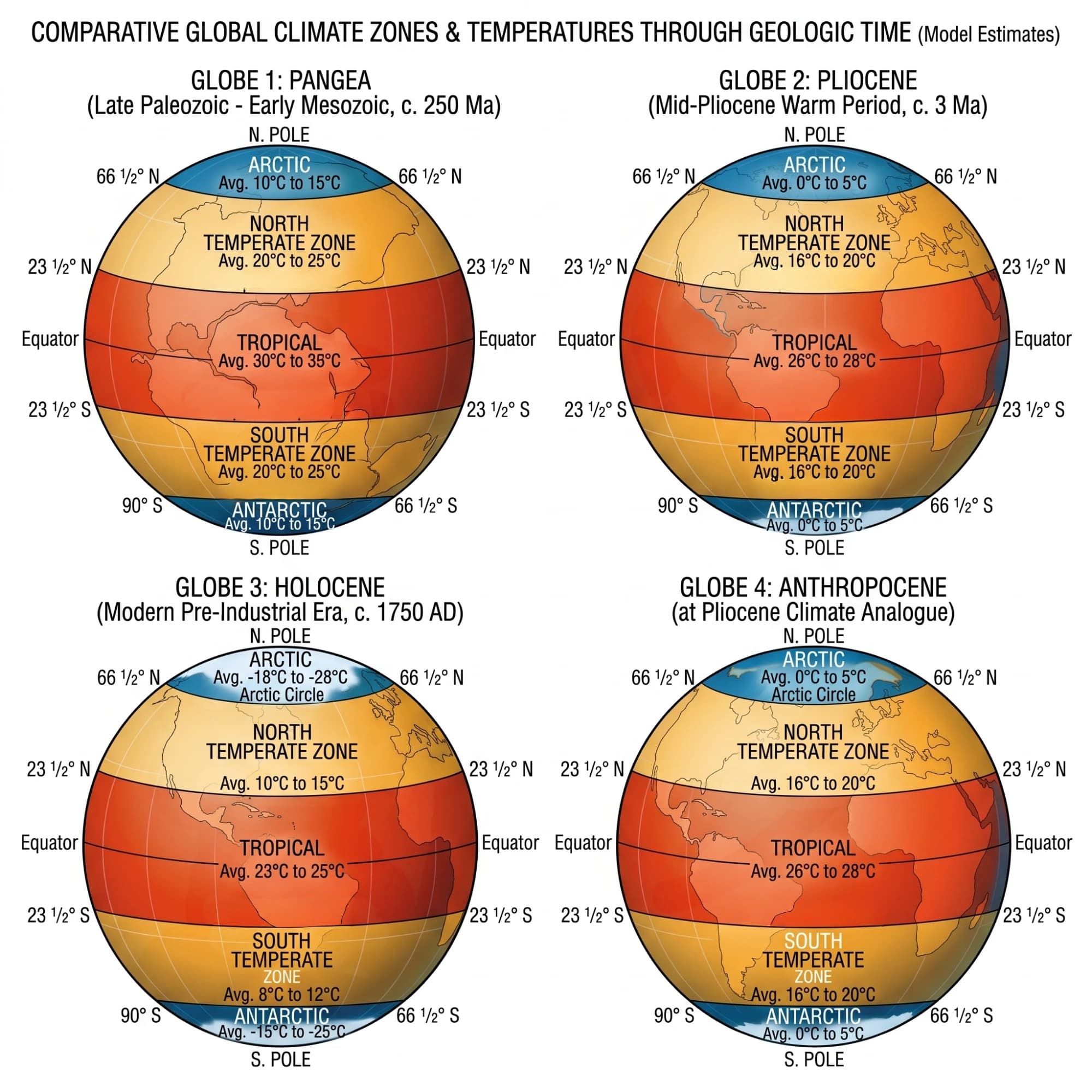
Temperature averages can be confusing, but they are important to understand. Before the Industrial Revolution, the Earth was in a period called the Holocene. During that time, the global average temperature was about 14°C to 15°C. Most of the world lived in a climate humans were well adapted to.
However, not every place on Earth had the same temperature. For example, the polar regions were much colder, averaging around -20°C to -30°C. At that time, carbon dioxide (CO₂) levels in the atmosphere were between 260 and 280 parts per million (ppm).
Scientists have found a strong connection between CO₂ levels and global temperatures. Since the Industrial Revolution, humans have increased CO₂ levels to about 425 ppm. This is similar to the amount of CO₂ that existed during the Pliocene, a much warmer period in Earth's history.
During the Pliocene, the global average temperature was about 16°C to 18°C, roughly 2°C to 3°C warmer than the Holocene. That may not sound like a big difference, but it can cause major changes around the world. At the poles, average temperatures rise from around -20°C to -30°C up to about 0°C to 5°C. Temperate regions, such as much of Europe and the United States, can warm by 5°C to 6°C on average. Many of the heat waves and record temperatures we are experiencing today are early signs of these changes.
I am also amazed by scientific advances such as gene editing and efforts to bring back extinct animals. But I think our first priority should be protecting the habitats and species that still exist. We should focus on preventing more extinctions before trying to reverse past ones.
Another issue is that fossil fuels are a limited resource. Oil will not last forever. Many experts believe that easy-to-access oil will become harder to find in the coming decades. Since most transportation and shipping still depend on oil, this could have major effects on the global economy.
1,700,000,000,000
Falling by 1,192 barrels every second — roughly one Olympic swimming pool of crude every thirteen seconds. At a flat 103 million barrels a day, the booked reserve base runs about 45 more years.
Proven reserves ÷ current burn rate, from the BP Statistical Review / OPEC band. A scale model of the burn rate, not a forecast — “proven reserves” is an accounting category restated every year, and the real constraint is a production peak, not an empty tank.
Countries are already asking difficult questions. What happens if international trade becomes harder? Can countries produce enough food and resources for their own people? These are important discussions, even if they are not often talked about in public.
For me, all of this has changed how I think about the future. I want to rely less on fossil fuels and live more sustainably. I believe it is better to make changes by choice now than be forced to make them later during a crisis.
My views on capitalism and technology have also changed. Markets and economic growth are important, but a healthy society needs more than that. Just as a body needs a heart, lungs, and other organs, a society needs balance. We cannot focus only on growth while ignoring the environment and the well-being of people.
I also think technology, including artificial intelligence, will remain important. However, technology alone will not solve all of our problems. We still need strong communities, practical skills, and cooperation.
To be honest, I am worried. The last few years have made climate change feel much more real to me. The extreme heat and environmental changes are difficult to ignore. That is one reason I decided to create this timeline. I want to explore what the future could look like for Europe and the rest of the world.
The timeline that follows is a scenario, not a prediction. It imagines a future based on some of the most severe climate projections. I use this approach because I believe it is important to think seriously about the risks we face.
More than anything, I believe we need to start thinking about community. We need to help one another and learn skills that make us more resilient. I have started learning how to grow vegetables and become less dependent on complex systems. These small steps help me feel more prepared for an uncertain future.
This is my message to anyone reading. I am looking for people who want to build strong communities and prepare for the challenges ahead. I do not have a large audience, and I do not have all the answers. But I believe we are living through an important moment in history, and I think we should face it together.
— Conny Lazo, Vienna
Now, the part that is not a scenario
- The warming rate has roughly doubled since 2013: 0.34–0.42°C per decade, and accelerating. Foster & Rahmstorf 2026, GRL
- June 2026: 5,764 excess deaths in France, in sixteen days, in one heatwave. Santé publique France
- Flying-insect biomass: down 76 percent in 27 years, inside protected reserves. Hallmann et al. 2017
- Monitored wild vertebrate populations: down 73 percent on average since 1970. WWF Living Planet Index 2024
- Human-made mass now outweighs everything alive on Earth, and doubles roughly every twenty years. Elhacham et al. 2020, Nature
- Ripple et al. tracked 34 ‘planetary vital signs’ — major measurements of Earth’s health, like heat, CO₂, ocean warming, ice loss, and forest damage. In 2025, 22 of those 34 signs had reached record extremes, meaning they were worse than ever measured before. Ripple et al. 2025, BioScience
- On that measured trend, the world does not just briefly touch 1.5°C. Between 2026 and 2029, the average global temperature rises more than 1.5°C above the pre-industrial level — the average before factories, coal, oil, and gas began adding large amounts of CO₂ — and stays there. Foster & Rahmstorf 2026
- Polar ice may be melting faster than many climate models expected. Hansen and colleagues warn that the Atlantic overturning circulation — a huge ocean current that helps move warm water toward Europe — could shut down within 20 to 30 years unless stronger action is taken. The Intergovernmental Panel on Climate Change (IPCC) views this as less extreme, so scientists disagree on the timing. But the danger is serious: it would make several more metres of sea-level rise unavoidable, even if the water takes a long time to fully rise. Hansen et al. 2025
None of that is the scenario. The scenario starts below.
2026–2033
The squeeze becomes undeniable
The baseline has moved
PremiseOmega block weather patterns over Europe are a normal part of summer.CauseBut because the planet has warmed, these weather patterns now start from a hotter baseline.ConsequenceThe same pattern can now bring temperatures 5-12°C higher than past averages, leading to long heatwaves, temperatures above 40°C, and extra pressure on power systems.ConclusionCity leaders, building owners, schools, and employers can adapt now: heat safety plans, cooler buildings and roofs, and work schedules that avoid the hottest parts of the day.The retirement wave crests
PremiseThe largest generation of people is retiring.CauseIn Europe and East Asia, the final wave of this generation will retire over the next years.ConsequenceThis means fewer workers available, while retirees spend their savings instead of investing them, making money and workers harder to find.ConclusionGovernments, employers, and care systems can prepare: use technology for the heavy work, retrain people quickly, and recognize caring for others as important work.Breach and stay
PremiseWarming used to increase by about 0.2°C every ten years, and keeping temperatures below 1.5°C was an important goal.CauseCleaner ship fuels reduce air pollution that used to block some heat, so warming is now increasing by more than 0.4°C every ten years and is still speeding up.ConsequenceAt first, some individual years reach 1.5°C of warming. Later, the average temperature reaches that level too, making unusually hot years the new normal. Every temperature line this century is crossed twice in this way: first by a single hot year, then by the average.ConclusionGovernments, city leaders, and businesses need to plan for a warmer world instead of expecting temperatures to stay below the old target.The pharmacy shelf turns geopolitical
PremiseMost medicines are made using key ingredients from a small number of factories in Asia.CauseWhen countries rely less on global trade, this system becomes more vulnerable to disruptions.ConsequenceShortages of common medicines become a major public concern and topic of political debate.ConclusionHealth ministries, drug makers, and governments can bring the production of important medicines closer to home, as part of national security planning.The water triangle
PremisePower plants, data centers, and farms often depend on water from the same rivers.CauseHotter and drier summers reduce the amount of water available for all of them. In July 2026, some power plants had to shut down because the rivers ran too warm to cool them safely.ConsequenceDuring droughts, these different needs compete for the same limited water supply.ConclusionGovernments and water authorities can write the priorities into law before a drought: drinking water first, food production second, machines and industry third.Drones outrun committees
PremiseMany defense programs are planned years in advance and rely on older types of aircraft and equipment.CauseNew technologies like drones and drone-blocking systems change and improve in just weeks or months.ConsequenceModern warfare is changing so quickly that governments and organizations often struggle to keep up, and increased defense spending is changing European industries.ConclusionDefense ministries and buyers should invest in equipment that is affordable, easy to replace, and adaptable, and improve it quickly as new challenges appear.The ocean pays first
PremiseMost of the extra heat trapped by climate change has been absorbed by the oceans, and we are already seeing the effects.CauseA single heat dome cooked shoreline life by the billion; river dolphins died by the dozen in a lake near 39°C; sponges bleached by the million in fjords made for cold.ConsequenceMarine heatwaves are becoming more common and lasting longer, turning rare disasters into regular events.ConclusionFishing towns, food companies, and marine agencies should watch ocean conditions the way farmers watch the weather, because what happens in the water reaches the dinner table later.The uninsurable map
PremiseInsurance companies are usually the first to act on climate risk, because they lose money when they get it wrong.CauseAfter repeated fire and flood years, insurers raise prices sharply in exposed regions or stop selling coverage there at all.ConsequenceHomes that cannot be insured cannot get mortgages, so property values fall in the riskiest places. The insurance map becomes the first honest map of the new climate.ConclusionFamilies, banks, and city leaders should watch where the insurers leave. They are telling you what they think happens next.The thinning
PremiseThe natural world helps control heat, store water, and reduce pests, often without people even noticing it.CauseIn protected areas, the number of flying insects has dropped by about 75%, and monitored wildlife populations have fallen by 73% since 1970.ConsequenceThis natural support system is becoming weaker at the same time that people need it more than ever.ConclusionEurope already wrote the rule that makes big companies report what they take from nature — the CSRD — then weakened it in 2026 before most had filed a single report. EU lawmakers, regulators, and companies need to move rules like this forward, not backwards: what is not counted will not be protected.AI slips into the clinic
PremiseHealthcare workers are already caring for more patients than there are staff available.CauseAI can help by analyzing medical images, helping decide which patients need care first, and handling paperwork.ConsequenceThis allows each doctor and nurse to help more people, keeping healthcare systems running smoothly.ConclusionHospitals and health ministries can start using AI where staff shortages are greatest, such as diagnosis, patient monitoring, and medical notes.The silicon island
PremiseAlmost all of the world's most advanced computer chips are made on one island, Taiwan.CauseThe neighboring country says the island belongs to it, and tensions keep rising as global cooperation weakens.ConsequenceIn this scenario, a blockade cuts off the supply of advanced chips for years. Computing power becomes something to ration, like energy.ConclusionGovernments and chip buyers should give chips the same planning as oil: reserves, second sources, and the ability to keep older systems running.Descent by duress
PremiseEurope still depends on fuel from other parts of the world, and efforts to reduce that dependence are not happening fast enough.CauseChanges in fuel prices and supply problems can affect people's lives before governments have time to respond.ConsequenceExtending the use of nuclear power plants, building more renewable energy, and using less energy can help, but important materials such as copper may become harder to get.ConclusionYou cannot make copper out of thin air. Business leaders and governments need to recycle materials, find alternatives, and design products that use less.
2033–2042
Adaptation goes mainstream
New ways to measure progress
PremiseEconomic growth is still the main way progress is measured.CauseMore cities begin using new systems that track community well-being, environmental health, and quality of life.ConsequenceSuccess is measured by things like housing, health, and access to water, not just economic growth.ConclusionMayors, finance ministries, and budget offices can change what is counted. When leaders measure different things, they make different decisions.Improving what we already have
PremiseConstruction has often focused on building new homes, offices, and other buildings.CauseHigher energy costs and climate goals make existing buildings more valuable and worth improving.ConsequenceMore projects focus on adding insulation, improving heating systems, and expanding public transportation.ConclusionGovernments, trade schools, and unions need to train these workers now, because the biggest challenge is finding enough skilled hands, not finding the money.People realize they are not alone
PremiseMany people want stronger action on important problems, but often think they are the only ones who feel that way.CauseWhen people learn that others share their concerns, those views become more visible and easier to discuss.ConsequenceAs more people speak openly, the mistaken belief that 'nobody agrees with me' starts to disappear.ConclusionCommunity leaders, teachers, and organizers should not try to convince people one by one. Show people that many of their neighbors already share the same concerns.Challenges in caring for an aging population
PremiseEach year there are more older people who need care and fewer younger people available to provide it.CauseThe large number of people retiring creates challenges, while countries continue to debate immigration and workforce needs.ConsequenceProviding care for older adults becomes one of the biggest worker shortages of this century.ConclusionHealth ministries, hospitals, and local care groups can build care around telemedicine and home monitoring, and count caring for others as valuable work.Focus on real emissions cuts
PremiseCompanies can sometimes claim to be 'carbon neutral' by paying for projects that reduce emissions somewhere else.CauseNew ways of measuring progress focus on real-world results instead of promises.ConsequenceCarbon offsets are treated as accounting tools rather than complete solutions.ConclusionThe most important goal is to actually reduce emissions by using cleaner energy and technologies, and governments can support this with clear laws.Two fields, different results
PremiseTwo fields can get the same amount of rain, but one dries out while the other keeps its water.CauseHealthy soil that is left mostly undisturbed can store rainwater, while damaged or compacted soil lets water run away.ConsequenceThe way land is managed becomes an important part of managing water resources.ConclusionFarmers, landowners, and local governments can use soil health everywhere — it is one of the fastest climate tools there is, answering in seasons rather than centuries.Water becomes a seasonal challenge
PremiseWater shortages and restrictions continue to make headlines.CauseInstead of becoming steadily drier, many areas experience extreme changes, such as floods one season and severe droughts the next.ConsequenceManaging water becomes a regular part of government planning each year, with rules designed for the worst droughts on record, and those records keep being broken.ConclusionWater authorities, farm groups, and mayors need to set clear water-use limits and drought plans before a crisis happens, not after it starts.The first billion outside
PremiseFor thousands of years, most people lived in places with a climate that was comfortable for farming, water, and daily life.CauseAs the planet warms, more people are living in areas that are becoming too hot or difficult to support their way of life.ConsequenceAt nearly 2°C of warming, more than a billion people may already be living outside the climate conditions that humans have depended on for centuries. That is the scientists' middle estimate; the real number could be higher.ConclusionMany people may need to move within their own countries because of climate change, so governments and communities should prepare for larger changes in the future.Prevention becomes a priority
PremiseAs populations get older, healthcare systems face growing pressure and higher costs.CauseUsing cleaner energy, creating walkable communities, and supporting local food can improve people's health.ConsequencePreventing health problems becomes more important than only treating them after they happen.ConclusionHealth ministries and finance departments should count the health benefits of cleaner air, active lifestyles, and healthier environments in healthcare budgets.The experts who manage risk act first
PremiseMany governments plan for climate change based on what is most likely to happen.CauseInsurance companies and pension funds also have to prepare for less likely but more serious risks.ConsequenceNew tracking systems measure the health of the environment, treating it as something that supports the economy and society.ConclusionInsurers, pension funds, and treasuries should put reasonable worst-case scenarios into every plan, because a stable future depends on both financial health and a healthy planet.New farming methods spread
PremiseSome farmers grow crops that need a lot of water, even as groundwater levels fall and droughts become more common.CauseIn parts of France, farmers have successfully used soil sensors, water-use limits, and crops that can handle dry conditions.ConsequenceFarmers are increasingly planting crops such as sorghum, lentils, and chickpeas because they need less water.ConclusionGovernments can set clear limits on water use in law, and farmers can choose crops that match the water actually available.The mosquito line moves north
PremiseThe tiger mosquito that carries dengue and chikungunya is already established across much of Europe, and it moves north by about sixty kilometres a year.CauseWarmer, longer summers let it survive further north and stay active more of the year.ConsequenceDiseases Europe thought belonged to the tropics become local summer risks, arriving in health systems already short of staff.ConclusionPublic health agencies and city crews should treat mosquito control like winter road salt: a routine seasonal public service.Conflict affects Europe indirectly
PremiseProblems caused by shortages of food, water, and other resources often grow fastest in regions outside Europe.CauseSome areas may struggle more as resources become limited, while others remain more stable and continue to grow.ConsequenceEurope often feels the effects indirectly through increased spending, border challenges, and people moving to safer places.ConclusionEuropean governments and aid agencies can help vulnerable regions stay stable — it costs less and causes fewer problems than responding after a major crisis.Nature under pressure
PremiseNatural systems such as pollinators, healthy soil, and forests help support food production, clean air, and a stable climate, even though their value is often overlooked.CauseHeat, drought, and pests are putting more pressure on ecosystems that have already lost many insects and wildlife populations.ConsequenceWhen pollinators decline and soils become less healthy, the effects are often seen as higher food prices and farming challenges.ConclusionFarmers, landowners, city leaders, and governments can protect and restore healthy ecosystems — one of the most affordable ways to keep nature supporting us.Technology moves faster than resources
PremisePeople often think progress means using more resources and building more things.CauseEnergy and important materials can be limited, but knowledge and technology can keep improving.ConsequenceFields like artificial intelligence, biotechnology, and new materials continue to advance quickly, while transportation grows more slowly.ConclusionBusinesses and researchers can point smart technology at saving energy and materials, because improving efficiency is one of the biggest opportunities for future progress.
2042–2050
Divergence
Early movers pull ahead
PremiseRegions around the world received similar warnings and forecasts in the 2020s.CauseSome communities acted early by investing in local energy, water management, and community support systems, while others delayed action.ConsequenceBy the 2040s, the difference is easy to see. Some places remain stable, safe, and attractive to live in, while others face ongoing economic and environmental decline.ConclusionRegional leaders and local governments should start early — starting sooner often matters more than money spent later, because lost time cannot be recovered.The umbrellas fold
PremiseFor decades, many countries felt safe without nuclear weapons because a superpower promised to protect them.CauseAs that promise weakens, some of them quietly reconsider.ConsequenceIn this scenario, several new countries reach the nuclear threshold within a decade of each other. More fingers on more triggers, in a world already under stress.ConclusionArms control was climate policy's quiet partner: both need working diplomacy. Governments need to fund the diplomats.Small towns, connected together
PremiseFor a long time, many people saw large cities as the best places to live and work.CauseHigh-speed internet, better transportation, and remote work make smaller towns more attractive and practical.ConsequenceGroups of connected towns with reliable food, energy, and services become popular places to live.ConclusionTown mayors, regional planners, and broadband providers can connect the towns — their strength comes from connection, not size.Backup systems return
PremiseFor many years, companies tried to make everything as efficient as possible by relying on a small number of suppliers and routes.CauseWhen major disruptions affected a key canal, a major manufacturing region, or an important supplier, entire supply chains were affected.ConsequenceBusinesses and governments now build backup systems and extra capacity on purpose, even though it costs more.ConclusionBusiness leaders and governments should build in backups on purpose, the way airplanes do — important systems are stronger when they are not pushed to maximum efficiency.Two billion people living outside the climate they were built for
PremiseThe climate conditions that supported human societies for thousands of years are slowly shifting toward the poles.CauseAfter warming passes about 2.5°C, roughly two billion people could be living outside those conditions on the central estimate, and the real number could be even higher.ConsequenceCountries are likely to tighten their borders faster than they create international agreements, making large-scale migration one of the biggest political challenges of the century.ConclusionGovernments face a choice: spend money helping people settle and contribute in new communities, or spend money trying to keep people out. Both cost money, but only one helps build the future workforce.Automation fills the gap
PremiseThe number of working-age people continues to shrink as more people retire.CauseMachines and software take over more physical work, transportation tasks, and routine monitoring.ConsequenceEach worker can produce more with the help of technology, even if the total amount of goods and services does not keep growing.ConclusionEmployers, unions, and governments should aim automation where there are not enough workers, rather than at people who still need the job.Building with materials nature can reuse
PremiseReducing fossil fuel use solved some problems, but it also increased demand for metals such as copper, lithium, and nickel.CauseHamant's rule is simple: whenever possible, build things from materials that nature can safely break down and reuse.ConsequenceA second materials economy grows alongside the metal-based one, using timber, lignin, and bio-based plastics made from plants.ConclusionProduct designers, manufacturers, and regulators can set the order clearly: biomass supports ecosystems first, food production second, and materials come only from leftovers and residues.The breadbaskets synchronize
PremiseThe world's food trade depends on a few large growing regions having a normal year at the same time.CauseA warming, wavier jet stream raises the odds that several of them fail together.ConsequenceIn this scenario, the first synchronized failure arrives in the 2040s: exporters ban exports, prices spike everywhere, and countries that import most of their food face unrest within months.ConclusionGovernments and food companies should hold real stocks, not just contracts — food reserves are cheap compared to food riots.Rain is made on land
PremiseAbout forty percent of the rain that falls on continents was evaporated from continents, forests and wet ground are rain machines.CauseWhen forests are cleared, wetlands are drained, and more land is covered with roads and buildings, less water returns to the air, reducing rainfall in areas downwind.ConsequenceBecause of this, managing forests, wetlands, and healthy farmland becomes part of managing future rainfall and water supplies.ConclusionLand planners, farmers, and city leaders can protect the green spaces that help make the rain — whoever keeps their green keeps more of their rainfall.Advanced medicine arrives — but not everywhere
PremiseGenetic screening and mRNA-based treatments are available and continue to improve.CauseThese technologies are adopted first in places where healthcare systems are still working well and have enough resources.ConsequenceCities begin tracking not just how long people live, but how long they stay healthy. At the same time, differences between high-quality and lower-quality healthcare become more visible.ConclusionHealth ministries and hospitals should make sure everyone has access to basic healthcare before spending heavily on the newest and most advanced treatments.The river has economic value
PremiseRivers like the Seine are important to society, but their value is often not included in company financial reports.CauseNew accounting rules require organizations to track how much they depend on natural resources and infrastructure.ConsequenceThings like the water needed to cool a power plant or the roads needed to deliver supplies are now counted as important assets and risks.ConclusionRegulators, accountants, and company leaders can measure and track these physical dependencies — what is counted is more likely to be protected.Rivers become leverage
PremiseMore than 260 river basins cross national borders, and the treaties that share them were written for a wetter world.CauseUpstream dams and shrinking flows turn water sharing into water power. India put the Indus treaty into abeyance in 2025 — old agreements can fail fast.ConsequenceIn this scenario, rivers become instruments of pressure between nuclear neighbors and thirsty regions. Some treaties are renegotiated; some simply stop being honored.ConclusionForeign ministries and water agencies should agree on sharing rules while the river still flows. Water diplomacy is cheap before the water is gone, and almost impossible after.Using less becomes normal
PremiseMany people in the 2020s expected levels of consumption to keep growing forever.CauseTwenty years of higher resource costs, changing technology, and careful planning gradually changed how people live and use resources.ConsequencePeople use about 25% to 33% less energy and materials per person than they did in 2020. In places that planned well, life is different but not necessarily poorer.ConclusionCommunities could either plan how to reduce resource use gradually or be forced to reduce it later by shortages and rising costs.The Atlantic question
PremiseA large area of the North Atlantic Ocean has been cooling compared to surrounding waters for many decades.CauseAs more ice melts and extra heat builds up in the oceans, scientists become increasingly concerned about changes to the Atlantic Meridional Overturning Circulation (AMOC), a major ocean current system.ConsequenceThe strength of AMOC becomes one of the most closely watched climate indicators in the world because it affects weather, rainfall, and temperatures across many regions.ConclusionGovernments and climate agencies need to keep cutting emissions while watching the Atlantic closely, because what happens to AMOC shapes how hard everything else becomes.
2050–2070
The fossil fuel era ends in the West
The four billion question
PremiseOn the actuaries' risk scale, a world that reaches about 3°C of warming by 2050 is classified as Extreme — a band whose mortality column is defined as more than four billion deaths, on a scale that ranks severity rather than predicting it.CauseThis is not about a single disaster. It is the combined effect of extreme heat, crop failures, water shortages, disease, and conflict affecting a heavily populated world.ConsequenceHow many people are actually harmed depends on the choices made before then, including water limits, shared resources, emergency planning, and whether migration is managed or left to become a crisis.ConclusionGovernments, city leaders, and health systems should treat it the way actuaries do: as a major risk to be reduced with every available tool and resource.The landing
PremiseThe amount of energy used per person reached its highest point about a generation earlier.CauseMost remaining fossil fuels are no longer used because supplies have declined, costs have risen, or laws have phased them out.ConsequenceCommunities that planned and adapted early live with fewer resources but remain stable, while places that delayed adaptation face greater economic challenges.ConclusionGovernments, businesses, and households can design life around the energy actually available — the biggest difference was never the amount, but the design around it.Three degrees, and the cost of the past
PremiseCountries in North America and Europe produced close to half of all fossil-fuel CO₂ emissions released since 1850.CauseGlobal warming is now past 3°C. The planet moves toward a climate very different from the one human civilization developed in, and it is happening extremely quickly compared with natural changes in Earth's history.ConsequenceFinancial support from wealthier countries to harder-hit countries is no longer seen only as aid or charity, but as sharing responsibility for a problem built up over many generations.ConclusionThe message is simple: countries that benefited most from past emissions should help repay the climate debt and support global adaptation efforts.The rent stops
PremiseSeveral large states are held together by money from selling oil and gas.CauseAs the fossil era ends in the West, that income shrinks decade by decade.ConsequenceIn this scenario, some petrostates manage the change with saved wealth. Others cannot pay the soldiers, subsidies and pensions that kept them stable, and their crises spill across borders.ConclusionEnergy-importing governments should plan for both outcomes: a customer can choose what it imports, but it cannot choose what happens to the seller.Adapting to smaller cities
PremiseFor a long time, cities were planned with the expectation that they would keep growing.CauseLower birth rates, aging populations, and rising sea levels make endless growth less likely in many places.ConsequenceCities focus more on upgrading existing buildings than constructing new ones. In some areas, people begin moving away from places that face increasing flood or climate risks. Food production becomes more visible and more local.ConclusionCities need plans for how to succeed with smaller populations. Without planning, population decline can lead to empty buildings, failing services, and urban decay.The sunshade temptation
PremiseSpraying particles into the high atmosphere could cool the planet within a year or two, at a price an ambitious country could afford alone.CauseIn this scenario, after a mass-casualty heatwave, a group of hot-zone countries stops waiting for permission.ConsequenceThe cooling works, unevenly: rain patterns shift, blame becomes geopolitical, and stopping suddenly would snap temperatures upward. The world now maintains a sunshade it never agreed to build.ConclusionThe United Nations and national governments need to set the rules before anyone grabs the thermostat — because the question was never only whether it works, but who holds it, and what happens if they let go.Climate's full impact arrives
PremiseThe Mediterranean was once one of Europe's most popular places for holidays and summer living.CauseThe biggest changes come from extreme heatwaves, not average temperatures. After several deadly summers within a decade, many people begin to see some areas as unsafe or too risky.ConsequenceSome regions lose population as people move away from the hottest and most difficult places to live. Migration changes where people live across Europe, especially from south to north.ConclusionNorthern regions need long-term plans for housing, jobs, schools, healthcare, and infrastructure so they can manage population growth before it becomes an emergency.Ecosystems become a security issue
PremiseGovernments now assess important ecosystems with the same seriousness used for national security risks, using official reports and risk ratings.CauseScientists warn that rainforests, mangrove forests, and other major ecosystems are reaching dangerous levels of stress and damage.ConsequenceProtecting nature begins to receive funding and attention similar to other critical national priorities.ConclusionFinance ministries and defense departments should fund ecosystem protection the way they fund security — because by this point, it is security.Debates about healthcare resources
PremiseNew gene and cell therapies can cure some serious diseases, but they are often very expensive.CauseMore people need healthcare, while a smaller working population is available to pay taxes that support health systems.ConsequenceSocieties have open debates about who should receive treatments, when they should receive them, and how the costs should be shared.ConclusionHealth ministries and care cooperatives can build the community solutions — cooperative clinics and shared eldercare — that keep basic care available to everyone.Rising seas already locked in
PremiseToday's CO₂ levels are similar to those during the Pliocene period millions of years ago, when sea levels were about 10 to 25 meters higher than today.CauseLarge ice sheets respond slowly to warming, but they have already begun to lose ice and contribute to sea-level rise.ConsequenceFor many coastal areas, the question is no longer whether some retreat will happen, but how and when it will be managed.ConclusionCoastal governments, banks, and planners should identify today which neighborhoods, roads, and buildings the rising seas will reach later this century.The microbe counterattack
PremiseAntibiotics were one of the greatest medical discoveries, but their effectiveness has been reduced by decades of overuse and misuse.CauseMore bacteria are becoming resistant to existing medicines, while international cooperation on health challenges becomes harder.ConsequenceAntimicrobial resistance becomes a major global health problem, causing more illnesses and deaths each year.ConclusionHealth ministries, hospitals, and farms need to use antibiotics carefully and produce key medicines locally — a matter of national security, the way oil once was.Managing extinction
PremiseEarlier warnings showed that many important ecosystems were at risk of collapse if they were not protected.CauseAt nearly 4°C of warming, many ecosystems continue to decline unless large amounts of land and resources are dedicated to restoring them.ConsequenceGovernments and communities must make difficult decisions about which species and habitats can be protected, which can be preserved in seed banks and gene collections, and which may be lost.ConclusionGovernments and conservation agencies should fund museums, seed banks, and wildlife centers as essential public institutions — and keep funding the wild land that is still cheaper to save.Intelligence is cheap; energy is not
PremiseComputers can process information using relatively little energy, but moving people, goods, and materials still requires large amounts of power.CauseFusion energy, or another major energy breakthrough, may become available. But it would arrive in a world that still faces limits on minerals, land, water, and other resources.ConsequenceEven a major technology breakthrough would not bring back the high-consumption lifestyle of the past.ConclusionGovernments, companies, and researchers need rules for what abundance is allowed to do — plentiful energy in a full world of nearly 10 billion people is very different from plentiful energy in an empty one.
2070–2100
A smaller, older, quieter humanity
After population peak
PremiseFor generations, people expected economies and populations to keep growing.CauseBirth rates fell below the level needed to replace the population in most countries, mainly because people chose to have fewer children.ConsequenceThe world's population begins to decline, and some of the forecasts that predicted faster population decline turn out to be the most accurate.ConclusionMany governments, businesses, and social systems were designed for growing populations. They now need to adapt to work well in a world with fewer people.The great rewilding
PremiseFarmland was once needed to feed the largest human population in history.CauseWith fewer people, more efficient farming, and diets that use fewer resources, less land is needed for agriculture.ConsequenceLarge areas of former farmland are allowed to return to forests, wetlands, and natural ecosystems across entire continents.ConclusionGovernments and landowners can let this happen on purpose: the biggest change is not something new being built, but land left for nature to recover — intentionally.Beyond anything humans have known
PremiseCO₂ levels rise above 600 parts per million (ppm), higher than at any time during the Pliocene period millions of years ago.CauseLarge ice sheets in Greenland and West Antarctica continue to melt and change, and these processes can continue for hundreds or even thousands of years.ConsequenceCoastlines, weather patterns, and ecosystems keep changing over time, often more slowly than governments and institutions can plan for.ConclusionCoastal authorities, port leaders, and governments need to make decisions with very long time horizons — thinking in centuries, like cathedral builders.The geography of survivable heat
PremiseThe human body can only handle so much heat. Beyond certain temperatures, even shade, water, and rest may not be enough to prevent serious illness or death.CauseAt this level of warming, about three-quarters of the world's population could experience deadly heat for more than 20 days each year by the end of the century. In the hottest years, the number could be even higher.ConsequenceCooler locations, such as places farther from the equator, at higher elevations, or near the ocean, become much more desirable places to live.ConclusionCity leaders, employers, and grid operators must design for extreme heat the way colder countries once designed for cold. Without adaptation, summer heat becomes a barrier to where people can safely live and work.The 2090 city
PremiseCities were once built to bring in large amounts of food, energy, and goods from far away.CauseCities become more compact and rely more on local food production, local energy, and shared community resources.ConsequenceShared vehicles, tool libraries, and community-owned utility services become common parts of everyday life.ConclusionCity governments, utilities, and residents can make shared systems so reliable that most people hardly need to think about them — that is what a successful city looks like.Healthy years matter most
PremiseMuch of 20th-century medicine focused on saving lives during emergencies and treating serious illnesses.CauseLow-cost health monitoring and better medical technology help detect problems earlier, while some aspects of aging can be slowed.ConsequencePeople live somewhat longer lives, but the bigger change is that they spend fewer years sick or disabled.ConclusionHealth systems, insurers, and governments should measure success by how many years people stay healthy and active, not just by how long they live.What returns — and what is lost forever
PremiseNature can recover when it is given enough space and time. Many animal and plant populations can grow again within a few decades.CauseExtinct species do not come back. Species lost during the hotter decades of this century are gone, and new forests may take hundreds of years to develop the diversity of older ecosystems.ConsequenceThe recovered world is greener, with more plant growth and biomass, but it may contain fewer kinds of plants and animals than before.ConclusionGovernments and conservation agencies must protect both: healthy populations because they can recover, and species because once gone, they cannot be replaced. Related goals — but not the same.The far north, unrecognizable
PremiseMillions of years ago, during a warmer period called the Pliocene, much of the Arctic was covered by forests instead of ice and tundra.CauseThe Arctic warms faster than the rest of the planet, and by this time that long-term warming has dramatically changed the region.ConsequenceForests spread into areas that were once tundra, while some farmland farther south is abandoned and slowly returns to forest.ConclusionArctic governments, Indigenous communities, and scientists need to protect and manage these new northern ecosystems as they form — they are now an important part of the planet's future.More with less energy
PremisePeople once measured progress by how much they could produce, build, and consume.CauseAfter a century of limits on energy, materials, and environmental resources, innovation focused on doing more with less.ConsequenceMedicine, farming, and manufacturing achieve far better results while using much less energy than they did in the 20th century.ConclusionInventors, funders, companies, and governments now measure progress by how much quality, health, and value each unit of energy creates.The green does the work
PremiseFor many decades, people focused on managing water problems while often treating forests, soils, and ecosystems as less important.CauseBy the end of the century, more land is given back to healthy forests, rich soils, wetlands, and natural water systems.ConsequenceHealthy ecosystems provide services that machines cannot fully replace, including storing water, supporting food production, cooling the environment, and protecting biodiversity.ConclusionThis is not the end of the world. It is the beginning of a different one — and everyone, from governments to households, has a hand in shaping it.
What progress means by 2100
The other timelines
If the six are wrong
The six threads
The same century, read six ways — each thread runs premise → cause → consequence → conclusion across all five eras.
By Conny Lazo · The Door · August 2026
A companion to Europe's Next 25 Years and The Blue Planet and the Green World
Hardware: Peter Zeihan · Fuel gauge: Jean-Marc Jancovici · Software: Jeremy Rifkin · Operating system: Maja Göpel
The green world: Olivier Hamant · Emma Haziza
Chart method: the main line deliberately runs the hot branch — the measured acceleration (0.34–0.42°C per decade post-2013, Foster & Rahmstorf 2026) continued and compounding, so 1.5°C is crossed immediately, 2°C in the mid-2030s, 3°C at mid-century — the top of the very likely range of the IPCC's worst-case pathway (SSP5-8.5: best estimate 2.4°C for 2041–2060, up to 3.0) — with the descent arriving late and slow, landing near 4.4°C by 2100, which is SSP5-8.5's central end-of-century estimate — the middle of its very likely band of 3.3–5.7°C, not its ceiling. In percentile terms the curve rides the band's top to mid-century, then lands on its middle. The CO₂ line is this page's own emissions story — burning that slows late — and ends at 615 ppm; it is not SSP5-8.5's concentration path, which passes 1,100 ppm. Pairing the worst case's warmth with less carbon is a deliberate claim: it is the branch where the climate responds more strongly than the central models assume — the measured acceleration continued, and Hansen's higher-sensitivity argument taken seriously. Both reference lines sit below it: the IPCC's strong-action pathway (1.8°C at 2081–2100) and current policies (~2.8°C by 2100, UNEP Emissions Gap Report 2025). Read that ordering honestly: this scenario assumes the acceleration wins and the descent loses the middle of the century — darker than the current-policy central estimate, and said so out loud. The adaptation story in the cards is what building the toolkit buys inside that world, not a force that bends this curve. Instrumental record to 2025. A scenario, not a forecast — and the whole page sits on the branch where the Atlantic overturning holds; if it does not, even this page is the optimistic version.