Europe's Next 25 Years: Why the Old Rules Are Breaking, and What Comes Next
By Conny Lazo
Agentic Engineer. Project Manager. Shipping software with AI agents.
A world built on borrowed time
I live in Europe. I've been worried about it lately — not the headline kind of worry, the quieter kind, where you catch yourself running the math on the next 25 years and don't much like the total.
So I did what I do when I can't tell whether a worry is lazy or earned: I went and read the people who have spent their lives on the question. Four of them, mostly. What follows is what they convinced me of, and whether any of it talked me back down.
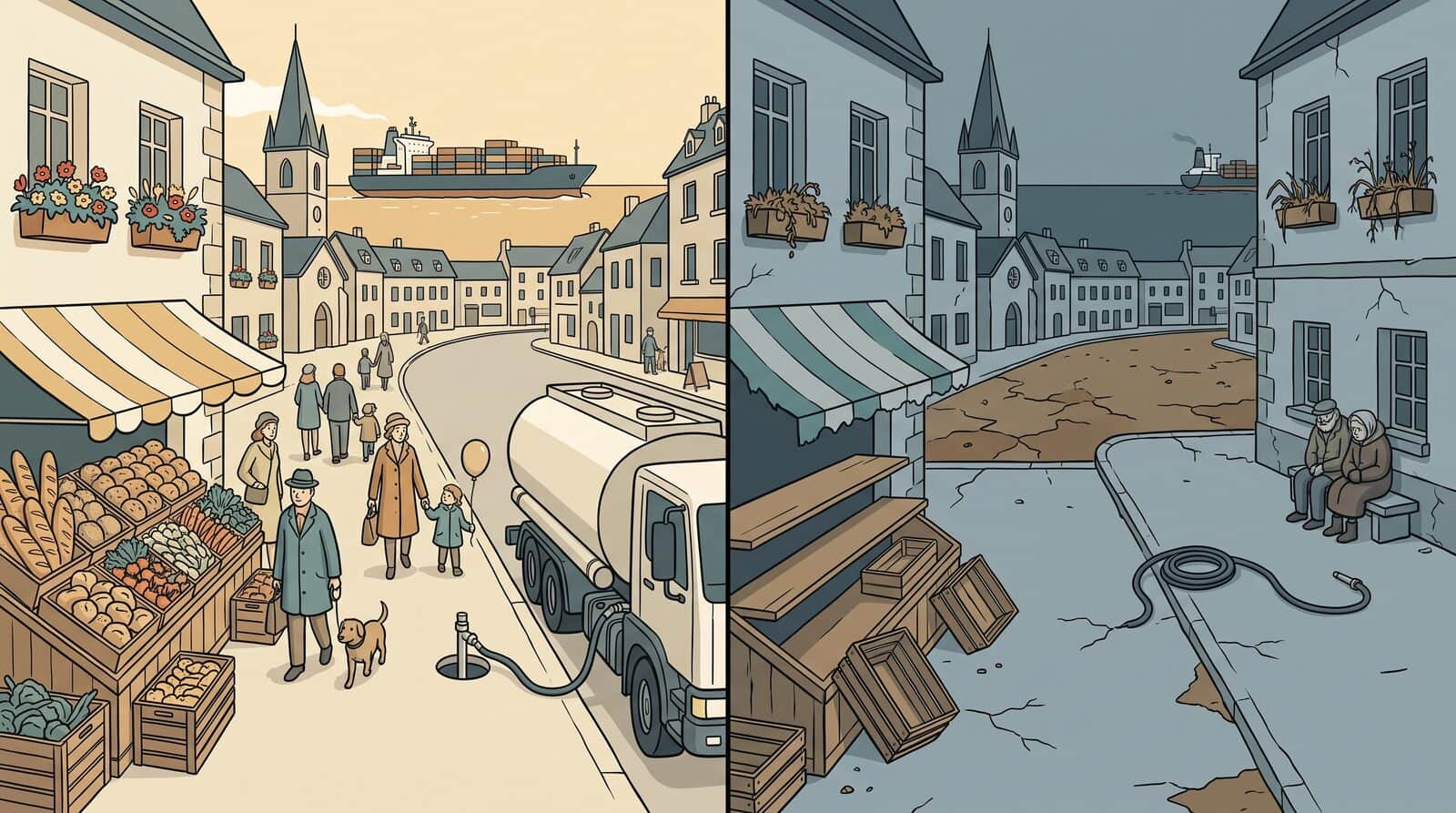
For almost 80 years, Europe lived inside a kind of bubble. The United States Navy kept the world's oceans safe, so ships could carry oil, food, and factory parts anywhere on Earth without much risk. Energy was cheap and easy to get. Weather was stable enough that farmers could count on good harvests almost every year. Most people never had to think about where their gas, their bread, or their safety actually came from. It just showed up. I was one of them.
That bubble is now popping. Four thinkers — Peter Zeihan, Jean-Marc Jancovici, Jeremy Rifkin, and Maja Göpel — have each spent years studying different pieces of this story. Put their ideas together, and a single, clear picture appears: the age of easy growth is ending, and Europe has about 25 years to figure out how to live differently, or the choice will be made for it.
I've tried to blend their four views into one story. Zeihan explains the political and military side. Jancovici explains the energy and physics side. Rifkin offers ideas for how ordinary communities can adapt and even thrive inside these new limits. And Göpel, a German political economist, zooms out the furthest: she argues that the deepest problem isn't oil or borders at all, but the invisible rules and habits our whole economy runs on — and that those rules can be rewritten.
We'll meet all four, look at where they disagree, and then at a problem sitting underneath all of them: why what people intend and what a society ends up with are so often two different things. After that, the pressures roughly in the order they build — the political gridlock slowing Europe down, the energy and water problems arriving on their own schedule, the hidden blind spots in how we count success, the local solutions that show a different way of living is at least possible, and a concrete plan for what to do now. Near the end, the strongest reasons all four might be wrong.
Four experts, one warning
Peter Zeihan is a geopolitical analyst — someone who studies how geography, borders, and population trends shape world events. His main argument is that the United States is stepping back from its old job of protecting global trade routes. For decades, American warships kept shipping lanes open so that any country could safely send goods across the ocean. Without that protection, trade becomes riskier, slower, and more expensive. Zeihan also points out that many countries, especially in Europe and Asia, are running out of young workers because birth rates have fallen so low for so long. Fewer young people means fewer workers, fewer soldiers, and fewer taxpayers to support the elderly.
Jean-Marc Jancovici is a French energy engineer. His argument is less about politics and more about basic physics. Almost everything modern life depends on — from tractors to fertilizer to trucks to plastic — runs on fossil fuels: oil, gas, and coal. These fuels are limited. They are running out in some places and getting harder to extract in others. Jancovici's key point is that Europe's economy has actually already been shrinking, in physical terms, since around 2007 — fewer cars built, fewer buildings constructed, less freight moved by truck — because there's simply less cheap energy available than there used to be. He believes Europe must plan for using about 5% less fossil fuel every year, on purpose, rather than being caught off guard when it runs out.
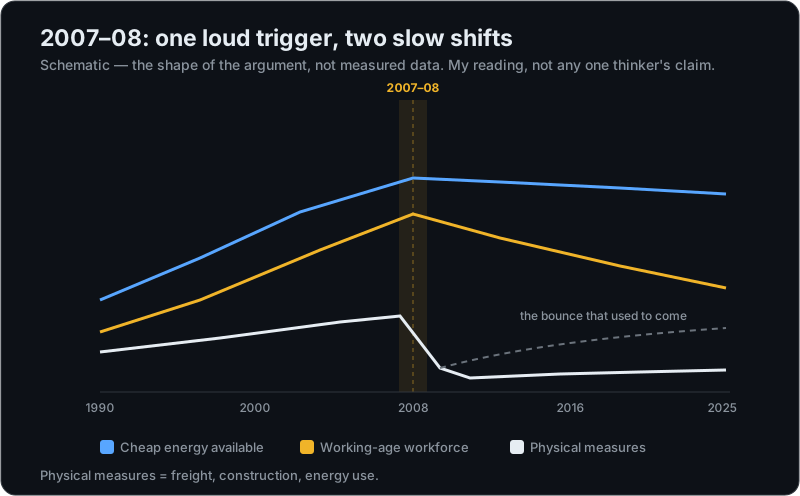
There's a detail here that ties the thinkers together. Two of them point to roughly the same moment — around 2007 and 2008 — as the turning point when growth started to stall, but they blame different underlying causes. Jancovici blames energy: less cheap oil and gas to power the machine.
Zeihan blames people: 2007 and 2008 are exactly when the first members of the baby boomer generation — the largest generation in modern history — started retiring. You can put a name to it. Kathleen Casey-Kirschling, born one second after midnight on New Year's Day 1946 and recognized by the US Social Security Administration as the first of the baby boomers, filed for her retirement benefits in October 2007 and collected her first check that February. For decades this enormous group had been the engine of the economy, working, earning, spending, and paying taxes; as they began leaving the workforce, a major driver of growth started to shut down. That was the first crack. The weight of it happens now: by the early 2020s the bulk of the boomers had gone, and a generation that spent forty years paying in is drawing out instead. Maja Göpel adds a piece of supporting evidence: she points at the carbon dioxide curve, and notes that it has bent exactly three times — during the 1970s oil shock, after the Soviet Union collapsed, and again after 2008 — because when the economy stalls, pollution stalls with it. Her point doesn't explain why growth stalled; it confirms that something real did.
Of course, most people already have a familiar name for what happened in 2008: the financial crisis. It's tempting to treat that as the whole story and these deeper shifts as a distraction — but it may be more useful to see them as parts of the same storm, a possibility we'll come back to once all four thinkers are on the table.
Jeremy Rifkin is more of an optimist. He believes new technology — the internet, 3D printers, solar panels, shared apps — can help people use resources far more efficiently. Instead of everyone owning their own car, their own tools, their own everything, people can share. He calls this a "Collaborative Commons," where communities cooperate instead of every person or company competing alone. Rifkin doesn't deny that hard times are coming. He believes communities that learn to share and cooperate will handle the coming changes far better than those that don't.
Maja Göpel comes at the problem from a completely different angle: not physics or geography, but ideas. She's a German political economist, and her argument is that our economy is running inside a box we've stopped noticing — one whose walls, she says, are built out of numbers and concepts we inherited rather than chose. For most of history, humans lived in what the economist Herman Daly called an "empty world," a phrase she borrows — few people, and seemingly endless room to expand, chop down, dig up, and move on. Our rules for success were built for that world. But we now live in a "full world," where there are far more people and far less untouched nature left. The trouble, she says, is that we're still following the old rules — chasing endless growth and measuring success mostly in money — even though those rules now quietly destroy the very things we depend on to survive. Her message is oddly hopeful: rules are made by people, which means people can change them.
The catch is that these four thinkers don't fully agree with each other. In fact, they'd argue fiercely if you put them in a room together — and those arguments are worth understanding before we go any further, because they're what keep the whole picture trustworthy.
Where the four thinkers clash
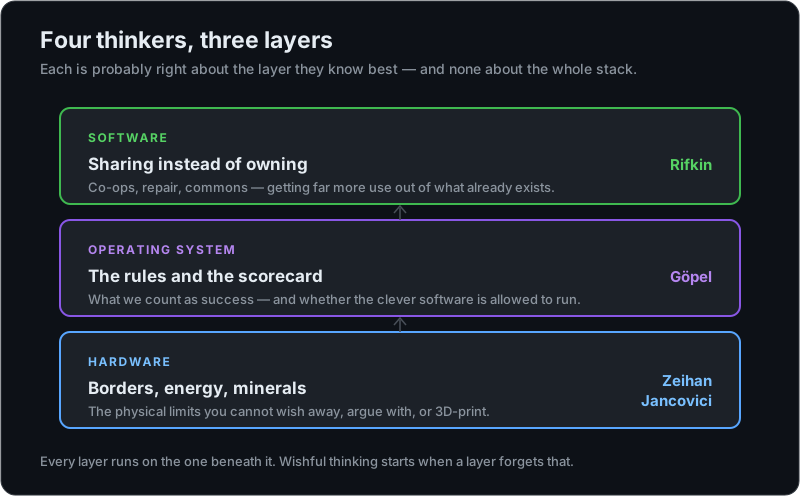
Start with the short version of the disagreement. Zeihan expects the coming decades to bring real conflict, as countries compete over dwindling resources. Jancovici thinks careful, fair planning can help society adjust peacefully — if governments act early enough. Rifkin trusts technology and cooperation to soften the blow. Göpel thinks the whole way we measure success has to change first. They agree the old system is ending; they split on what happens next. One simple way to hold them together is to picture a computer. Zeihan and Jancovici describe the "hardware" — the hard physical limits of borders, energy, and minerals you can't wish away. Rifkin offers the "software" — clever new ways to live within those limits by sharing instead of every person owning everything. And Göpel provides the "operating system" — the underlying rules and mindset that decide whether any of the clever software can actually run. Keep that picture in mind, because the disagreements between these layers are not small.
The sharpest fight is between Rifkin and the two "limits" thinkers, Jancovici and Göpel. Rifkin's most famous idea is that technology is driving the cost of making things toward almost nothing. Information is the clearest case: once a song or a design exists, copying it costs practically zero. He believes the same thing is starting to happen with energy (sunlight is free once you've built the solar panel) and even physical goods (3D printers can make objects on demand). His conclusion is optimistic: we're heading toward an age of near-abundance, where sharing networks let everyone access what they need without the old scramble.
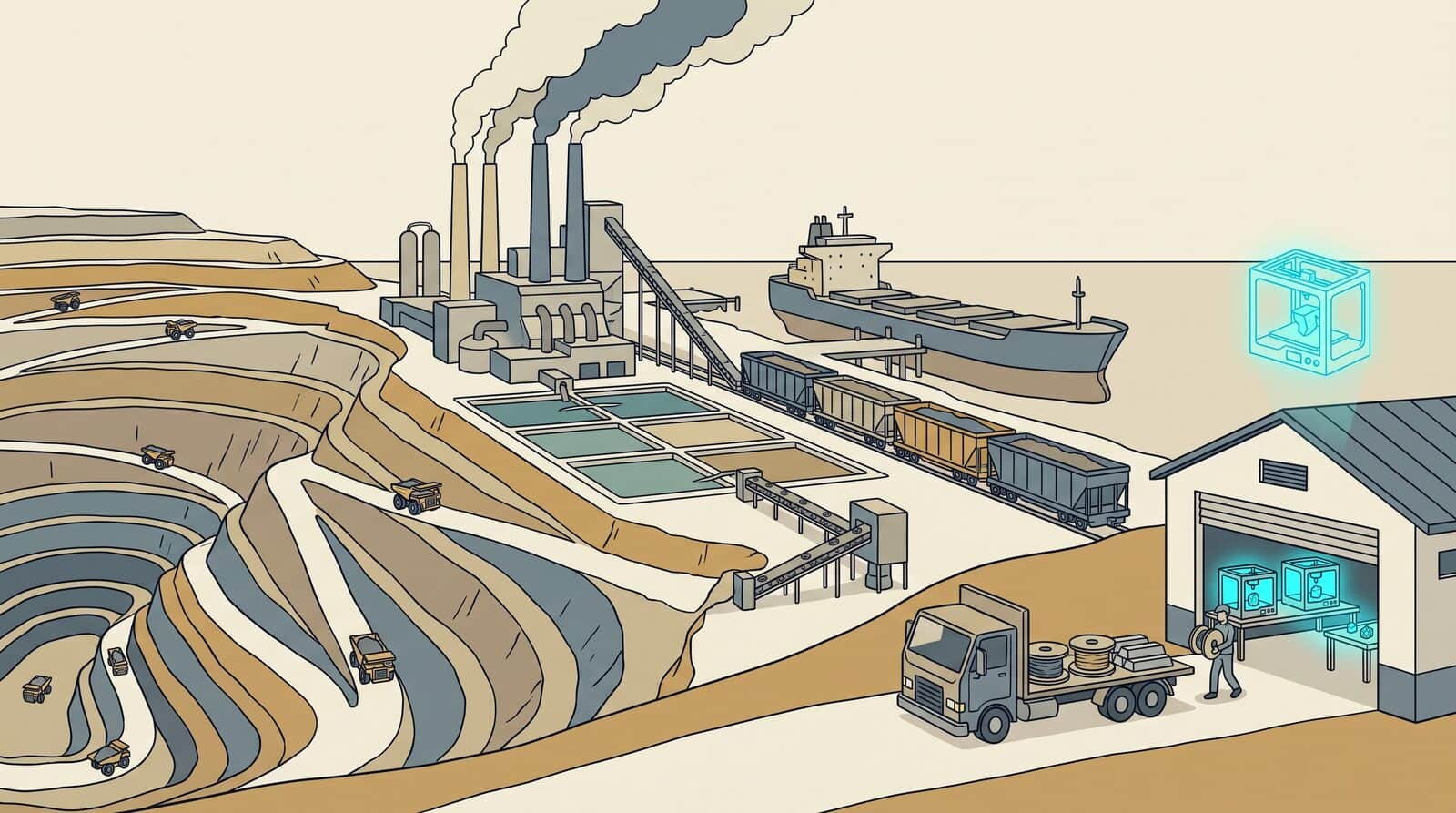
Jancovici's response is the physical one, and I'd put it like this: you cannot 3D-print copper. A design might be free to copy, but the solar panel, the battery, the electric motor, and the power line are all made of physical stuff — metals and minerals that have to be dug out of the ground, often in only a handful of places on Earth, using enormous amounts of energy. The information might be nearly free, but the hardware never will be. So while Rifkin looks at technology and sees abundance coming, Jancovici looks at the same technology and sees a mountain of copper, lithium, and steel that someone has to mine, ship, and pay for. To be fair to Rifkin, his point about sharing still holds even if his point about abundance doesn't: getting more use out of each object we already own is exactly what a resource-tight world needs. But the dream of effortless plenty runs straight into the periodic table.
Göpel sides with Jancovici on the physics, but adds her own objection to the idea that technology will save us. She points to a real and telling example: in March 2018 Walmart filed a patent application for tiny robot "bees" to pollinate crops, a response to real bees dying off. To her it's a warning — when we damage a free, self-repairing natural system, our instinct is to replace it with a machine, and the machine is almost always more fragile, more expensive, and more energy-hungry than the thing it replaced. A real bee feeds itself, repairs itself, and makes more bees for free. A robot bee needs factories, batteries, and constant maintenance. Betting the future on replacing nature with technology, she argues, is not clever — it's a way of making ourselves more vulnerable, not less.
Then there's the split between Zeihan and Göpel — though it turns out to be subtler than it first looks. Zeihan's picture of the future is a scramble: as global order breaks down, strong, well-positioned countries will grab what they can, weaker ones will fall behind, and it will often be brutal. It's worth being precise about what kind of claim that is. Zeihan isn't arguing that people are permanently selfish or that cooperation is impossible. He's predicting how states tend to behave when the structures holding them together weaken — a bet based on patterns in history and geography. "Likely, based on the past" is a much weaker claim than "fixed forever," and it's the only one his argument needs.
Göpel's objection is that treating the scramble as the default helps bring it about. To her, "every country for itself" is precisely the mindset that created the crisis, and she argues cooperation is not naïve idealism but a practical survival skill that societies can deliberately choose.
Notice, though, that these two claims aren't quite opposites, because they live at different scales. That neighbors grab sandbags together during a flood tells us very little about whether governments will fight over gas supplies. Both happen; both are happening right now, in the same world, in the same week. Everyday human decency and international hard-elbowing coexist perfectly comfortably.
So the real test of Göpel's case isn't whether people help each other on a flooded street. It's whether cooperation has ever worked at the large scale, where Zeihan's pessimism lives. And sometimes it has. In 1987, facing a growing hole in the ozone layer, virtually every country on Earth signed the Montreal Protocol and phased out the chemicals causing it; the ozone layer is now slowly healing. It remains the clearest proof that nations can act together against a shared physical threat when the evidence is clear and the alternative is frightening enough. Europe's own founding is another: countries that had spent the previous decade slaughtering each other pooled their coal and steel industries, specifically to make another war between them impractical. Montreal is also the easiest case anyone will ever cite, and it's worth admitting that. The chemicals had drop-in replacements, a handful of firms made them, swapping them cost ordinary people almost nothing, and nobody had to change how they lived. Fossil energy has none of those properties. Montreal shows cooperation is possible. It does not show it is cheap.
Neither example makes cooperation the norm. They do make it possible, which is all Göpel needs to claim.
They disagree, too, about whether the United States is the winner or the cautionary tale. Zeihan sees America as the country best placed to thrive: it has its own energy, its own food, two protective oceans, and friendlier population trends than most. In his telling, the US can pull back from the world and do just fine. Jancovici and Göpel see the American way of life — high energy use, endless consumption, sprawling suburbs — not as a model to envy but as exactly the pattern the planet can no longer support. For them, the question isn't whether America "wins" the old game; it's that the old game itself is ending, and copying America would just mean hitting the wall faster.
The gap between what people want and what happens
Underneath all three of those disagreements sits a deeper problem, and it was mapped out decades ago by the economist Thomas Schelling, who won a Nobel Prize for this kind of thinking. Schelling's central insight is that you usually cannot read a society's outcomes off its individuals' intentions. The two live on different levels, and the journey between them is full of surprises.
His most famous demonstration involves neighborhoods. Imagine everyone in a town is fairly relaxed about who lives next door — nobody wants to be the only person of their kind on the street, but nobody is trying to exclude anyone either. Each person simply moves if they end up heavily outnumbered. Run that forward and the town sorts itself into sharply separated blocks that almost nobody actually wanted. Mild individual preferences produced an extreme collective result. Schelling's point wasn't that people are secretly prejudiced; it was that you cannot work backwards from a segregated map and conclude anything reliable about what the individuals wanted. The pattern misleads you about the people.
That cuts in every direction here, which is exactly why it's useful. It means Zeihan's scramble doesn't require selfish nations: it could emerge from perfectly reasonable countries each protecting themselves, none of them wanting the world they collectively produce. But it also means Göpel's hopes need more than good intentions, because a great deal of well-meaning local cooperation does not automatically add up to a cooperative world — any more than everyone sensibly running for the exit of a burning building means everyone gets out.
The practical lesson is the one Göpel cares most about. If outcomes don't follow automatically from intentions, then the rules, structures, and incentives connecting the two are where the real work happens. Good intentions are not enough; bad outcomes are not proof of bad people. Both are arguments for paying attention to design.
That habit of mind — looking at how separate forces combine, rather than hunting for the single cause — suggests something about our earlier puzzle that none of the four states outright. Treat what follows as my own reading rather than any one thinker's claim. Remember that shared 2007–2008 turning point. The obvious explanation is the financial crisis — and that was certainly the loud, visible trigger. But it may have hit so hard, and left such a long hangover, because it collided with two slower shifts arriving at the same time. The largest generation in history was beginning to pull its money out of the economy just as the cheap-energy engine that powered the postwar boom reached its plateau. A financial bubble bursting is normally a shock economies recover from within a few years; this one landed exactly as the workforce peaked and fuel grew tighter, which may be why Europe's physical measures — energy use, freight, construction — never really bounced back the way they had after past recessions. If that reading holds, 2008 wasn't a one-off we've moved past. It was the first time these deeper pressures showed up in the headlines, wearing a financial disguise. That's speculation, not proven fact — but it's the kind of pattern you only notice when you stop looking at each cause alone.
So who's right? Probably each of them about the layer they know best, and none of them about the whole stack. The hardware thinkers keep the software and operating-system thinkers from drifting into wishful thinking; the software and operating-system thinkers keep the hardware thinkers' world from hardening into a self-fulfilling prophecy of every-nation-for-itself. That's the case for keeping all four in view at once. Now for the layers themselves — starting with the one everything else runs on top of, and the slowest to update: European politics.
Why the European Union can't make quick decisions
To understand why Europe is struggling to prepare, you have to understand how the European Union — the political and economic partnership of 27 countries — actually makes decisions.
On many important issues, especially anything involving foreign policy or military matters, EU rules require unanimous agreement. That means all 27 member countries have to say yes. If even one country says no, the whole plan is blocked. By one tally from the Centre for European Reform, this veto power was used 45 times between 2011 and 2025 — with Hungary alone accounting for 19 of them.
Picture a group project where 27 people all have to agree before anything gets decided, and any single person can shut the whole thing down. That's the EU today. It made some sense when the EU was smaller and less urgent decisions were involved. But now, with security threats rising and countries needing to respond quickly, this system is becoming a serious problem. Some EU leaders are pushing to change the rules so that most countries — rather than all of them — can approve certain decisions. This idea is called "qualified majority voting." As of 2026, twelve member countries, including Germany, France, and Italy, support this change. But ironically, changing the voting rules itself requires unanimous agreement — the very same veto power that's causing the problem in the first place.
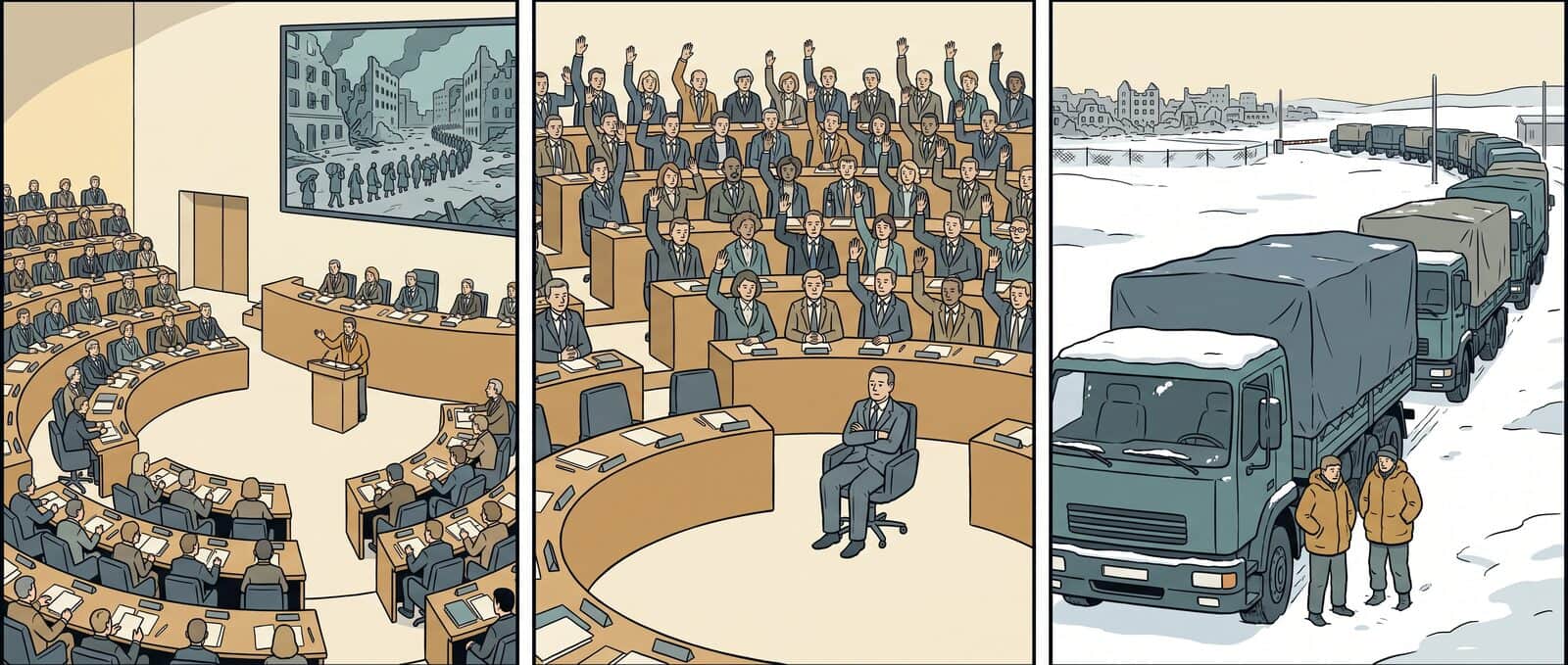
It's worth saying why that rule is there, because it wasn't an oversight. Unanimity is the condition on which the smaller countries agreed to join at all. It is what stops a country of half a million people being outvoted twenty-six to one on whether its soldiers go to war, and it is what keeps Irish and Austrian neutrality from being voted away by larger neighbours who don't share it. Whatever you make of how Hungary has used it lately, the veto isn't simply a bug nobody got around to fixing. It is part of the price of having twenty-seven countries in the room, and removing it means asking the smallest members to accept a deal they never signed.
Because of this gridlock, some people expect the EU to drift toward a "two-speed" union: a smaller, more tightly connected core group of countries that acts fast and together, surrounded by a looser, larger group that moves more slowly. It isn't official policy, and it isn't a consensus forecast either — Zeihan thinks it very unlikely, and expects the Union to crack before it deepens. But it is the shape people reach for when the veto problem won't move. Nowhere does this slow-moving system matter more than in energy, because the fuel Europe runs on is the thing it controls least of all.
Running out of gas — literally
Europe currently depends on other countries for about 97% of its oil and roughly 90% of its natural gas. Almost none of the fossil fuel Europe burns is actually produced within Europe. It all has to be imported, mostly by ship or pipeline, from places like the Middle East, Russia, and the United States.
This dependence isn't just risky because of war or politics — the fuel itself is a limited resource. Oil and gas fields are gradually running dry, and new sources are harder and more expensive to find. Jancovici argues that the countries supplying Europe will see their own oil production roughly halve by 2050 — and that what actually arrives here could fall by anywhere between a factor of two and a factor of ten over the same stretch, because exporters serve their own people first. His suggested response is to get out in front of it: deliberately reduce fossil fuel use — oil, gas and coal together — by around 5% every year, starting now, so the decline is planned rather than chaotic.
What makes that number hard to wave away is that it arrives twice, from opposite directions. Come at it from the climate side and you need roughly 5% a year. Come at it from the supply side — Europe's incoming oil divided by three or four over twenty-five years — and you land on the same figure. Whichever view you take, he says, it comes out at about 5% a year. France, in its better years, manages about 3% — and that is emissions, not fuel.
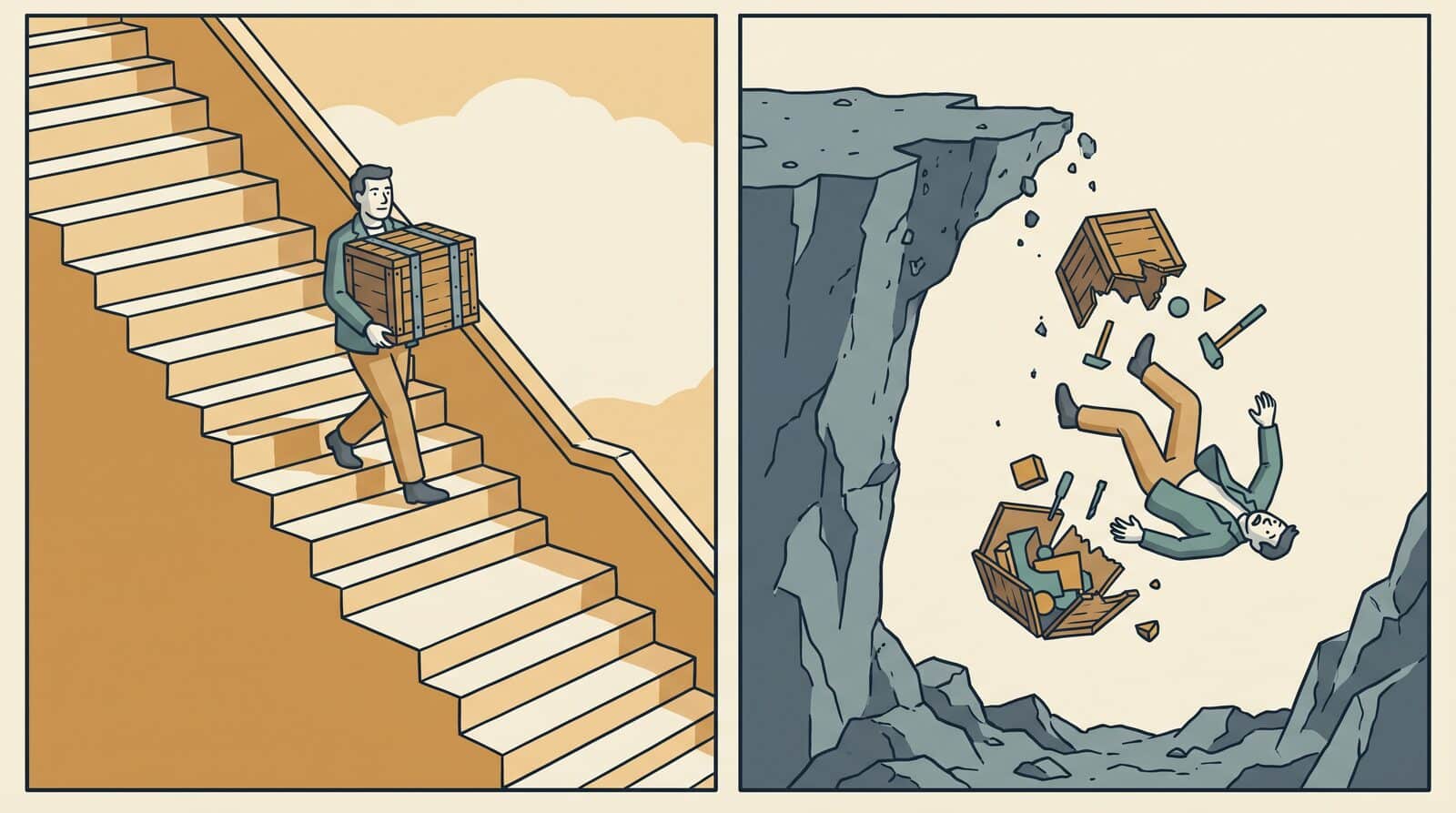
Switching to renewable energy — solar panels, wind turbines, batteries — sounds like the obvious solution, but it comes with its own catch. Building all of that renewable equipment requires huge amounts of specific minerals: copper, lithium, cobalt, and others. These minerals are also limited and geologically concentrated in only a few places on Earth. You can't 3D-print copper. You can't download lithium from the internet. The world may face significant shortages of these materials by the mid-2030s as demand for renewable technology grows.
Renewables also run into a basic physics problem: solar panels don't produce power at night, and wind turbines don't spin without wind. Storing enough energy to cover cloudy, windless days — let alone an entire winter — is still extremely difficult and expensive with today's battery technology. This is why Jancovici and many energy experts argue that Europe still needs "pilotable" power sources — ones that can be turned on and off as needed, like nuclear power plants — to fill in the gaps that solar and wind leave behind.
Göpel adds a warning here that's easy to miss. People often assume that making things more efficient — cars that sip less fuel, light bulbs that use less power — automatically means we use less energy overall. History usually shows the opposite. When light bulbs got cheaper to run, people simply installed far more of them. When car engines got more efficient, carmakers poured the savings into bigger, faster, heavier cars instead of smaller fuel bills. Scientists call this the "rebound effect," and it's one of the most overlooked traps in going green. The lesson is that better technology alone isn't enough: to actually shrink our footprint, we have to pair efficiency with genuinely using less — which is exactly the hard, deliberate choice Jancovici is pointing at.
Europe does have one unusual factor working in its favor here, though it's a grim kind of help. A shrinking, aging population — the same trend that causes so many problems elsewhere in this story — also means fewer people consuming overall, which naturally pulls total energy demand down. It won't cancel the rebound effect (each remaining person can still burn through their efficiency savings on more stuff), and it's no one's idea of a good way to cut emissions. But it does mean that part of the reduction Jancovici says Europe needs may arrive on its own, simply because there are fewer Europeans to feed, house, and move around. The challenge is to make that decline something Europe manages deliberately, rather than something that just happens to it.
Water: the quiet three-way fight
But the fix just described — nuclear power — runs into a problem of its own, one that connects nearly everything else in this article: water.
During hot summers, French nuclear power plants sometimes have to shut down or reduce power because the rivers they use for cooling get too warm or too low. At the same time, massive data centers — the buildings full of computer servers that run the internet, including artificial intelligence programs — also need enormous amounts of water for cooling. And farmers need water to irrigate their crops.
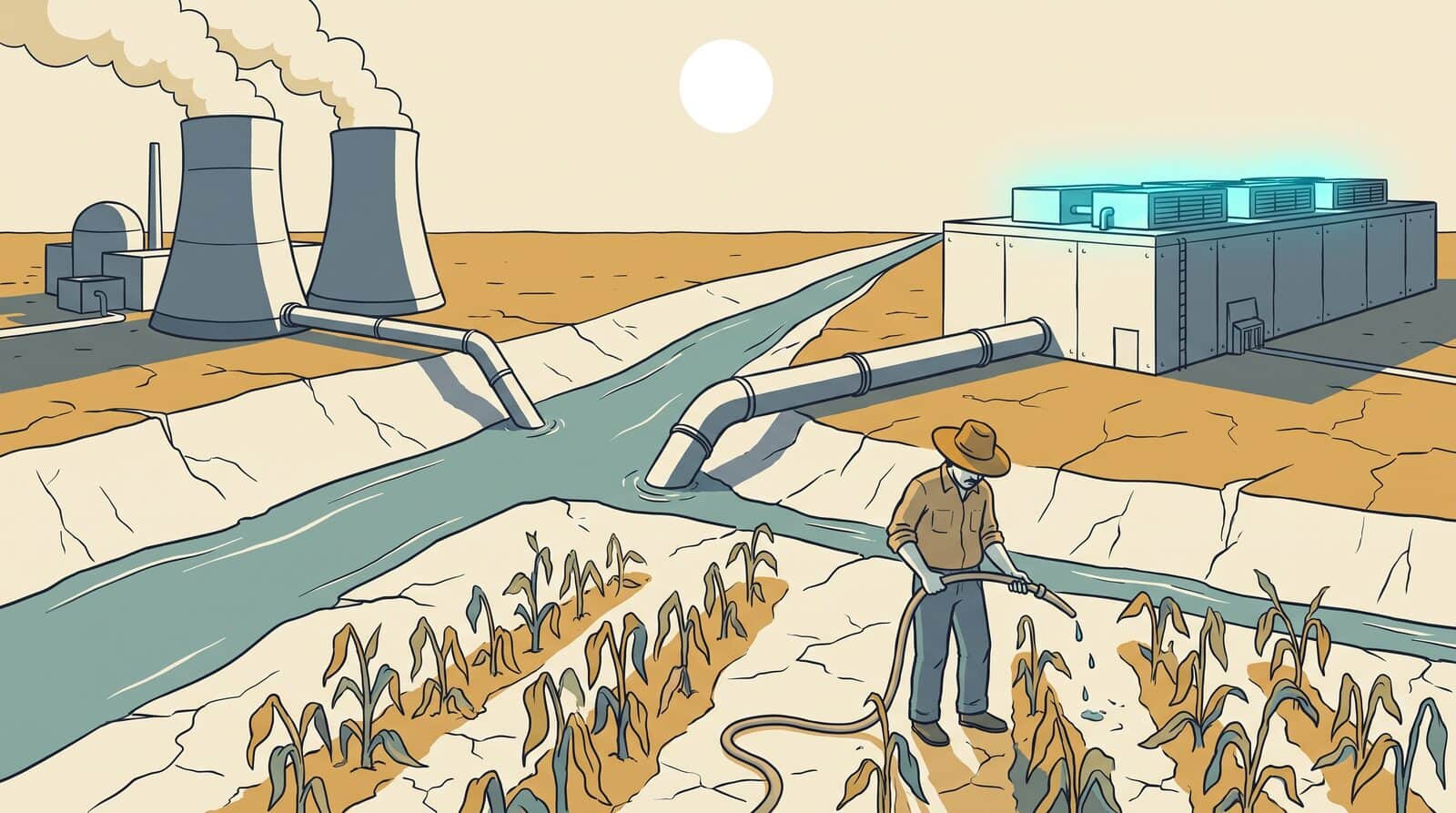
All three of these — nuclear plants, data centers, and farms — end up competing for the same limited water supply, especially during increasingly common heat waves. During recent heat waves, French utilities have had to shut down or throttle several nuclear reactors precisely because the rivers used to cool them ran too warm or too low — the plant that needs water to make electricity has to power down exactly when the heat is at its worst. Meanwhile Amsterdam has put a moratorium on new data centers specifically to protect its drinking water, and farmers face tightening limits on irrigation.
It's a three-way tug-of-war, though not an equal one, and the difference matters. Farming is the big consumer — around 61% of the water France actually uses up, on three and a half percent of its land. Power stations take about half of everything drawn from French rivers, but hand most of it back warmer rather than consuming it; their problem is heat, not volume. All 352 French data centers together used about 681,000 cubic metres in 2023, which against the other two is a rounding error — and most of their real thirst is indirect anyway, because what they consume is electricity, and electricity is cooled by the same rivers. So it is less three ropes than two, with a third being spliced on fast. Climate change pulls harder on all of them every year.
I have to stop here, because I'm in this picture. Those data centers are running, among other things, the AI I used for work and also to do research. The same kind of machine that helps me find answers about the strain is part of the strain. I don't have a clean way out of that, and I don't think my feeling bad about it changes anything on that river. What I keep seeing instead is that somebody decides where these buildings go, what they're allowed to draw in a dry August, and which of the three pipes gets turned down first. Those are rules, and people write them. That's the argument I'd rather be having.
The blind spot hiding in company balance sheets
The water fight is really a small preview of a much bigger blind spot Jancovici has spent his career pointing out. Companies depend on basic physical things that never show up on a balance sheet. A skyscraper full of offices is worthless if the toilets stop working or the road leading to it floods. A factory is worthless without reliable electricity and water. These aren't things a company can buy more of when they run short — they're background conditions that modern business simply assumes will always be there.
Jancovici also warns about a trap he calls a "deadly anesthetic" — claims of carbon neutrality, and the offsetting that props them up. Many companies claim to be "carbon neutral" by purchasing carbon offset certificates — essentially paying someone else, often far away, to plant trees or reduce emissions instead of reducing their own. His concern is that this creates a false sense that the problem is solved when the underlying physical dependence on fossil fuels hasn't actually changed. It's a bit like paying someone to go on a diet for you and believing your own weight problem is fixed.
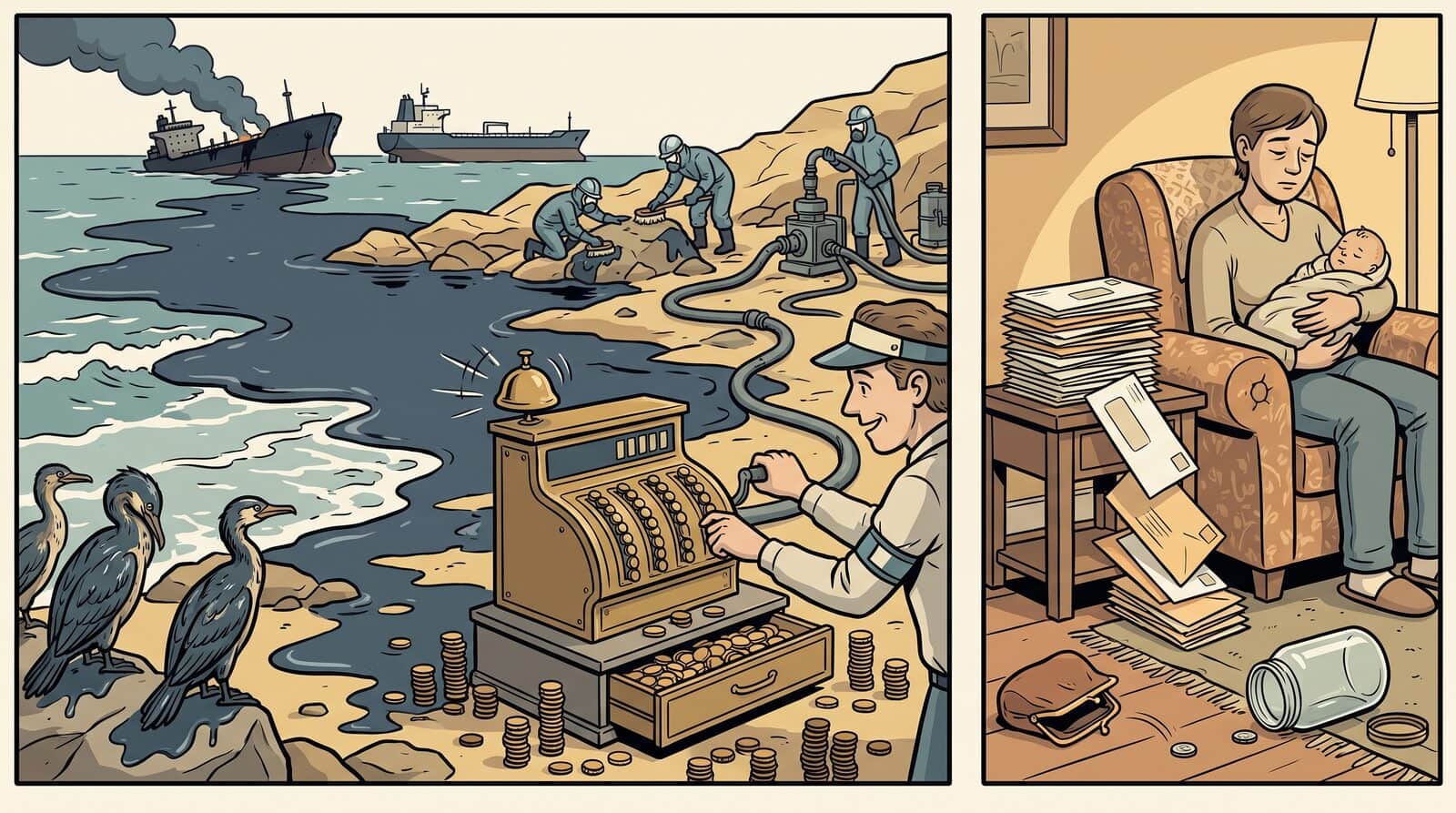
Göpel takes this blind-spot idea and makes it even bigger. The main scorecard countries use to measure success is called GDP — basically, the total value of everything a country buys and sells in a year. The problem is that GDP is strangely blind to what actually keeps us alive. When an oil tanker spills and wrecks a coastline, GDP goes up, because cleaning it costs money and counts as "activity." When a parent stays home to care for a newborn, GDP goes down, because no money changed hands. Nature does enormous work for free — bees pollinating crops, forests cleaning the air, rivers carrying water — and because it's free, it shows up nowhere on the scorecard. That's the same blind spot behind the robot-bee story from earlier: we let the free, self-repairing systems collapse and then pay fortunes to replace them with machines, and call it progress. Fixing this, Göpel argues, starts with changing the scorecard itself, so that wrecking nature no longer counts as "growth."
Small towns showing the way forward
Despite all these heavy problems, there are real examples of communities adapting successfully — and they offer a genuine blueprint for the future. A fair warning first: these are hand-picked success stories. For every town that reinvented itself, others tried similar things and failed, and a village of a dozen people with a million visitors is not a model every place can copy. The point isn't that these examples are typical — it's that they show what's possible, and that the moves behind them can be adapted more widely.
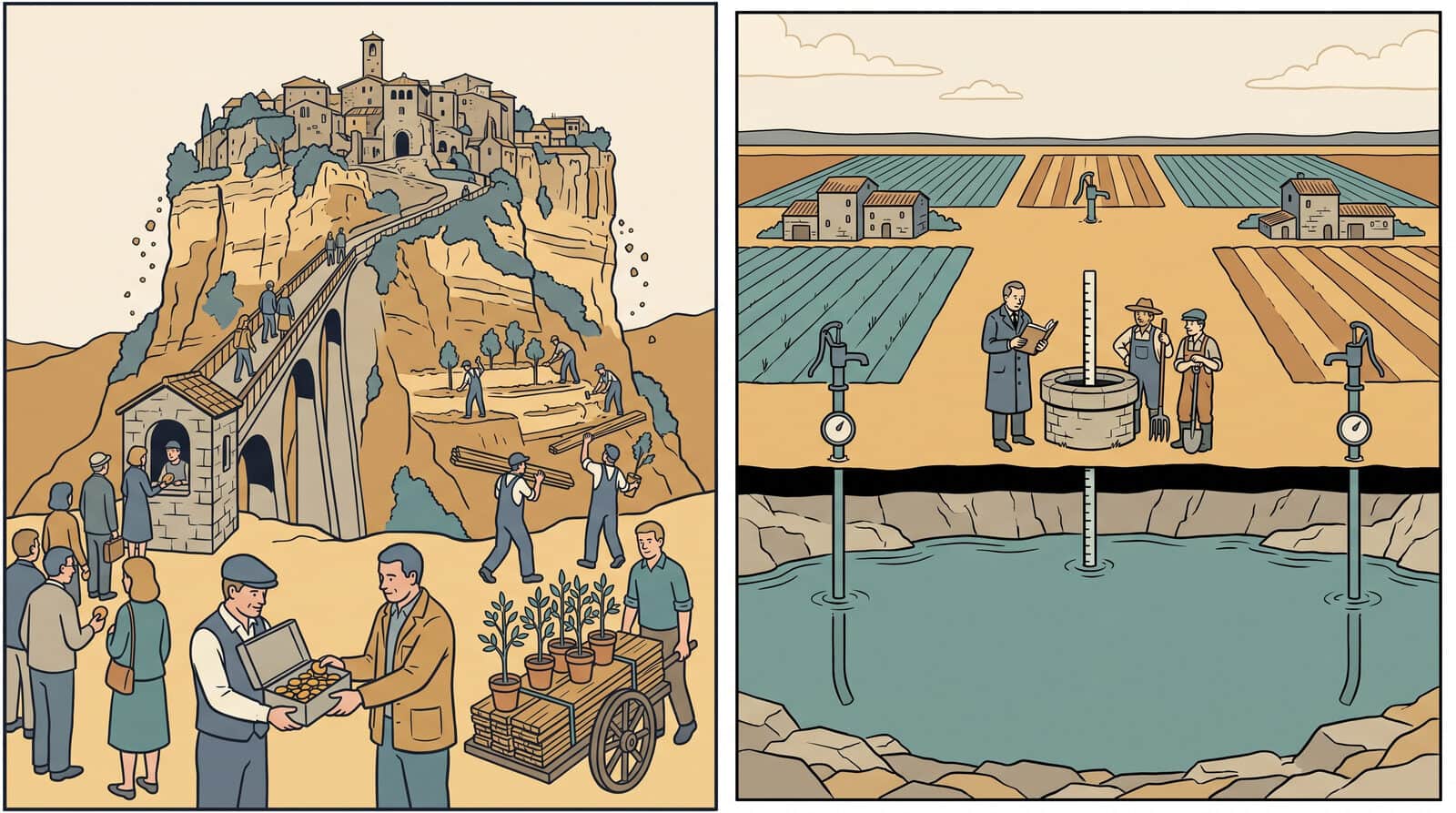
Take Civita di Bagnoregio, a small hilltop town in Italy that's been slowly crumbling off its cliff for centuries due to erosion. Only about a dozen people live there year-round, but the town gets nearly a million tourist visits a year. Instead of just watching the town erode, local leaders introduced a small tourist entry fee — about five euros — and used that money to fund geological surveys and replant trees on the hillsides to stabilize the ground. The rate of erosion has slowed dramatically. It's a small example, but it shows something powerful: a community identified its specific physical risk, found a funding source connected to that risk, and invested in fixing the actual problem rather than just hoping it would go away. There's even a twist that makes the lesson sharper — the same tourists whose fees pay for the repairs are themselves part of the problem, their footsteps wearing down the fragile ground. The town's answer wasn't to ban visitors or ignore the damage, but to turn the threat into the funding stream that fights it. That's the core move of smart adaptation: make the thing causing the pressure help pay to relieve it.
Similarly, in the Beauce region of France — sometimes called the "granary of France" because of its wheat farming — farmers facing hotter, drier summers have started shifting away from thirsty crops like corn toward more drought-resistant crops like sorghum, lentils, and chickpeas. They've also adopted smart irrigation technology: sensors buried in the soil that measure exactly how much water the ground needs, connected to systems that deliver precisely that amount — no more, no less. But the most interesting part isn't the technology; it's the cooperation. The Beauce sits on top of a giant underground reservoir of water, and if every farmer simply pumped as much as they wanted, the whole region would drain it dry — a classic trap where everyone acting in their own interest ruins the shared resource for all. So the farmers and the authorities built a rule instead. The aquifer is governed by a local water commission that sets a total volume for the year and hands every single farmer an individual maximum, adjusted down in dry years and up in wet ones, with the level watched through a network of monitoring boreholes. It is worth being precise about this, because the precision is the point: it isn't a handshake between neighbours. It is a rule, written down, with an authority behind it and a number attached to each farm. That is why it holds. No single farmer could have solved the problem alone, and no amount of goodwill would have done it either.
That word — together — is the thread running through every real solution, and it points toward the practical toolkit Rifkin has spent decades describing. Some of what follows is his directly; some of it is simply what a "Collaborative Commons" looks like when ordinary people build one without having read him. Either way it stops being theoretical the moment you look at communities already using it. Consider a few that exist right now across Europe:
Car cooperatives let neighbors share a small fleet of vehicles instead of everyone owning a car that spends nearly all its life parked. A household gets the use of a car when it actually needs one, without the cost — or the resource footprint — of owning one outright. In a world of tightening fuel and materials, getting far more use out of each vehicle is exactly the kind of efficiency that matters.
Energy cooperatives are already widespread in Germany, where hundreds of them let ordinary people pool their money to build and own shared solar panels or wind turbines. Instead of a distant company owning the power supply, the community owns it, splits the benefits, and keeps the profits local. When a neighborhood owns its own small grid, it's also more resilient: a problem far away on the national grid is less likely to leave everyone in the dark.
Repair cafés — community spaces where volunteers help people fix broken appliances, clothes, and furniture instead of throwing them away — have spread to thousands of locations across Europe. They sound modest, but they strike directly at the "conveyor belt" economy Göpel criticizes: every toaster or jacket repaired is one that doesn't need to be manufactured again from scratch, saving the energy and materials a replacement would have cost.
Community land trusts let a town collectively own land and keep housing permanently affordable, rather than letting prices spiral until locals can't afford to live where they grew up. It's a direct answer to a problem Göpel highlights — that when everything is priced purely by the market, essentials like housing can drift out of ordinary people's reach.
Maker spaces — Rifkin calls them Fab Labs — with 3D printers and shared tools let a community produce simple parts and goods locally, instead of waiting weeks for something to ship from across the ocean. This is where Rifkin's optimism holds up best, within limits worth stating: you can't print the metal, and most of what comes out of these machines is plastic. But you can send a design anywhere on Earth for nothing and make the object where it's wanted, and that is worth having when the long supply chains get slow.
None of these ideas alone will solve Europe's challenges. But together, they form a pattern: get more use out of what already exists, own important things collectively, keep money and power close to home, and manage shared resources by agreement rather than a free-for-all. That's the practical, ground-level version of everything the four thinkers are pointing toward.
This kind of cooperation is already far more common in Europe than most people realize. In Germany, roughly one in four people belongs to some kind of cooperative. In France, around 30 million people are members of cooperative businesses. This existing culture of working together gives Europe a real head start — if it chooses to build on it.
So, what actually needs to happen now?
Bringing all of this together, a few clear priorities emerge for what Europe should focus on in the years immediately ahead.
At the European Union level: Leaders need to seriously reform the unanimous voting system, at least for security and foreign policy decisions, so that a single country can't block urgent action. Countries that want to move faster together should be allowed to form a more tightly integrated core group, rather than waiting for all 27 members to agree on everything.
At the national level: Governments need to treat energy reduction as a real, planned project — not something that happens by accident during a crisis. That means investing in reliable, low-carbon power sources like nuclear energy alongside renewables — while taking seriously that those plants want cooling water in exactly the summers when everyone else wants it too — protecting water supplies by prioritizing drinking water and food production over less essential uses during shortages, and taking population decline seriously with family support policies and skills training. Governments also write the rulebook the whole economy follows, so they can change the incentives — adjusting taxes and subsidies so that prices finally reflect the real cost of pollution, and rewarding businesses that build long-term resilience instead of chasing only short-term profit.
At the local, community level: Towns and neighborhoods don't need to wait for national governments to act. They can start car-sharing programs, build community workshops with tools like 3D printers, form neighborhood energy-sharing groups, set up fair water-sharing agreements between farmers like the one in the Beauce, and fund local adaptation the way Civita paid for its erosion control — all based on models already working somewhere in Europe today.
One idea in that agenda — that governments should actively reshape the rules rather than just stay out of the way — often gets dismissed as unrealistic. As with Schelling earlier, two more economists help fill in what our original four leave sketchy. The first is Mariana Mazzucato, whose work helped shape Göpel's thinking, and who has spent years showing that active government isn't a fantasy. In her book The Entrepreneurial State, she points out that the technologies we usually credit to bold private companies were built on top of government-funded research first. The internet, GPS, the touchscreen, even the voice assistant inside a smartphone all began with public money taking risks that private businesses were unwilling to take. Her point isn't that companies don't matter — it's that governments have quietly been among the boldest investors all along, and could deliberately steer that power toward the clean, resilient economy the next 25 years will demand. In a second book, The Value of Everything, she sharpens the scorecard argument this article keeps circling back to: our economy rewards "taking" — extracting wealth, often through clever financial tricks — far more than "making" the useful things a healthy society actually runs on. Straightening out that confusion between taking and making, she argues, is one of the most powerful levers a government has.
That can sound abstract until you see someone actually doing it. Since 2010, a movement that started in Austria — the Economy for the Common Good — has built a working tool for exactly this job. It's called a Common Good Balance Sheet, and it sits alongside a company's ordinary financial accounts rather than replacing them. Where the normal accounts track money in and money out, this one scores an organization on how it treats its suppliers, employees, customers, and neighbors, and what it does to the environment — turning things like fairness, dignity, and ecological care into numbers a business can be measured and compared on. More than 1,400 companies have now been assessed this way, along with nearly 50 towns and cities. In 2015 the EU's own Economic and Social Committee voted overwhelmingly to recommend the approach across Europe, and Amsterdam has built it into city strategy alongside another model we'll come to shortly. Set against the weight of the global economy it's still a small movement. But it shows that "change the scorecard" isn't only a slogan: the blueprints exist, they've been tested, and thousands of organizations are already keeping their books this way.
But what if they're wrong?
Any trustworthy article has to admit that not everyone agrees with these four thinkers — and some of the criticisms are serious. It would be a mistake to treat their warnings as settled fact. Here are the strongest arguments on the other side.
The biggest pushback comes from economists who believe in what's often called "green growth." Their argument is that economies can keep growing while using less energy and fewer resources — a process called "decoupling." They point out that several wealthy countries, including Britain and Sweden, have actually grown their economies in recent years while their carbon emissions fell. If that trend is real and can spread, then Jancovici's and Göpel's core claim — that growth and environmental damage are locked together — would be too pessimistic. Supporters of this view argue that clean technology is improving faster than the limits thinkers expect, that solar power and batteries have gotten dramatically cheaper and better in just the past decade, and that human inventiveness has repeatedly solved problems that once looked impossible. Critics of Jancovici and Göpel would say they underestimate how quickly things can change.
There's a fair counter-counterpoint worth knowing, too: skeptics note that some of that "decoupling" happened only because rich countries moved their dirtiest factories to other countries, so the pollution didn't disappear — it just moved somewhere that doesn't show up on the home country's scorecard. Who's right depends on details that experts genuinely argue about. The point for a careful reader is that this is a live debate, not a closed case.
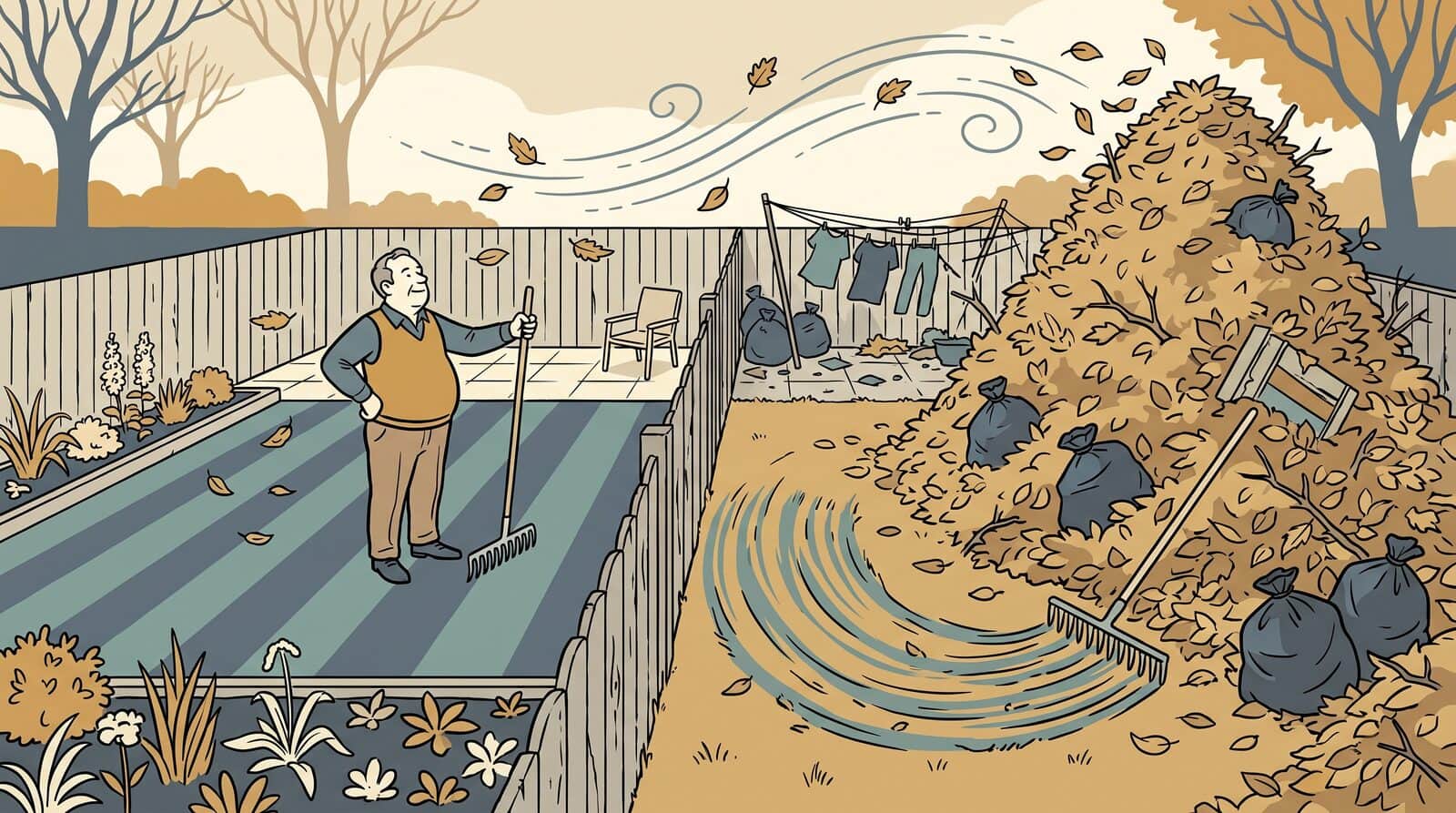
Zeihan, in particular, draws sharp criticism. He makes bold, specific predictions with great confidence, and confident predictions about the future have a long history of being wrong. Critics argue that he understates how adaptable countries can be, and that he's been predicting a dramatic collapse of China for years in a way that keeps not fully arriving on schedule. Many also object to what they see as a "geography decides everything" style of thinking — too neat for a messy world in which human choices regularly overcome geographic disadvantages. We gave Zeihan the more careful reading earlier, treating his claims as bets about likely behavior rather than iron laws, and that reading still seems the fair one. But it's worth noting how often his work gets received as prophecy rather than probability — and that a forecaster who states things as confidently as he does bears some responsibility for that. His specific timelines, including the idea of a narrow two-to-three-year window of maximum danger, are best read as one analyst's educated guess, not a countdown clock.
Jancovici draws his own share of criticism, and it's worth stating plainly since so much of this article rests on his physics. His strongest critics argue that he underrates human ingenuity and the speed of the energy transition — that he's too quick to treat today's technology limits as permanent, too gloomy about renewables, and too attached to nuclear power as the answer. His claim that Europe's economy has been physically shrinking since 2007 is also contested: most mainstream economists measure the economy in money, not tons and kilowatt-hours, and by that measure Europe kept growing for years after 2007. Whether his "physical" way of keeping score is the more accurate one, or just a gloomier one, is exactly the kind of thing reasonable experts disagree about.
Rifkin gets criticized from the opposite direction — for being too optimistic. Skeptics point out that the "sharing economy" he championed often didn't turn into the friendly, cooperative commons he imagined. In many cases it turned into a handful of giant companies (think of the big ride-hailing and short-term-rental platforms) that own the technology and take the profits, while ordinary people do the work with less security than before. Sharing, in other words, doesn't automatically mean fairness — it depends entirely on who owns the platform. This is actually a place where Göpel's emphasis on rules matters: the same technology can lead to a genuine commons or to a new kind of monopoly, depending on how it's governed.
And Göpel's own school of thought — the idea that we should stop chasing growth, sometimes called "degrowth" — has its critics as well. Some argue that growth is exactly what poorer countries still need to lift people out of poverty, and that telling them to stop growing is unfair coming from rich nations that already got wealthy. Others argue that deliberately shrinking an economy is politically almost impossible in a democracy — people vote out governments that preside over falling living standards — so the whole approach, however logical on paper, may simply never happen in the real world.
One more fair objection is worth naming, aimed at me rather than any single thinker. The solutions I lean toward — cooperatives, shared ownership, an active government rewriting the rules, penalizing pollution — line up with a broadly left-of-center politics, and it's worth being honest that they are choices, not scientific conclusions. You could accept every physical fact in this piece and still prefer a different response: a market-driven, nuclear-heavy technical fix, say, or a more nationalist "look after our own first" approach. The physics and the demographics set the boundaries of the problem; they don't, on their own, dictate one and only one answer.
So why take these four seriously at all, if smart people disagree with them? Because even their critics mostly agree on the basics: that the climate is changing, that resources are finite, that populations in much of the world are aging, and that today's supply chains are fragile. The argument is about how fast and how bad and what to do — not about whether these pressures are real. The political question — how to respond, and whose values guide the response — is genuinely separate, and worth having out in the open rather than smuggling in under the cover of physics. Some of what's in the "what to do" section is worth doing across a wide range of politics, even if the four thinkers turn out to be too pessimistic. Cheaper energy, more resilient local communities, less waste, and keeping essentials within people's reach are not the property of any one party — none of that is a bad idea even in an optimistic future. But I shouldn't smuggle the rest through on the back of it. Scrapping the national veto, pricing carbon properly, letting towns own land to hold housing down: those aren't common sense, they're arguments, and the people who lose them lose something real. The insurance-policy case covers the local, no-regrets half. The other half I have to win on its merits, like anyone else.
The bigger picture
None of these four thinkers is predicting the end of the world. They're predicting the end of a very specific, unusually comfortable period in human history — one built on cheap energy, guaranteed global trade, and steadily growing populations. That period is ending, not because of any single event, but because several long-building trends are all reaching their limits at roughly the same time.
The good news is that history shows communities can adapt to hard limits when they act early and work together. The towns and regions already experimenting with these solutions — sharing resources, planning for less energy rather than assuming unlimited growth, and investing in resilience before disaster strikes — are showing the rest of Europe what's possible.
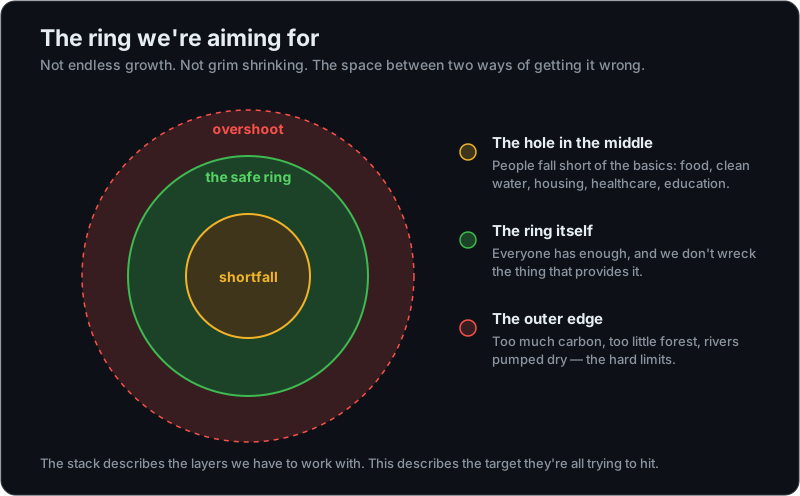
If all of this raises the obvious question — so what exactly are we aiming for? — one of the clearest answers comes from the second of those two economists: Kate Raworth, who drew a simple picture she calls the "doughnut." This is the model Amsterdam paired with the Common Good Balance Sheet mentioned earlier, and it's easy to see why the two travel together. Imagine a ring, like a doughnut. The hole in the middle is a danger zone: it's where people fall short of life's basics — enough food, clean water, housing, healthcare, education. The outer edge is the other danger zone: it's where we push past the planet's limits — too much carbon, too little forest, rivers pumped dry. The safe, good place to live is the ring itself — the space where everyone has enough, but we don't wreck the planet providing it. If the computer picture from earlier describes the layers we have to work with, the doughnut describes the target all those layers are trying to hit: Zeihan's and Jancovici's hard limits mark the outer edge, and the basic human needs any real solution has to protect mark the inner one. The goal isn't endless growth, and it isn't grim shrinking either. It's finding the ring — and staying in it.
Göpel sums up the whole change of mindset as a handful of simple swaps in how we think. A few of them capture the spirit of everything these four thinkers are saying: from treating the economy as a one-way conveyor belt that turns raw materials into garbage, to running it as a cycle where one thing's waste becomes the next thing's fuel; from competition to cooperation; from extracting to regenerating; and from measuring success in money to measuring it in real, lasting value. None of these swaps requires a new invention. They just require deciding that the old way of keeping score no longer fits the world we actually live in.
The next 25 years will likely be harder, in a physical and practical sense, than the last 25 were. But "harder" doesn't have to mean "worse" for everyone. The old engine — cheap fuel, an ever-growing workforce, and oceans an outside superpower kept safe — is winding down all at once. Europe's job now is to build something new in its place: an approach based on cooperation, careful planning, and a realistic understanding of the physical limits the planet actually has. The communities and countries that start building those new habits now will be the ones best prepared for whatever comes next.
I started this worried, and I am ending it worried. Reading four clever people did not talk me out of it, and reading their critics — which I did hoping they would win — did not either.
What changed was the shape of the worry. When I began, "humans can find answers together" was the sort of thing you say to yourself in the dark. Then I noticed it was already sitting in everything I had written down. A treaty is actually healing the ozone layer. The farmers in the Beauce actually share their water, by rule, farm by farm. A quarter of Germany actually belongs to a cooperative of some kind, even if for a lot of them that means a bank. None of that is a feeling. It is rules that people chose, in places you could drive to.
They are not the same size, and that matters — a treaty between governments and a water rule for one French plain are different animals, and one tells you very little about the other. What they have in common is smaller than I'd like and still worth having: in each case somebody wrote the rule down, and it held.
I started by asking whether the worry was lazy or earned. It's earned. I'm not going to dress that up.
But earned isn't the same as decided. What happens over the next 25 years comes down to what people agree to and who gets to write it down — and that part, unlike the physics, is still open.
Sources
This article draws on the work of four main thinkers, one economist whose work provides a lens for reading the others, two supporting economists, and a range of data sources used to check the specific facts and figures. Population projections and cost estimates in particular are revised regularly, so the figures reflect the most current data available at the time of writing (July 2026).
The four main thinkers
- Peter Zeihan — The End of the World Is Just the Beginning (2022) and Disunited Nations (2020); analysis and video commentary at Zeihan on Geopolitics (zeihan.com).
- Jean-Marc Jancovici — talks, articles, and explainers at jancovici.com; reports from The Shift Project (theshiftproject.org), the think tank he co-founded.
- Jeremy Rifkin — The Zero Marginal Cost Society (2014) and The Age of Resilience (2022).
- Maja Göpel — Unsere Welt neu denken: Eine Einladung (2020), published in English as Rethinking Our World: An Invitation to Rescue Our Future.
A lens on all four
- Thomas C. Schelling — Micromotives and Macrobehavior (1978) and "Models of Segregation," American Economic Review 59:2 (1969). Awarded the Nobel Prize in Economics in 2005.
Supporting economists
- Mariana Mazzucato — The Entrepreneurial State (2013), The Value of Everything (2018), and Mission Economy (2021).
- Kate Raworth — Doughnut Economics: Seven Ways to Think Like a 21st-Century Economist (2017).
Data and fact-checking sources
- Energy import dependence — Eurostat ("Energy in Europe: imports dependency," 2026); European Council / Consilium ("Where does the EU get its oil from?"); Ember ("Shockproof: how electrification can strengthen EU energy security," 2026).
- The first baby boomer to retire — US Social Security Administration (Kathleen Casey-Kirschling, born 1 January 1946, filed in October 2007 and received her first benefit in February 2008).
- EU vetoes and qualified majority voting — Centre for European Reform ("Does EU enlargement require voting reform?").
- Cooperatives — Coop FR; the International Co-operative Alliance (ICA); Deutschland.de on German cooperatives.
- Civita di Bagnoregio — Zeihan on Geopolitics, on the entry fee, the geological surveys and the reforestation of the hillsides.
- The Beauce aquifer — SAGE Nappe de Beauce; the Commission Locale de l'Eau sets the annual volume and the individual allocations, monitored by piezometer network.
- French water, heat waves and data centers — ARTE, 28 minutes, "Canicules à répétition : la France à court d'eau"; Amsterdam's data-centre moratorium.
- The robot bees — US patent application 2018/0065749, filed March 2018.
- Critical minerals for the energy transition — International Energy Agency (IEA), Global Critical Minerals Outlook 2025.
- Economy for the Common Good — econgood.org (movement figures as of its 15th anniversary, October 2025); European Economic and Social Committee opinion on the Economy for the Common Good (2015).
- The Montreal Protocol and ozone recovery — UN Environment Programme; World Meteorological Organization ozone assessments.
A note on the figures
Where sources genuinely disagree — for example, France's cooperative membership, counted at roughly 29 to 32.5 million depending on the method — I've used a cautious middle figure or noted the range rather than picking the most dramatic number. Forward-looking claims from all four thinkers, including specific timelines and collapse scenarios, are presented as informed argument rather than settled fact.