
The Machine Is Not Allowed to Sign the Checks
By Conny Lazo
Agentic Engineer. Project Manager. Shipping software with AI agents.
In 2018 I spent a few weekends doing something that probably sounds insane: I rebuilt a stranger's investing tool from the outside.
The stranger was Phil Town — a value investor who wrote a couple of best-selling books about buying businesses the slow, patient way. He had a website that would take a company, run its numbers, and hand back a verdict: cheap, or not. I couldn't see how it worked under the hood. So I sat down with Intel's financials and reverse-engineered it, cell by cell, until my own spreadsheet's answer matched his tool.
Not roughly. Ninety-nine point nine percent.
I remember staring at that number. It meant I'd finally understood the machine he'd built. What I didn't know yet was that I'd spend the next eight years trying to turn that spreadsheet into the thing I actually wanted — and that the last, hardest mile would be teaching an AI to keep its hands off my formulas.
The boring idea that works
Let me back up, because the why matters more than the spreadsheet.
Phil Town calls his method Rule #1 — after Buffett's line that the first rule of investing is don't lose money, and the second rule is don't forget the first. It comes down to an almost old-fashioned idea: a share isn't a ticker wiggling on a screen, it's a piece of a real business, and the idea is to consider that piece like you owned the whole pie. So you buy a wonderful business at a fair price and you own it for ten years, the way you'd own a farm. You don't trade it. You don't check it on Mondays and then decide to sell it off.
To find a wonderful business, you ask many questions. Has it grown — sales, earnings, the cash it actually throws off — steadily, for years, and not just in one lucky quarter? Does it earn a high return on the money put into it? Does the person running it seem to care about the people who work there and the people who own the shares, or only about the next bonus? Would you be calm if the stock market closed for a decade and you simply could not sell?
And then the part that saved me from myself: margin of safety. You work out what the business is honestly worth — and then you refuse to pay it at the price. You wait for a price well below that number, half that price to be clear, so that when you're wrong, and you will be wrong, the discount eats the mistake instead of your savings.
That's the whole religion. It is deeply unsexy, which is exactly why it works.
The obsession
I did not arrive at this calmly. I followed Phil Town for years. I flew to the United States and sat in a room with him for a few days. The following year, I paid six thousand euros for the more in-depth course.
What I came home with was a method I trusted and a spreadsheet that was a misery to use. Every company meant an hour of copying figures out of financial statements into the right cells, and a single wrong paste anywhere down the chain quietly poisoned the answer at the end.
Then you had to go through each 10-K, through each of them to answer the questions that were fundamental to Phil Town, Warren Buffett and other great investors. I had the list of questions, each answering a specific dimension. You need to go through the last 10 years of 10-K publications, reading the story that was being unfolded, trying to understand the narrative the 10-Ks were telling and asking myself those foundational questions.
You see, the numbers were the easiest bit of the story, the reading, analysing SEC filings, understanding what the company was saying, deciphering, looking for the truth. Was the company walking the talk, or just talking.
So in 2018 I had a small, specific dream: a website where I'd type a company's name and it would ask all of Phil Town's hard questions for me — automatically, every time, a system that would go through my whole method, question by question.
I didn't have the skills to build it, nor did I have the money to spend on a dev team to build it for me.
Eight years of sitting
For eight years it sat. Every so often I'd open the spreadsheet, work through a company by hand, promise myself I'd build the real thing one day, and close it again.
What changed isn't a mystery. I can build software now — not because I learned to code, but because the machines learned to, and I learned how to direct them. (I've written elsewhere about how that quietly turns one person into a whole company.) So, over a few months of slow evenings, I finally built it.
The part I didn't expect to be hard
Here's what caught me off guard: the hardest part wasn't building the tool. It was stopping the AI from being helpful.
When you build with these agents, the machine is eager. You ask it to put in a formula and it will — and if it's not quite certain how the formula goes, it won't stop and ask. It'll improvise one that looks right. It will happily re-derive the math from first principles and hand you something plausible. For most software, plausible-but-slightly-wrong is a bug you'll catch soon enough: a page looks off, a test goes red, something falls over.
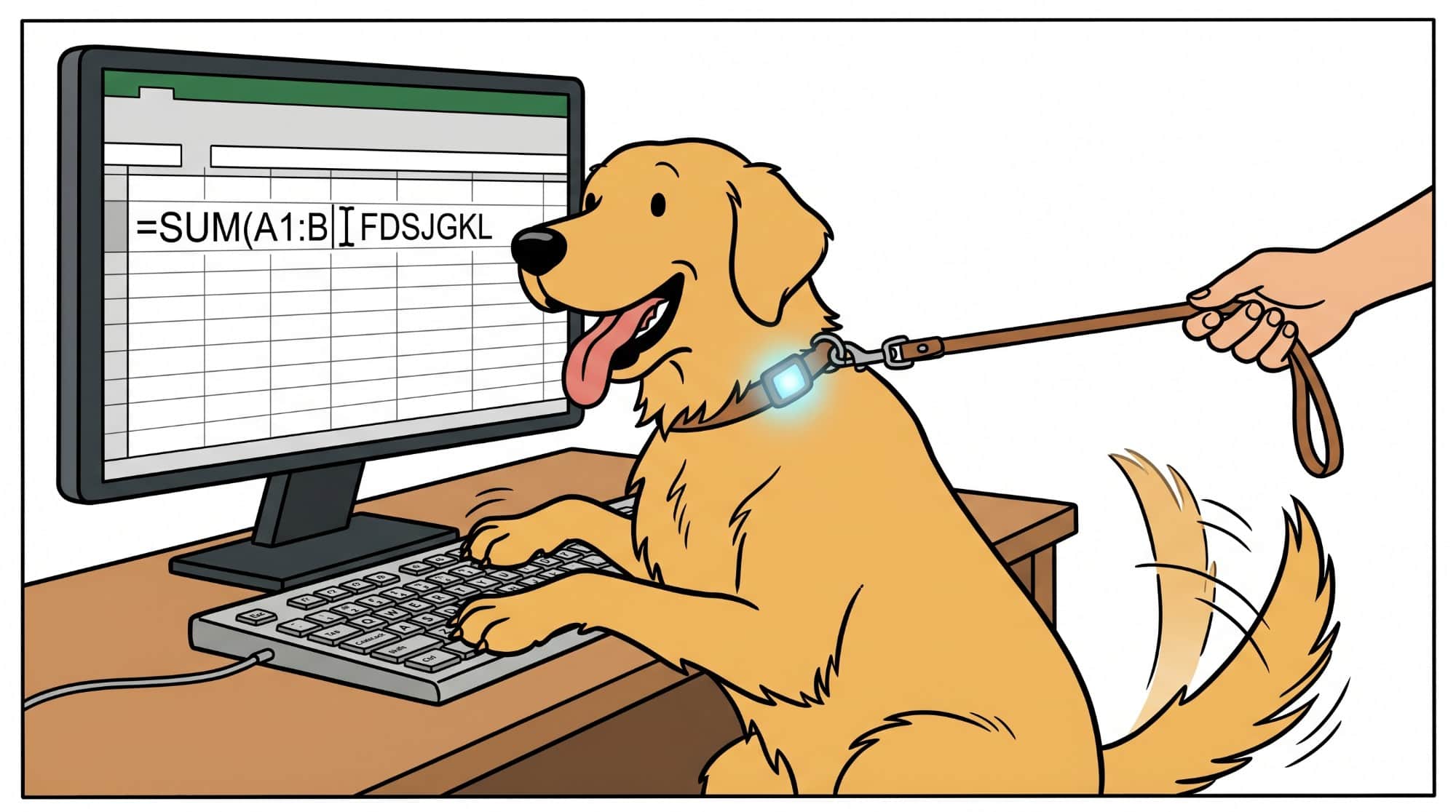
The eager assistant typing a formula it doesn't actually know — and the hand on the leash.
Not here. If the agent quietly "improves" the return-on-invested-capital formula — reaches for net income, say, where Phil Town's method calls for operating profit after tax — nothing falls over. No test goes red. The app still returns a number, in the right font, with a confident little verdict beside it. It's just the wrong number. And a wrong number in this app doesn't annoy you. It tells you to buy something you shouldn't, or to walk away from something you shouldn't, with your actual money. The mistake stays invisible right up until it's expensive.
So I built the whole thing around one rule: doctrine wins. When the machine's idea of a formula disagrees with Phil Town's published method, Phil Town wins — every time, no matter how clever the machine's version sounds. Every formula has to trace back to a source: his method, the original spreadsheet, or a decision I made on purpose and wrote down. Never the agent's own bright idea.
There's a note in the project now, half to myself and half to whatever agent touches it next: if you "tighten" a formula by re-deriving it on your own, that is not an improvement. It's a silent error, and it ships straight into someone's portfolio.
That's the leash. The AI does the typing, the fetching, the assembling — the hour of grunt work the spreadsheet used to cost me. What it does not get is a vote on what's true. The method is Phil Town's. The judgment is mine. It's the fastest, most tireless research assistant I've ever had — and, like any good assistant, it is not allowed to sign the checks.
And so far, I did the easiest bit, the numbers, the math. Yes, you heard me right, the math is the easiest bit. Answering those questions, questions such as, "how well do I understand this business?", "if it is well priced, why?", "it crashed, can it survive?", "the management changed, can I trust its new structure and people?". Those are the hardest questions, and ensuring you answer them well is the whole point of this tool.
Why I'm not selling it
People find it strange that I don't plan to sell this. We've been trained to believe the point of building something is to sell it to as many people as possible.
But I didn't build it to get rich. I built it because I wanted it to exist, and because I wanted to hand something genuinely useful to the few people I care about — my wife, a handful of friends — and watch it help them make a calmer decision with their money. That's the return I'm actually after. If I ever open it to a wider audience, it'll start here — in this microcosm.
And there's a small symmetry I only noticed at the end. Value investing is one long lesson in patience: you buy, and then you wait, for years, and you don't flinch when the screen goes red. Building this turned out to be the same lesson in a different room — eight years of wanting it, months of slow evenings, and a hundred small arguments with a machine about whether it was allowed to be clever. You don't get the good thing by rushing it. You get it by knowing exactly what you want, refusing to overpay for it — in money or in shortcuts — and then waiting, patiently, until it's actually right.
One ask before you close the tab: should I make this available to people — and would you want in when it opens? It's one click. I'm not expecting a crowd; I'd just like to know if anyone's out there. I'll report back what you said.
Sources
- Rule #1 investing — Phil Town. (The method described here — own a wonderful business for the long term, the growth-and-returns checks, margin of safety, sticker price — is Phil Town's published Rule #1 approach, from his books Rule #1 and Payback Time.)
- Value investing — Wikipedia. (Benjamin Graham and David Dodd at Columbia — Security Analysis, 1934; the "margin of safety" principle is from Graham's The Intelligent Investor, 1949; popularized by Warren Buffett — long-horizon ownership, distinct from short-term trading.)