Not a Discount. A Different World.
By Conny Lazo
Agentic Engineer. Project Manager. Shipping software with AI agents.
For months now I've been writing the same sentence in different costumes: the roles are compressing.
I'll spare you the essay this time — I've made the case enough, most recently in one I only put on LinkedIn. The program manager, the product manager, the person who used to own one slice of the work: that slice is eating the rest of the plate. You've heard me. So let me show you the part I haven't.
I'm building a one-person company. In my evenings, mostly alone — and, I'll be honest, having more fun than I've had in years. You don't get a smaller job. You get the whole company.
The whole company is one chair now
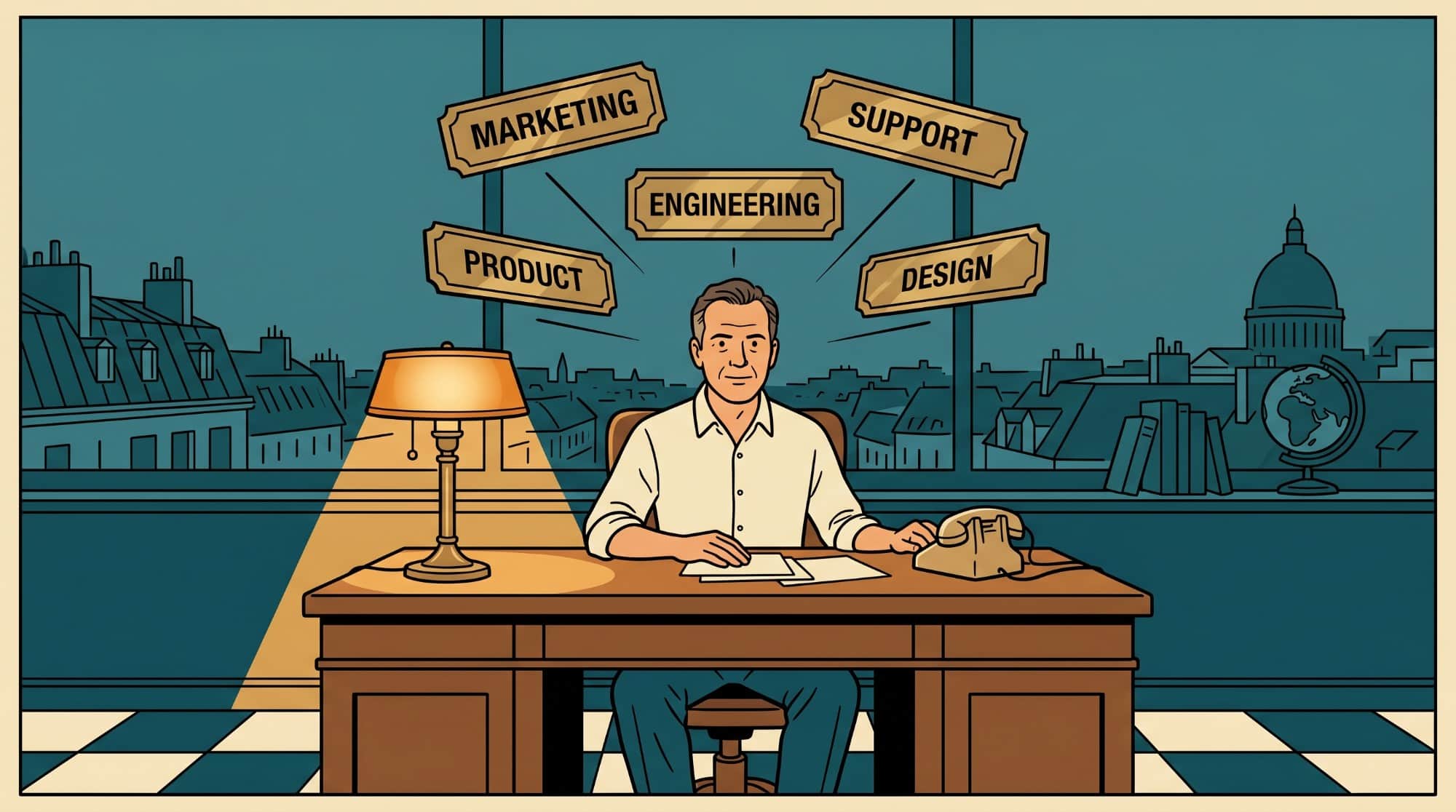
Here's the shape of it. The old org chart had a box for marketing, a box for product, a box for the person who writes the code, a box for the person who fixes it at two in the morning, a box for support. Those boxes are collapsing into one chair. Mine, for instance.
You've probably seen the forecast everyone quotes — Gartner, something like 80% of project-management work run by AI by 2030. I wouldn't lean on it too hard; it's a 2019 guess, and it was really about the clerical grind — the status reports, the chasing, the spreadsheet hygiene. But the direction is right, and I don't need a forecast to see it. I'm living in it.
So a couple of years from now, when you hire, you won't be hiring a project manager. You'll be hiring someone who can put up the landing page, ship the feature, catch the bug, answer the customer — and build the handful of agents that lets one person do all of it. The question stops being have you managed a team? It becomes can you build one?
Quick receipts
I don't trust manifestos either, so — receipts.
I've been building these things non-stop for a while now. The first was an engine for writing software with these machines; I called it Orchemist, pushed it to see how far the idea would go, watched it fall over, open-sourced it anyway, and moved on. I've heard, secondhand, that a couple of companies actually run it. I don't. For me it was buggy, and by the time I'd have fixed it I'd already rebuilt its brain as a set of skills for Claude Code that just work — so I'm in the slightly absurd position of having shipped a tool I don't use, that other people apparently do. Somewhere in there I wrote a book, then built a thing to translate it, because of course I did.
The how — the loop with an opponent in it, the reason I'm not stuck with any one model — I've written into the ground already, here and here. This piece isn't about the how. It's about one number.
The number
The thing I'm building right now is a value-investing tool — the slow, Buffett kind. The whole point of it is to answer the hard questions about a company reliably: is this a business you'd want to own for ten years, does the management actually care about its people and its shareholders, the questions that are easy to ask and hard to answer honestly. That matters to me because these machines are right maybe eighty percent of the time and confidently wrong the other twenty, and almost everything I build is really an attempt to pin down what's actually true.
Here's the number. A few years ago, building this would have meant a small team — five or six people, a designer, a couple of coders, someone to argue with — plus tens of thousands of euros before anyone wrote a useful line, and a year of waiting on other people's calendars. I'm doing it alone, on a hosting plan that costs about as much as lunch, for a couple of thousand euros and my evenings.
That's a big difference. Not a discount — a different world. The reason one person can suddenly own the whole thing is that owning the whole thing got cheap. The job didn't shrink. The price of doing all of it did.
The irony, and I own it
And yes, I hear the joke in it. I'm building a calm, long-term investing tool while I'm convinced — genuinely convinced — that a very large crash is coming. I told my wife back in 2024: 2026 is the year the floor gives out. Here we are. I think there's going to be blood everywhere before it's over. And I'm pouring everything into the calmest thing I can build, aimed straight at the loudest year I can imagine. The irony sits with me, of course. I'm building it anyway.
The part nobody puts in the pitch
I want to be honest about the heavier part, because the cheerful version leaves it out.
I've already written what I think about the backlash, so I won't go through all of it again — the short version is that this technology is genuinely magical, and it got handed to the world in close to the worst way it could have been, by some of the greediest people in it. The tool isn't the villain. The people forcing it on you are.
And there's a real cost coming. A lot of jobs will go. That isn't the market quietly fixing itself; it's a bill, and somebody has to decide who pays it. I think that's on governments, and I think retrain and good luck isn't going to cover it this time. I don't have the answer. I just don't think we get to pretend the question isn't there.
But here's what I actually believe, underneath all of it — and it's the hopeful part. This thing is, in a real way, the whole of human knowledge gathered up and handed to anyone who reaches for it. The question that matters isn't whether it takes jobs; it will, and it'll change far more than it takes. The question is whether we can hand it to everyone instead of letting a few people ration it out. I'd like us to figure that out together. Whatever side of this you think you're on, we're on the same boat. And if the whole thing vanished tomorrow — I'd be alright. I'd still have my wits, I'd still know how to build, and nobody can take that from me.
Why I bother
So why write any of this down? I've nothing to sell you, and I'm bracing for a crash.
Honestly, because writing in public is the only way I've found to think straight, and because every now and then someone writes back. I'm not built for the loud version of this — I got into a public scrap over one of my tools once and it rattled me far longer than it should have — so I do it quietly, on a website nobody asked for, and I wait to see what drifts in. Sometimes a reader. Sometimes a better argument than the one I started with. Maybe, one day, the thing I'm actually after: work where I get to do exactly this, out in the open, next to people who get it, with the time these things honestly take.
A word about where I stand, since I've been throwing euros around. I'm not rich. I'd call myself wealthy, which I've decided is the better word — not broke, a little set aside each month toward a house, a modest salary, and I sleep fine.
Sources
- Groundhog Day, AI edition — Conny Lazo, connylazo.com, May 2026. (The per-step adversarial loop — challenger / implementer / reviewer, fresh context each pass — and the value-investing tool it builds.)
- Your Friends Just Downloaded Claude. They're About to Use It Wrong. — Conny Lazo, connylazo.com, March 2026. (Why the framework, not the model, is the moat — and why a price hike wouldn't strand the work.)
- The Backlash Is Right About the Wrong Things — Conny Lazo, connylazo.com, May 2026. (Magical tool, worst possible delivery; the tool isn't the villain.)
- Digitalization's Impact on PPM Practices and the PMO by 2030 — Gartner, 2019. (The source of the widely-quoted "~80% of project-management tasks run by AI by 2030," scoped to clerical/administrative PM work — data collection, tracking, reporting — and framed as a shift in the work, not wholesale job loss. Cited here lightly, not as a precise prediction.)