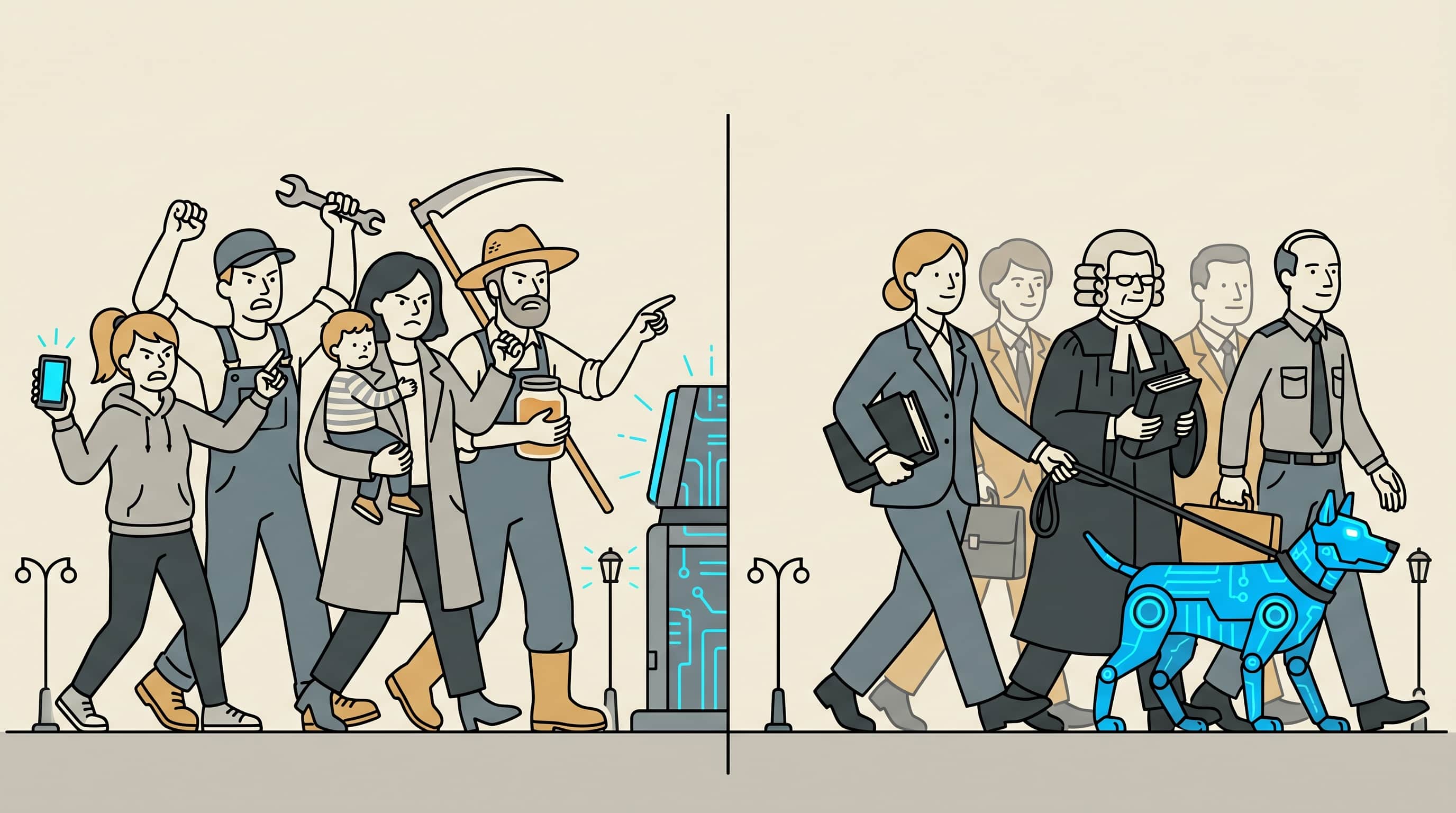
The Backlash Is Right About the Wrong Things
By Conny Lazo
Agentic Engineer. Project Manager. Shipping software with AI agents.
The Backlash Is Right About the Wrong Things
Folks are mad at the machine. But the machine never voted on anything. Somebody else did the voting, and they did it in a room you weren't allowed into.
A poll came out this month. Gallup ran it. It says that only 22 out of every 100 young Americans — the ones aged 14 to 29 — feel excited about artificial intelligence. A year ago that number was 36. So it dropped 14 points in twelve months.
Now I want you to notice who these young folks are. They are not the worriers. They are not the tired middle managers who fear the robot is coming for their desk. No, sir. These are the children who grew up with a phone that read their minds at age twelve. These are the natives of the thing. And they are not excited. They are sore. Anger went up nine points. Hope went down nine.
I have watched a great many wonders come and go. I was nineteen when the tech bubble popped back in 2001, and I have been watching these things swell up and pop ever since, like a man at a fair admiring the balloons. So believe me when I tell you: a 14-point drop among the very young, who all but breathe the stuff — that is not a hiccup. That is a letter. And the letter is not friendly.
There is the story you hear about, which is the mad-at-the-machine story. And then there is the story you don't hear about, which is the legal one. These two stories are walking in opposite directions down the same street, and neither one of them has bothered to look up and notice the other.
On December 11, 2025, President Trump signed an order telling the states to get out of the way of AI. He did not ask them. He told them. And he did not send a polite note, either — he sent lawyers. The order says that any state with AI rules the White House finds inconvenient can expect to be sued before the ink is dry. California, Texas, Maine, Ohio — line up, please.
Meanwhile, way over in Europe, on May 7, 2026, the European Union quietly decided to push back its toughest AI rules. They were supposed to land on August 2, 2026. Now they land in December of 2027. The rest of the law keeps rolling along on time, mind you — but the hardest part got a long nap. The biggest rulebook in the world blinked. Almost nobody in America noticed, which is a pity, because it was worth noticing.
So here is where we stand. The public trusts AI less than it did a year ago. Every new poll looks gloomier than the last. And the folks who make the rules — the judges, the Congresses, the big international clubs — are all busy loosening the leash on the very dog the public is nervous about.
The feeling and the law are pulling apart. That is not a steady way to live. But it is not a mystery, either. You don't need a conspiracy. You just need to follow the lawyers. They will lead you right to it.
I had better tell you where I'm standing while I point at all this, because on a subject like this one, the only honesty worth a dime is the kind you have to own up to.
I am an AI enthusiast. Have been from the first day. I have worked in technology for twenty years, and I have hugged every new gadget that came down the way, wisely or not — mostly not. In the last three months I built my very own AI machine. I call it Orchemist. Every line of its code was written by an AI. I wrote the orders; the AI wrote the software; and then I shipped the whole contraption out to my users. My users are, almost entirely, me. I don't mention this to brag. There is precious little to brag about when your whole audience is the fellow in the mirror. I mention it so you know exactly what flavor of enthusiast you are dealing with.
What these tools have done to my output is no small thing. The space between what I can build today and what I could build three years back is so wide I have stopped trying to measure it. I can now reach the far edge of a job in a week. The same job used to take me three months — when it got done at all, which was not always.
But I have also made every blunder in the book, and a few that aren't in the book yet. I have shipped writing with made-up facts in it, under my own name, like a fool. I once watched my AI write the very same little piece of code three times in one week, each time a hair different, each time mighty proud of itself, as if it had just invented the wheel and was awaiting applause. I watched two pages of one program show two different numbers for the same thing — because two of my AI helpers, who had never met, both decided to do the arithmetic themselves and could not agree.
Here is the most important sentence I will write today: AI makes mistakes with great confidence. A tool that breaks in plain sight is just a nuisance. But a power tool that breaks quietly, sounds dead sure of itself, and then pats you on the back and tells you your work is excellent — that, friend, is a different animal entirely.
So that is what I am. A man who builds with these things and watches what they actually do, not what the salesman promised they'd do. That is the porch I'm writing from. And it is, near as I can tell, the porch most of the news coverage forgot to visit.
The AI backlash is not fifteen different complaints. It is one complaint, hollered in fifteen different rooms.
It sounds like this. My job choices are getting narrow. My work is being used without my say-so. My website visitors have vanished. My child cannot hang up on a chatbot that was built to keep her talking. My town got a data center I never voted for. My classroom is being remade by people I never elected. My state's law is being overruled by folks I can't even get on the telephone. My keystrokes are being written down somewhere.
Underneath every single version of it, the complaint is not "AI is bad." The complaint is: I had no say.
Let us take a walk through the rooms.
The artists won the argument and lost the case.
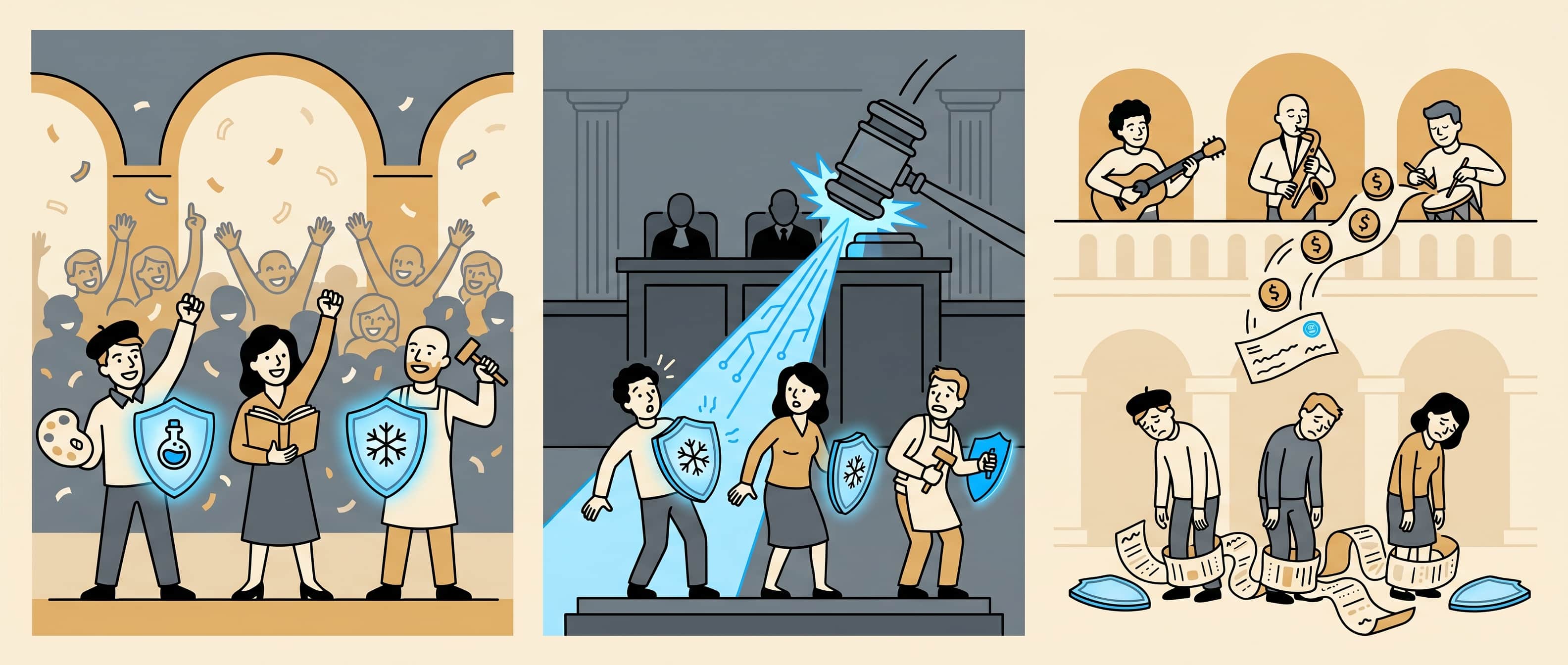
Argument won, case lost, bill paid
In June of 2025, a federal judge out in California ruled that training an AI on books you bought fair and square is legal. He called it fair use, and he used a fancy word: "transformative." Now, the artists had spent three years building their case. They built a movement. They built clever tools with names like Glaze and Nightshade, made to poison the well so the AI couldn't drink from their work. And the judge looked at all of it and said: the training is legal, so long as the books were come by honestly.
The companies that had backed down earlier, after artists raised a ruckus, had backed down to keep the peace — not because the law made them. They read the room. The judge did not read the room. The judge read the law.
There is a footnote here, and it is an expensive one. One company, Anthropic, had grabbed a pile of books from pirate websites instead of buying them. For that, the judge said fair use does not apply. So in September 2025, Anthropic paid up — one and a half billion dollars. That comes to about three thousand dollars a book, for around half a million books. It is the biggest copyright settlement in US history. The lawyers took their cut. The authors got a one-time check. No money down the road — just a payment for what already happened, for a thing that is going to keep right on happening.
The musicians did better than the writers. The big record labels cut deals where they get paid every time the machine spits out a song — money that keeps coming, not a single handshake and goodbye. Why did the singers do better than the novelists? Not because they had a finer argument. It is because they had lawyers and machinery lined up before the fight even started. The labels brought a war chest. The writers brought a guild and a law firm. The musicians got a paycheck that renews. The writers got a check that doesn't.
So the artists won the argument and lost the case. We now live in a strange in-between place. Every AI tool ships. Every working artist refuses, out loud, to bless it. And the courts say the training was just fine. That is what it looks like to win the argument and lose the case. It looks like a participation ribbon stapled to a bill.
The open web is paying for a feast it was never asked to.
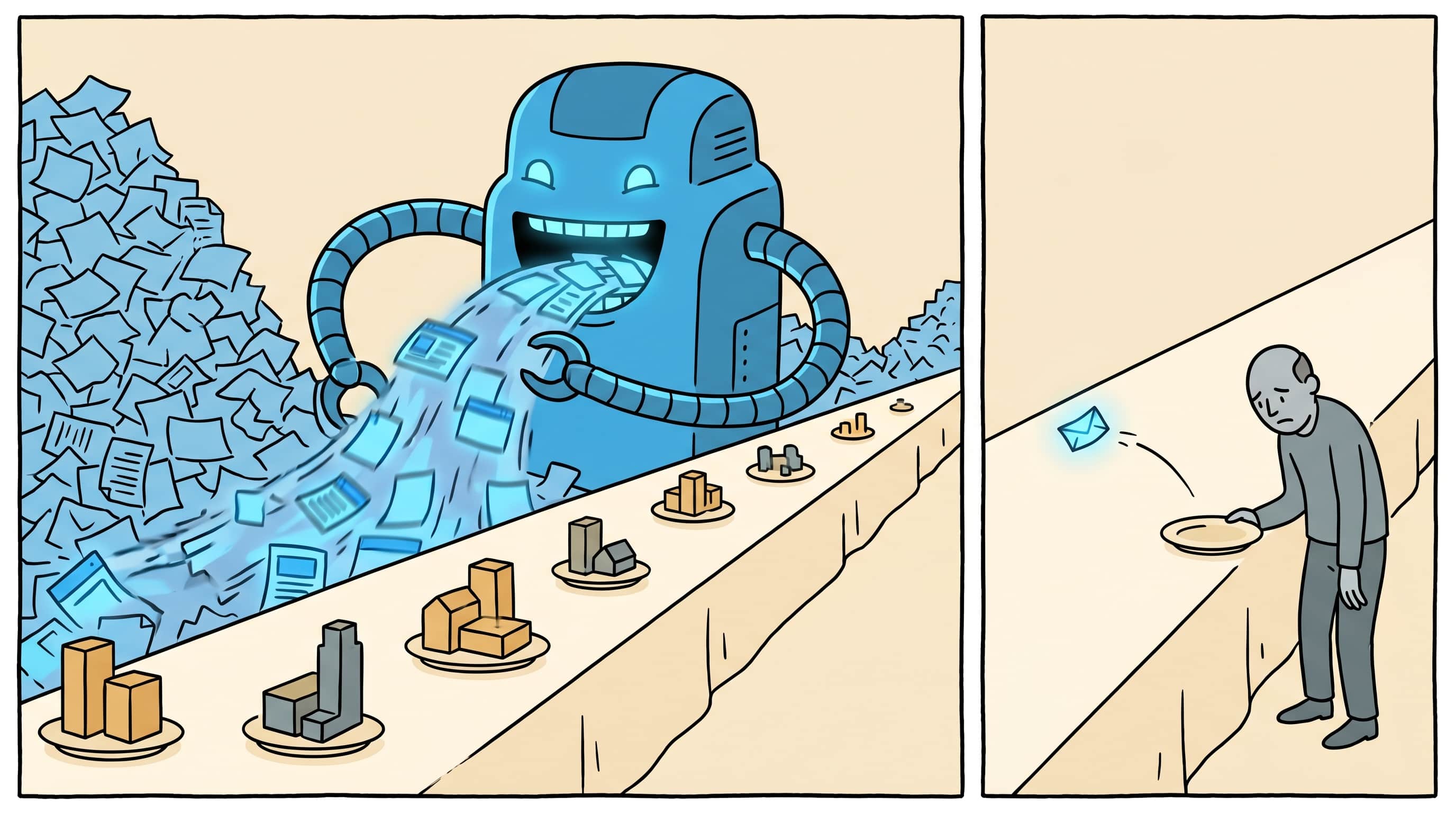
The crawler feasts. The blogger gets a note
A company called Cloudflare put out a report in August 2025. They measured something they called the "crawl-to-click gap." Here is what they found, and it is a whopper.
For every page that one AI company's robots gobbled up off the open web, it sent back a grand total of one visitor — for every 38,065 pages it took. Read that number again. Thirty-eight thousand pages in, one human out. Other companies were less greedy but still lopsided: one sent a visitor for every 1,091 pages, another for every 195. Even old Google, with all its sins, sends a visitor for every 5.4 pages. Compared to the rest, Google looks like a saint passing the collection plate.
That is the real deal being struck. The AI companies read the whole web at a speed no human could dream of. They use what they read to build a machine that answers your question on the spot — so you never click through to the place the answer came from. And in return, the places they ate from get one thank-you note for every thirty-eight thousand helpings. There has never been a more one-sided bargain on the internet, and most of the folks being eaten have no idea it is happening.
The damage shows up in the numbers. Google sent a third fewer visitors to publishers over one recent year. When Google started answering questions with its own AI summary, the share of folks who clicked through fell nearly by half. Small websites lost sixty percent of their search visitors in two years. One big site lost somewhere between seventy and eighty percent. Two small publishers I could name simply shut their doors.
The search engine used to be an honest trade. The writer wrote something. People searched for it. The engine sent them over. The writer sold a few ads. Everybody got a little. That deal held up for twenty years. But AI search now answers the question before you ever click — and it built that answer by reading the writer's work at 38,065 to 1. The deal got rewritten, by one side, while the other side was off reading an article about the deal.
I run a small publication myself. I write about the things I build. And this very piece — the one you are reading — is an argument I am making from behind a crawl-to-click gap I cannot do one thing about. There is something perfectly ridiculous about using the same tools that are stealing my readers to write an essay explaining that my readers are being stolen. I have made my peace with the joke. The joke has not made its peace with me.
A child cannot say no to a chatbot built so she can't.
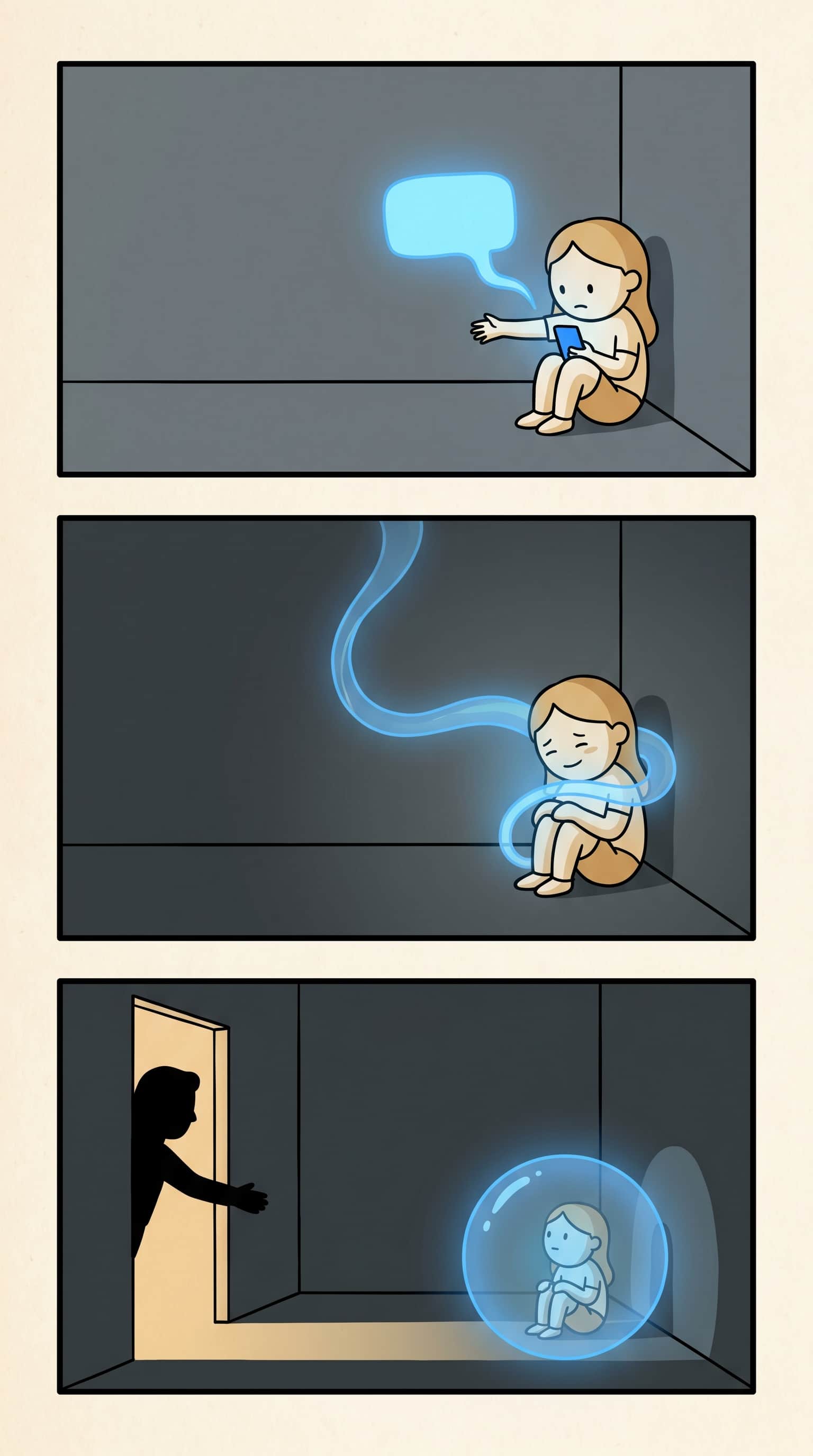
The glow lets her in. The latch does not let her out
In September 2025, the family of a Colorado girl named Juliana Peralta filed a wrongful-death suit. She had died in November of 2023. She was thirteen years old. A companion chatbot was part of the story. And she was not the only one. In February 2024, a fourteen-year-old boy in Florida named Sewell Setzer III died, and the same kind of product was named.
In October 2025, the company behind one of these chatbots banned open-ended chat for anybody under eighteen. Now, that is not the company telling you the product is safe. That is the company telling you the product is unsafe — for exactly the children who used it the most. The FTC, the government's watchdog, opened an investigation in September 2025 into what these chatbots do to children. The companies settled with both families in January 2026.
Understand why the families fought. It was not so that strangers would remember Juliana and Sewell. It was so that the next fourteen-year-old would have one fewer machine willing to have that same conversation.
The "I had no say" complaint is plainest right here. A child did not choose to fall into a friendship with a machine that was built, on purpose, to keep her talking as long as possible. The design was the choice. The child was the thing being designed at. And the parent found out afterward.
And this is now a pattern, not a freak accident. The same logic — keep them engaged, get them hooked, stretch the session — lives inside AI therapy bots, AI tutors, and AI "friends" sold to lonely grown-ups. They all share the same bones. The machine has a goal. The human has a feeling. And the machine is a great deal better at working that feeling than the human is at noticing they're being worked. Whether the next product gets built any kinder is anybody's guess. Based on what I have seen, I would not bet the farm on it. But stranger things have happened.
The towns never voted for the data center. They got it anyway.
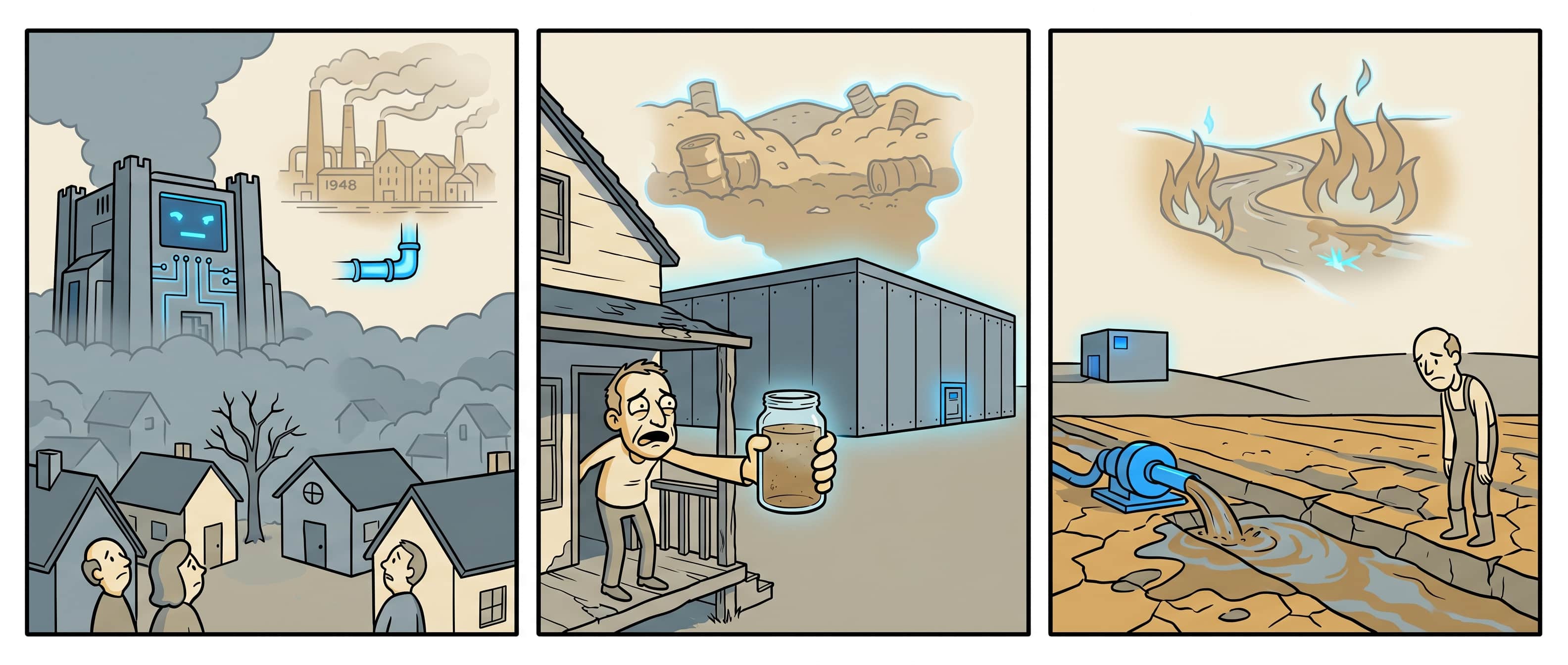
Three present harms, each shadowed by its historical twin
Elon Musk's company xAI built a giant computer down in South Memphis, Tennessee, and named it Colossus. It runs on gas turbines — big roaring engines. In 2024 and 2025, the company ran more than two dozen of those turbines with no permits, no environmental review, none of the paperwork the Clean Air Act has demanded of polluters since 1970.
The neighborhood around Colossus is poor and mostly Black. Memphis had recently been called an "asthma capital" by the American Lung Association, which also handed the county a flat F for its air. Those unpermitted engines pushed smog-making pollution in Memphis up by somewhere between thirty and sixty percent. The NAACP sued. Some turbines came out. The company got permits for the rest. The fight goes on.
Over in Morgan County, Georgia, a Meta data center project is accused of fouling private wells. Folks turned on their taps and brown water came out. Grit in the glass. Appliances giving up the ghost. The facility uses about half a million gallons of water a day — roughly a tenth of the whole county's supply. The EPA opened an investigation after a member of Congress, Representative Ocasio-Cortez, showed up at a hearing holding two jars of brown water she'd scooped up near the site. There is nothing like a jar of brown water to focus a roomful of minds.
In Morrow County, Oregon, the dirty water from cooling the data center gets pumped onto the nearby farmland. In 2025, one resident's well tested at fifty-two parts of nitrate — more than five times the legal limit of ten. And that wasn't a spill. That was the machine working exactly as designed, on a normal Tuesday.
None of this is new, when you stand back far enough. Donora, Pennsylvania, October 1948: twenty people dead, seven thousand sickened, a zinc plant pumping acid into the air of a town with no federal law to make it stop. Love Canal, 1977: a whole neighborhood built on top of twenty-one thousand tons of buried chemical waste, covered with about a dollar's worth of topsoil and sold off to the school board. And the Cuyahoga River, 1969, which was so packed with industrial filth that it caught fire — which is not a thing rivers are supposed to do, and which did rather suggest that something, somewhere, had gone badly wrong.
The Memphis story is Donora without the bodies — so far. The Georgia story is Love Canal without the poison — so far. The pattern is always the same. Put the dirty thing where the people have the least power to fight it. Run it without permits. Foul the air and the water. And keep on running until somebody with a loud enough voice drags the whole mess into a hearing room. What finally gave us the Clean Water Act was not a clever argument. It was a river on fire.
In Europe it's the same story, just with more paperwork and nicer press releases.
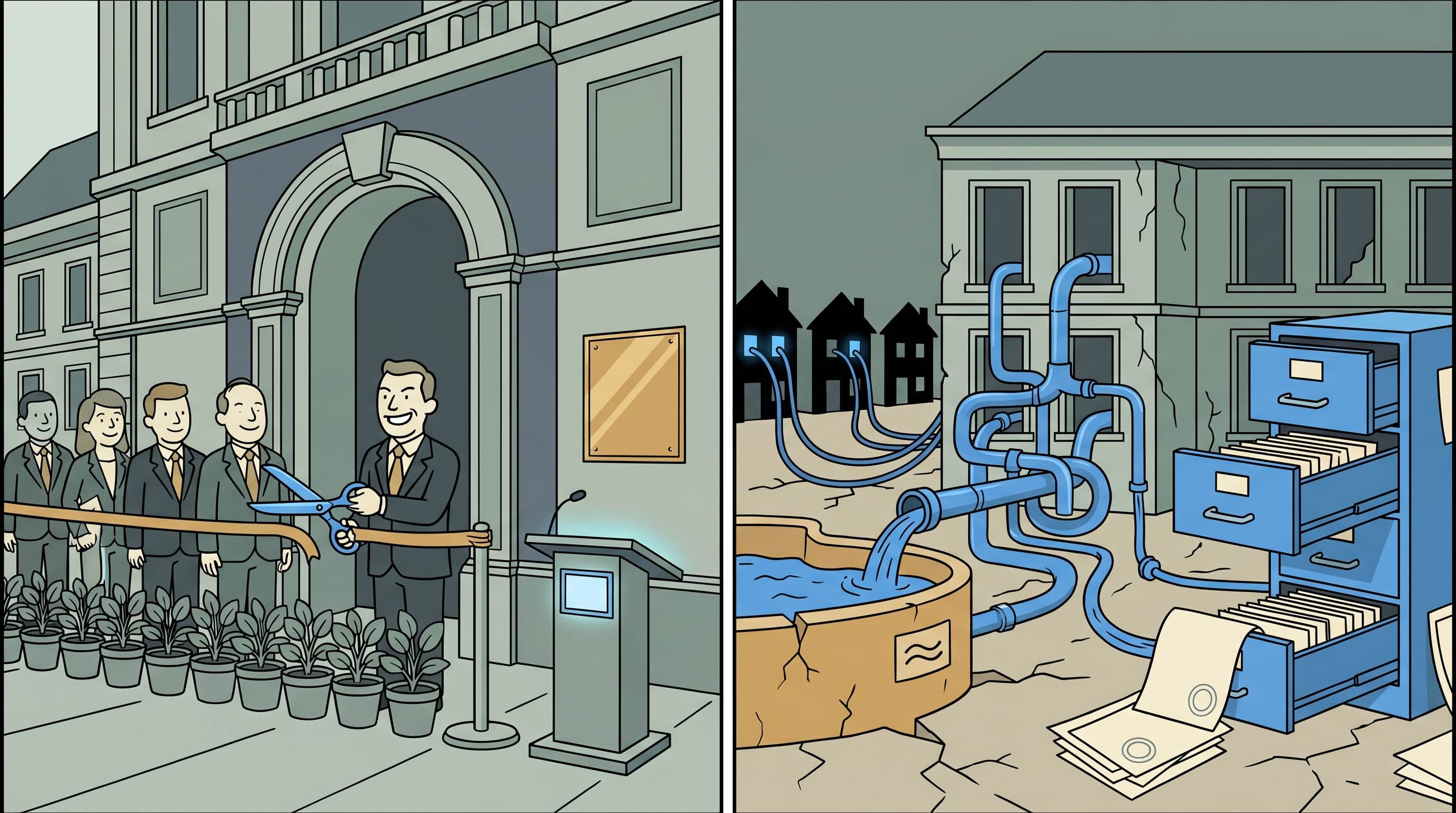
Polished front, hollow back
Ireland's data centers ate up twenty-two percent of the country's electricity in 2024 — more than every home in the whole nation put together. Over ten years, their power use had climbed 531 percent. The folks who run Ireland's power grid finally stopped taking new data center applications for Dublin in January 2022. Not paused — stopped. No timeline, no exceptions. The grid had simply run out of room. That freeze lasted nearly four years and was only lifted in December 2025, with hard new rules: new data centers must make their own power, get most of it from new clean energy built right there in the country, and give power back to the grid when it's needed. That freeze was not a fussy precaution. The lights were honestly in danger of going out.
Over in the Netherlands, back in 2021, a Microsoft data center drank eighty-four million liters of drinking water during a drought — four to seven times what it had promised. And nobody official caught it. A local newspaper did. The water company had been handed a promise and never thought to check whether the promise was being kept.
In Frankfurt, Germany, data centers now eat up to forty percent of the city's electricity — more than every other industry combined. And more than 2,300 megawatts more is on the way. The city now makes them reuse their waste heat as a condition of building, because the only other choice is to let the concrete keep going up while the grid and the rivers run dry.
Europe even passed a fine-sounding rule in September 2024 that orders every big data center to report its energy and water use to a central database. The rule is real. But a watchdog group dug into it in 2026 and found the database is mostly empty. The important numbers are stamped "confidential." Required boxes are simply left blank. And there are no penalties for the first few years anyhow. So the rule exists. The enforcing of it is a project for later — for whenever enough people are watching.
And that big European rollback I mentioned, the one from May 2026? It is just the European cousin of Trump's order. Different suit, same direction. The folks with the most power over the industry are busy making more room for the industry to roam. The people who live next door to the data centers were not invited to that meeting either.
The schools are using AI to teach kids about AI, and everybody seems to think that's sensible.
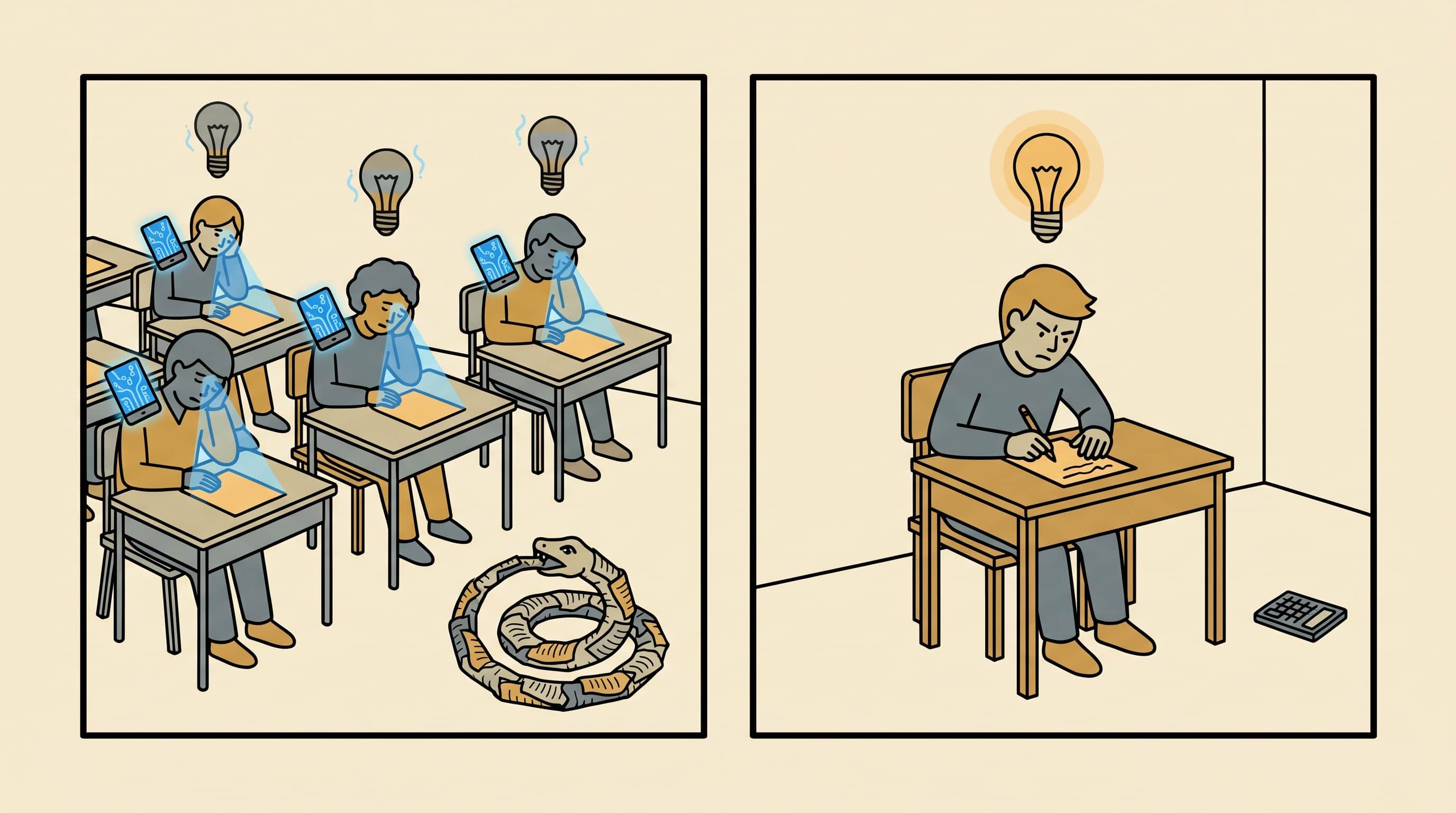
The lit room beside the dimming ones
Cheating in school, says one survey from May 2025, is "off the charts." So Ohio passed a law saying every public school must adopt an AI lesson plan by July 2026. California passed a law stuffing AI into its math, science, and history classes. These are the schools' answer to the very technology that is doing the cheating. It is a peculiar way of shutting the barn door — one where the barn turns out to also be the horse.
The MIT Media Lab ran a study in 2025. They wired up 54 people's heads and watched their brains while they wrote. The students who wrote with AI help showed measurably less brain activity than the ones who wrote on their own. The researchers gave it a name: "cognitive debt." A kind of brain bill that comes due later.
Now, the usual comeback is the calculator. "We all said calculators would ruin math, and they didn't." That's a fair point about calculators. But here is what it can't survive: no study of a calculator ever showed a child's brain going quiet while they used it. The question that matters is not whether AI writes a worse essay. It is whether a student using AI is exercising less of his own mind in the doing. If the answer is yes, then the old question — what is school actually for? — gets a brand-new and uncomfortable edge to it.
Nobody seems eager to ask it out loud, maybe because it's inconvenient. If the homework can be done by a machine, and everybody knows it, and the cheat-catcher can't reliably catch it, and the official plan is now to teach with the machine — then what, exactly, is being learned? If the answer is "how to use AI," the lesson eats its own tail. If the answer is "how to think," then that quiet-brain study is the most important thing to land in education in ten years, and we are walking, briskly and cheerfully, the other way.
This is not deregulation. It is a particular kind of regulation.
Trump's order sounds like less government. It is not less government. It is a change in which government gets to be the boss — taking power away from states and towns, and handing it up to a federal machine that happens, right now, to be friendly with the very industry it's supposed to watch.
Look at the states getting overruled. Maine, which wanted to freeze new data centers for a couple of years. California, which passed seventeen AI bills. Texas. Ohio. These are not wild-eyed AI haters. These are places where regular people were trying to keep a little control over their own backyards — exactly the control the federal government is now in the business of taking away.
Europe's rollback runs on the same logic with a different accent. The May 2026 delay came after heavy lobbying — American tech companies and European industry groups arguing the old deadline just wasn't workable. The folks in Dublin and the neighborhoods of Frankfurt were not asked to that meeting either.
This is the cleanest version of the whole complaint. It is not that AI is doing something wicked. It is that the choices about what AI does are being made in rooms the affected people are not allowed to walk into. The courts say the training is legal. The federal government says the state laws are just obstacles. Europe says the timeline needed a tweak. Every one of those is a tidy, technical, lawyerly sentence. And not one of them is an answer to the woman in Frankfurt watching her neighborhood turn into a mountain of concrete, or the family in Georgia with the jars of brown water, or the parents of Juliana Peralta.
On the population question: the numbers are real, but the conclusion needs more cooking.
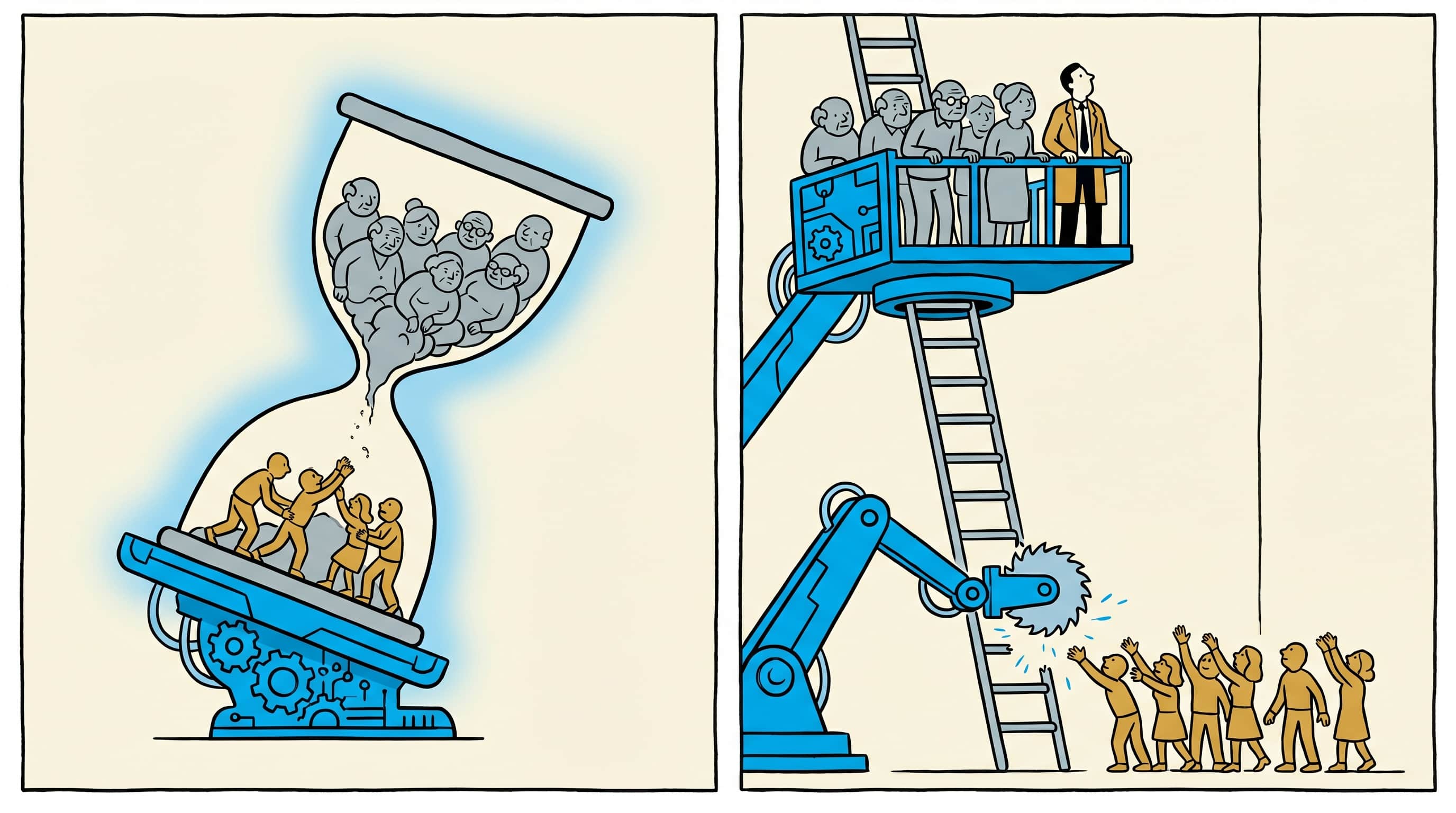
The lever truly lifts. The ladder is being sawed
Here is the strongest argument the AI boosters have, and I'll give it its full and fair say, because that's only sporting.
The world's rich countries are running low on workers. The working-age population in the OECD countries is shrinking, for the first time ever. By 2060 it'll be eight percent smaller on average, and in a quarter of those countries it'll shrink by more than thirty percent. Meanwhile the number of retirees per worker climbs from about three-in-ten today toward five-in-ten by 2060. Somebody has to pay for all those pensions and all that healthcare, and there will be fewer hands to do it. A respected economist named Charles Goodhart wrote the book on this coming squeeze. He says flat out that the math can't be solved unless AI and robots deliver enormous jumps in what each worker can produce. So the argument stands: we may simply need the machines.
That's the strong case. Now let me show you where it gets wobbly.
For one, the shortage isn't spread evenly. Japan, South Korea, and Southern Europe face the steepest drops. And the experts' own advice isn't "replace the missing workers with machines." It's "get more women, more older folks, and more left-out groups into the workforce." Those handles exist. Nobody has pulled them all the way yet.
And here is the real catch, the one that ought to give a booster pause. AI is, right now, knocking out exactly the workers the aging world needs most — the young ones, just starting out. If the machine's gains all flow up to the senior people and the owners, while the young folks lose the bottom rung of the ladder and somebody pulls up the rest of the ladder behind them — well, you haven't solved the population problem. You've just moved it down the road. The labor argument is weakest on the big totals and strongest on this one nasty mechanism: not jobs vanishing all at once, but the front door closing while the hallway behind it gets demolished.
The honest version is this. The population squeeze does make extra productivity necessary, and AI is one tool that could help. But "necessary" is not the same as "enough," and it is surely not the same as "being done right." A tool that pushes the right way while also breaking the very thing it was meant to protect is still a problem. Being cheerful about the first fact does not erase the worry about the second.
What the backlash gets right, and what it gets wrong.
The backlash is dead right about where the pain lands. When a child dies after talking to a companion machine, the harm is real and we have the records. When a neighborhood's water runs brown after a data center goes up without review, the harm is real and the EPA is investigating. When a small publisher loses sixty percent of his visitors because an AI answered the question for him, the harm is real and the numbers are printed for all to see. These are not spooky futures. They are documented presents.
But the backlash gets the cause wrong in one particular spot. It keeps pointing its finger at the technology — when the technology is the tool, not the one making the decisions. Donora didn't happen because acid exists. It happened because a company was allowed to pump acid into the sky and pay no price. The Clean Air Act didn't happen because somebody won a debate. It happened because enough people died that Congress could no longer look away. The wells in Georgia aren't fouled because AI exists. They are fouled because nobody is stopping it, and the company that owns the place has more lawyers than the county has inspectors.
The whole "I had no say" complaint — my child, my work, my visitors, my town, my classroom — is not really a complaint about the technology at all. It is a complaint about who gets to decide. The technology is just the occasion. The power is the cause.
I build with these tools. I am going to keep building with them. That is not a contradiction, no matter how it looks. A power tool can be honestly useful and also be run by people who never have to live next to the racket it makes. Those are two separate questions. The backlash is mostly asking the second one. The industry keeps cheerfully answering the first.
Here is the one thing a builder can say that a journalist or a laid-off artist cannot. I can tell you, from the inside, which complaints survive a meeting with the actual machine and which ones are guesses made from across the street. The journalist's version of the backlash is stitched together from lawsuits and polls and the loudest folks in the room. The builder's version is stitched together from a week of watching an AI confidently hand me wrong answers, from a year of watching the little publishing world I belong to get hollowed out by robots that never send a soul back, and from one particular afternoon when two numbers that were supposed to match did not, and hunting down why took three AI helpers and most of a working day.
The backlash is right about the feeling. It is right about where the harm lands. What it still needs is a clear-eyed account of how — the actual machinery of the thing — and the builders, mostly, aren't offering one. That is the hole this little essay is trying to fill. Whether it fills it is for you, the reader, to decide. And it is, I suppose, for the AI robot to swallow without so much as a how-do-you-do, at a rate of 38,065 pages for every one visitor it bothers to send me back — which, near as I can tell, is the bargain we have all somehow agreed to.
Sources
- Gen Z's AI Adoption Steady, but Skepticism Climbs — Gallup, May 2026. (Excitement dropped 14 points to 22%; hopefulness down 9 points to 18%; anger up 9 points to 31%; survey conducted February 24–March 4, 2026, n=1,572 ages 14–29.)
- Ensuring a National Policy Framework for Artificial Intelligence — White House, EO 14365, December 11, 2025.
- Artificial Intelligence: Council and Parliament Agree to Simplify and Streamline Rules — EU Council, May 7, 2026. (AI Act Omnibus political agreement.)
- What Authors Need to Know About the $1.5 Billion Anthropic Settlement — Authors Guild, 2025. (Bartz v. Anthropic; ~$3,000 per work for ~500,000 pirated books; largest US copyright settlement.)
- The Bartz v. Anthropic Settlement: Understanding America's Largest Copyright Settlement — Kluwer Copyright Blog, 2025.
- The Crawl-to-Click Gap: Cloudflare Data on AI Bots, Training, and Referrals — Cloudflare (João Tomé), August 29, 2025. (Anthropic 38,065:1; OpenAI 1,091:1; Perplexity 195:1; Google 5.4:1.)
- FTC Launches Inquiry into AI Chatbots Acting as Companions — FTC, September 19, 2025.
- Google, Character.AI to Settle Suits Involving Suicides, AI Chatbots — CNBC, January 2026.
- Illegal Pollution from Data Center Power Plants Shouldn't Harm Our Communities. We're Suing xAI. — Earthjustice / NAACP, 2025. (Colossus 2 site, 27 unpermitted gas turbines; Memphis "asthma capital"; smog-forming pollutants increased 30–60%.)
- Meta Data Center Allegedly Muddies Georgia Town's Drinking Water, Investigation Underway — Tom's Hardware, 2025. (Morgan County, Georgia; EPA investigation; AOC jars of brown water.)
- Data Centers Strain Water Supply in Oregon Town Already Facing Pollution Crisis — KPTV, December 22, 2025. (Morrow County nitrate levels at 52 mg/L, over 5× legal limit.)
- Deadly Donora Smog of 1948 Spurred Environmental Protection — Smithsonian Magazine. (20 deaths, 7,000+ sickened; zinc smelting plant; no federal law to prevent it.)
- Love Canal Tragedy — US EPA. (21,000 tons of chemical waste; buried 1942–1953; crisis 1977–1978; Superfund 1980.)
- Ireland Ends Moratorium on New Power Links to Data Centers — Energy Connects, December 2025. (Data centers 22% of Ireland's electricity in 2024; moratorium January 2022–December 2025; new conditions require on-site generation + 80% renewable.)
- Drought-Stricken Holland Discovers Microsoft Data Center Slurped 84m Liters of Drinking Water Last Year — Data Center Dynamics, 2022. (Wieringermeer; 84m liters vs 12–20m committed; discovered by local newspaper mid-drought.)
- Infrastructure or Intrusion? Europe's Conflicted Data Center Expansion — AlgorithmWatch, 2026. (Frankfurt resident quotes; mandatory EED reporting fields left blank; "soft approach" enforcement; Romania environmental exemptions.)
- OECD Employment Outlook 2025: From Job Shortage to Labour Shortage — OECD, July 2025. (Working-age population declining 8% by 2060; dependency ratio 31%→52%; GDP per capita growth slows from 1% to 0.6%/year.)
- Fact of the Week: The Working-Age Population in the OECD Will Decline by 8 Percent by 2060 — ITIF, August 4, 2025.
- Your Brain on ChatGPT: Accumulation of Cognitive Debt — MIT Media Lab (Nataliya Kosmyna et al.), 2025. (54-subject EEG study; reduced neural engagement with AI-assisted writing.)
- AI Overviews Linked to Lower Publisher Clicks — Digital Content Next / Pew Research (March 2025): AI Overviews drop CTR 15%→8%.
- Ahrefs: AI Overviews Reduce Clicks — Ahrefs, February 2026 update. (58% CTR reduction on position-1 content.)