The Clone Is the Appraisal
By Conny Lazo
Agentic Engineer. Project Manager. Shipping software with AI agents.
There is still an empty chair next to my desk. That is where the agent sits — the thing that types every line of the engine I spent four months building, while I describe what should exist and the work appears. In May I told you about that chair. I told you the uncomfortable thing it implies: that if my whole product can be described in one sentence, that sentence is also the prompt that replaces it. I put myself on the table next to everyone else and said, check my math, I am not a neutral party.
I got one thing wrong. Not the math. The room.
I wrote that warning for builders, about competitors. The villain I imagined was a rival founder reading your release notes on a Saturday morning, rebuilding your product by Sunday lunch, shipping it to eat your lunch. A clone, built to beat you. I called it the Saturday Test. I meant it as a thought experiment — a thing you do in your head, on a weekend, to find out whether your wall is real.
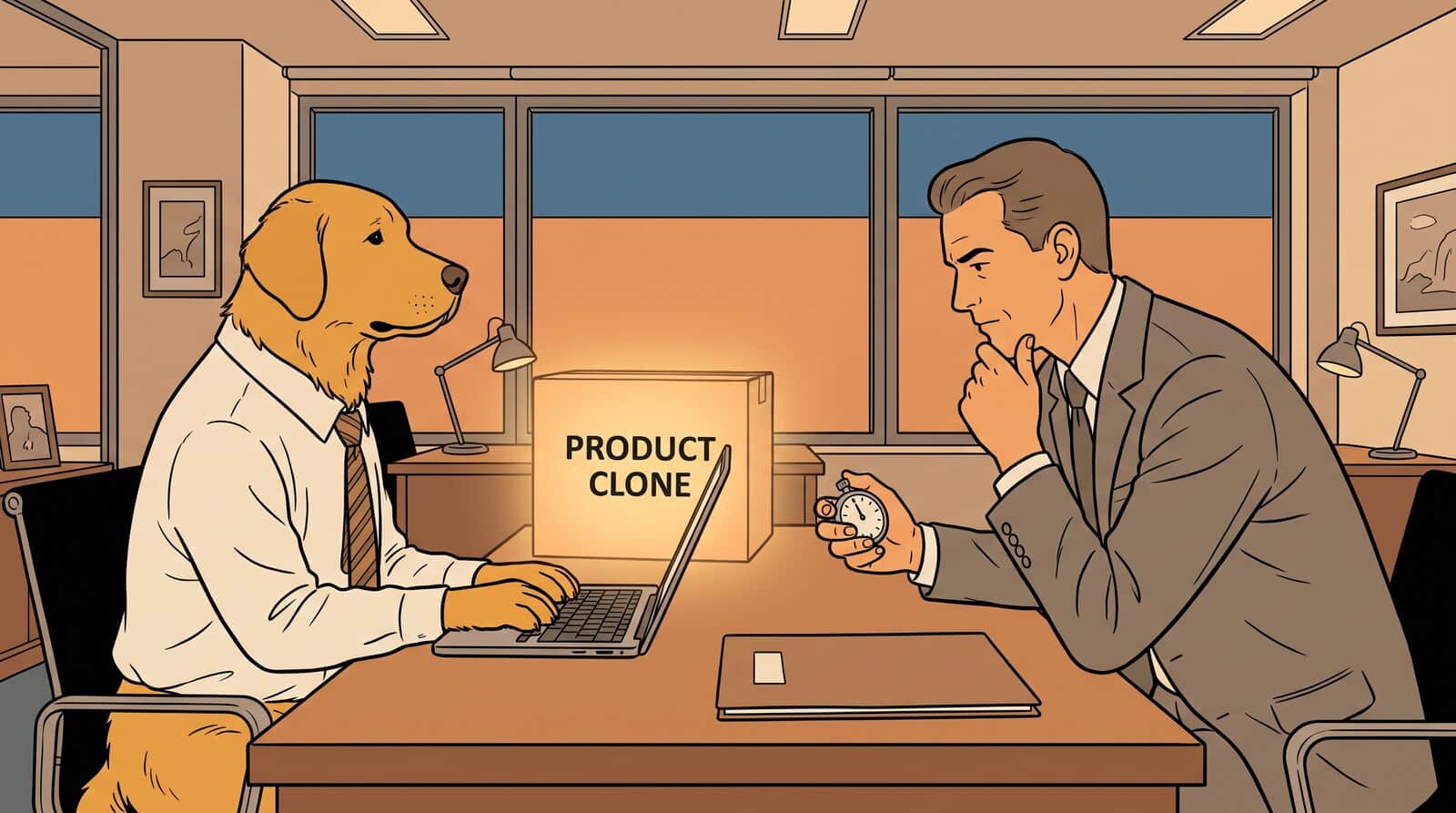
On June 22 the Financial Times reported who actually picked up the teaspoon. It was not a rival founder. It was Bain & Company — the management consultancy — building working replicas of software companies during the due diligence on whether to buy them. Vibecoded. In a matter of days. With tools that include, per the FT, AI coding agents — the same kind that types for me.
That is the thing on the empty chair next to my desk. The same agent that built my engine now sits in the room that decides what engines are worth. I did not write a warning for builders. I wrote, by accident, a spec for a billable line item in mergers and acquisitions.
So I am back on the table. My own four-month engine is exactly the kind of thing Bain would vibecode in an afternoon, with the same tool that typed it. I am not standing over this with a clipboard. Let me show you what I missed.
They're Not Cloning You to Beat You
Here is the part I got backwards, and it is not a small part.
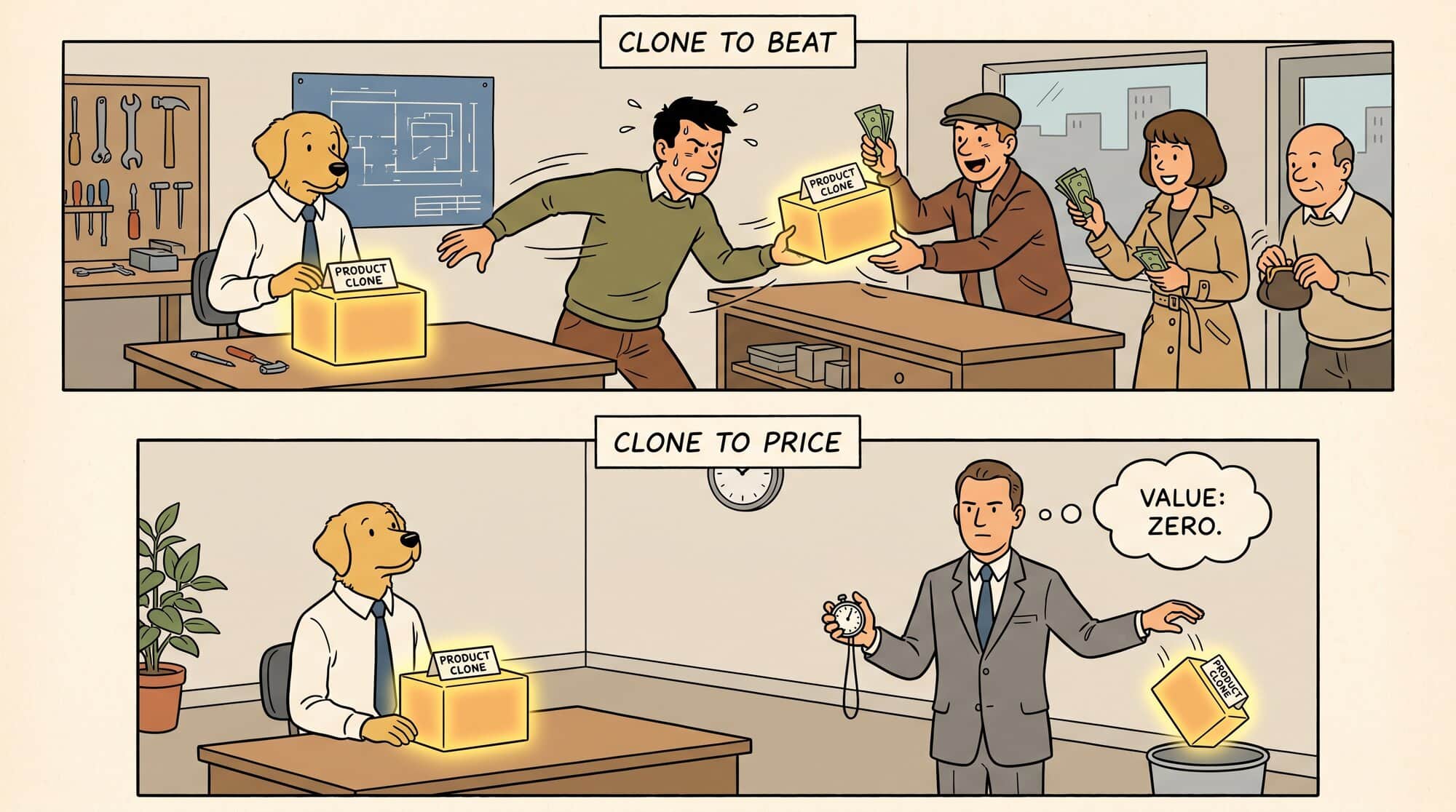
I assumed the danger was that someone clones your product and ships it — takes your customers, your market, your lunch. Clone to beat. That is the founder's nightmare, because the founder thinks of his product as a thing that competes. So that is the threat he can imagine.
Bain isn't shipping anything. The replica is never released. It does not go to market; it goes in the bin. The whole point is what gets learned in the days it takes to build it. Rebecca Burack, who runs Bain's global private equity practice, describes it as looking at a target from the outside in, and frames the value as the difference between "seeing something in 2D versus 3D". You can read a target's pitch deck and its financials — that is the 2D. Or you can have three consultants spend a week building the thing, and then you know in three dimensions exactly how hard it was to build, because you just built it.
The replica is not a competitor. It is an appraisal instrument.
And the question the instrument is built to answer is the one I should have led with in May. Burack says they use it "to understand whether it is the actual code that is the defensible part of the business or something else".
Read that again, because the second half is the whole story. Or something else. That is a person who has rebuilt enough products to know that the code is usually not the wall — that the thing you are paying for, if there is a thing, is somewhere the clone can't reach. She is not asking whether the software works. She is asking whether the software is the point. Those are different questions, and most of the money in the world gets spent answering the first while believing it answered the second.
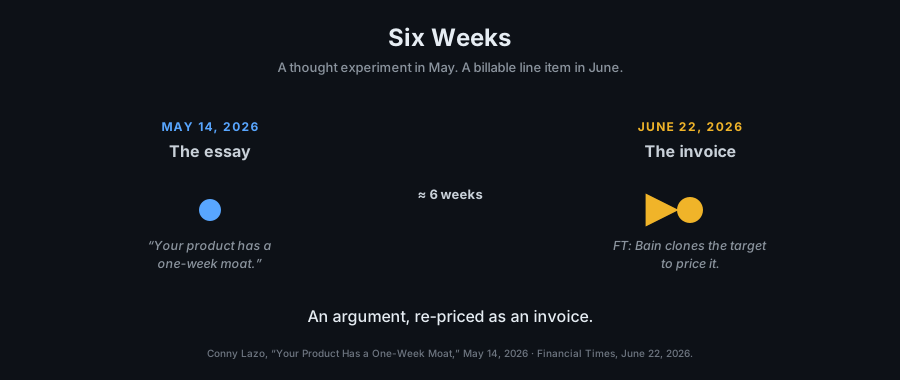
The Saturday Test was a thought experiment in May. In June it is a line item you can put on an invoice. The market did not just quietly agree my moat was a week deep. It built a stopwatch, hired some consultants, and started charging the seller to confirm it.
The Invoice Is Real
This is the part where I stop talking about my own metaphor and show you the receipts, because the difference between a clever essay and a true one is whether anybody paid for it.
Somebody did. The FT reports that a private equity firm dropped out of bidding on a software company after Bain cloned its analytics platform. Sit with the order of events. The firm wanted to buy the company. Bain built the company over a few days. The firm looked at how few days it took, looked back at the asking price, and walked. The replica went in the bin and took the deal with it.
The program is not a one-off stunt. The FT says Bain started it in 2023 with dedicated engineers, and that it has since produced hundreds of these rough prototypes — now built by regular consultants, not a special team. That is the tell. A thing graduates from a skunkworks to a standard procedure exactly when it stops being clever and starts being cheap. The Saturday Test became Tuesday's billing.
One buyer reportedly put the rule plainly: "If it's in the question box, we're not going to touch it". Meaning: if the heart of the company is a prompt — if the whole thing lives in the box where you type what you want and software comes out — then there is nothing there to buy, because anyone can type into the box. That is my one-sentence trap, read back to me by a person with a checkbook. He is not theorizing about wrapper economics on a blog. He is declining to wire the money.
And the backdrop is the market doing in dollars what I did in a metaphor. Private equity deal value in software has fallen sharply over the last two quarters. Big enterprise software companies have been re-rated hard this year, with some of the names everyone owns shedding a large share of their value. You can argue about which number is exactly right. You cannot argue with the direction, and the direction is a market re-pricing software now that it knows how cheap software is to re-type.
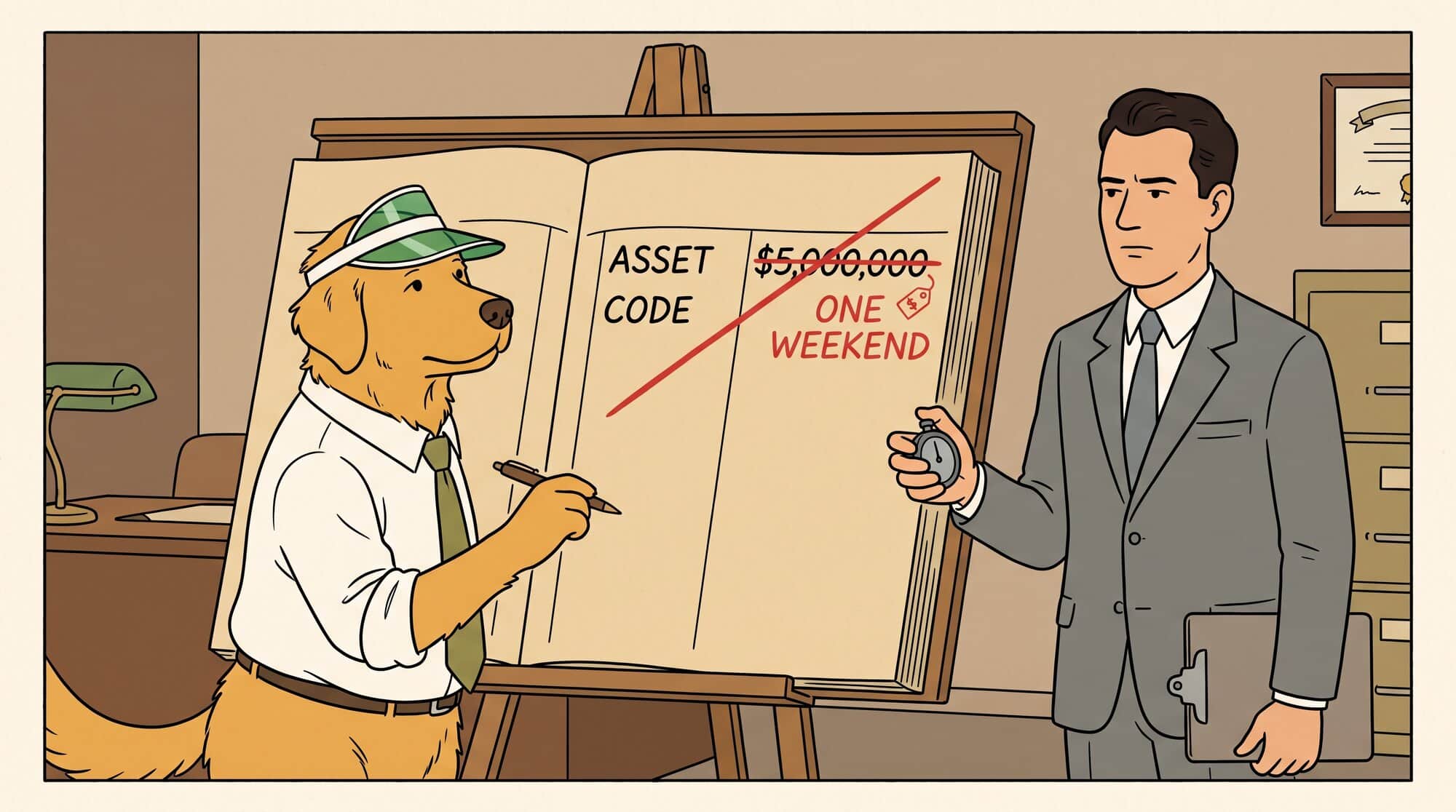
For decades, code sat on the balance sheet as an asset, because the honest answer to what would it cost to replace this was a team, a year, and several million dollars. Bain's stopwatch is the new answer — replacement cost is now a long weekend, so the asset quietly becomes a quote: the same instinct as marking a company to its fundamentals instead of its story, the same move pointed at the code.
What Survives the Inspection
Here is where the appraisal turns into something I did not expect, and where my May piece and this one finally shake hands.
The replica strips a product down to the part that can be rebuilt in a weekend. That is what it is for. But the act of stripping it has a side effect nobody designed and everybody should notice: whatever is left over, after the clone has reproduced everything it can reproduce, is by definition the part that isn't code. It is the residue. It is Burack's "or something else."
And inside that "or something else" is the only moat I left standing in May.
I argued then that four of the five moats everyone counts — trust, distribution, context, liability — are not yours; they are tollbooths you rent. The fifth, the only one that cannot be regressed to the mean or shipped as a free feature next quarter, was a point of view. Taste. Encoded intent. The gate that says no, not that, not like that when the model would happily hand you all of it. I said that was the one thing a foundation model could not average its way into, because it is the one input that was never in the training data.
Bain has now built, by accident and for money, the best instrument yet made for finding it.
Run the appraisal. Let the consultants clone everything clonable. Whatever the replica can't reproduce — the judgment about what to leave out, the specific bet about who this is for, the thousand small refusals that add up to a taste — that is the part of the residue the stopwatch can't bill against, the part nobody can buy. The appraisal that reduces your code to a weekend is, by accident, the cleanest test ever devised for the one moat that was never code in the first place. If the replica fully reproduces you, you were always a prompt, and you are now an invoice. If it can't, the gap between the replica and the original is the only thing you actually owned. The clone is the appraisal, and the appraisal measures everything except the thing worth buying.
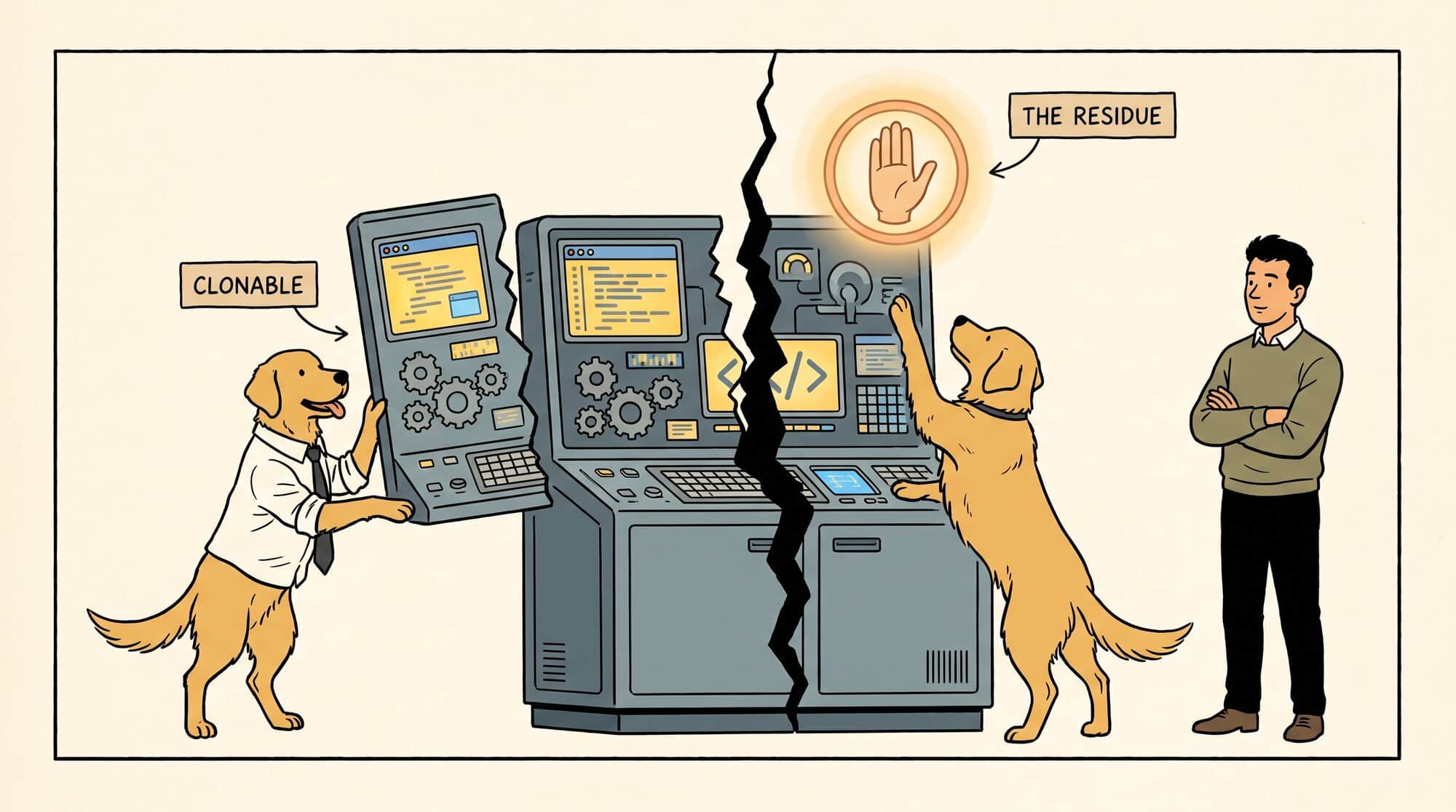
So put it on the table next to my own engine, because that is the only honest place to stand. Someone could vibecode my four months in an afternoon. With the same tool I use. They could appraise it the way Bain appraises everything else, and the stopwatch would come back with a number measured in weekends. I have known that since May; the FT just attached a bill to it.
The agent that wrote my engine now sits in the room that prices engines. It is very good at telling you what your code is worth. It is constitutionally incapable of telling you what your point of view is worth, because that number is not in the box.
Sources
- Vibecoding is becoming a deal-breaker test for software acquisitions — The Decoder, June 2026. (Secondary summary of the FT scoop; corroborates the Burack quotes, the "question box" line, and the private-equity bidder who walked.)
- Financial Times — original report (paywalled) — Financial Times, June 22, 2026. (The Bain scoop behind this piece: the Burack quotes, the 2023 origin, the "hundreds" of vibecoded prototypes, and the firm that dropped its bid. Corroborated by the secondary coverage here.)
- Bain uses AI "vibecoding" to build software replicas in PE due-diligence shift — Private Equity Wire, June 2026. (Independent corroboration of the program.)
- Q1'26 Pulse of Private Equity: US and global investment trends — KPMG, Q1 2026. (Market backdrop for the software deal-value decline.)
- Rebecca Burack — Bain & Company — Bain & Company. (Confirms her title: head of Bain's global private equity practice.)
- Your Product Has a One-Week Moat. So Does Mine. — Conny Lazo, May 14, 2026. (The piece this one answers: the empty chair, the Saturday Test, the one-sentence-is-the-prompt trap, and the four-tollbooths-and-one-real-moat survey.)