
I Wrote Intel's Comeback Story. Then I Asked My Tool What It Was Worth.
By Conny Lazo
Agentic Engineer. Project Manager. Shipping software with AI agents.
I bought Intel at twenty-five. Sold at forty, certain it would clear a hundred. Then I watched it actually clear a hundred — from the outside, with my hands in my pockets, like a guy who left the stadium early and heard the crowd roar from the parking lot. Then I ran the same company through the value tool I built. Two words came back: too hard.
I bought Intel at around twenty-five dollars a share.
This was years ago, before the comeback, when the company was a punchline and the math was the only thing in the room that liked it. I had done the work. The numbers said cheap. I had conviction. So I bought.
Then I sold at around forty.
I was certain — not hopeful, certain — it would clear a hundred. It did. It blew past a hundred and just kept going, all the way to the hundred-and-thirty-dollar all-time high I wrote about a few weeks ago. And I watched every single dollar of that gain happen to someone else.
It's the investing version of getting off a roller coaster mid-ride because you think you've seen enough. "Yep, I've got the idea. I'll just — yep, I'll hop off here, thanks." Then you look back from the exit ramp while everyone else is screaming with their hands in the air.
I sold for reasons that had nothing to do with the company and everything to do with my own life that year. My read was right. I just wasn't holding the ticket when it paid.
So I have, on paper, every reason to like this stock. I called the bottom. I called the direction. I even wrote the comeback story — the whole saga of the five chip recipes and the CEO who got fired for shipping them, the stock going from twenty to a hundred and thirty in a year and a half. Pat Gelsinger spent his career inside Intel, made the right call, and impatient investors pushed him out the door one node early. I believed in that plan when I bought, and I still believe in it.
And then, a few weeks after I finished writing that story, I did something that felt almost disloyal. I took Intel — my Intel, the one I'd been right about twice — and I ran it through the value tool I'd spent eight years wanting and a few months building.
I wanted it to tell me to buy back in.
It shrugged. Two words came back. Too hard.
This is the story of why a machine I built to find good businesses looked at the one I knew best and politely refused to answer. And why, this time, I think it's right.
What "too hard" actually means
First I have to clear something up, because the whole piece falls apart without it.
"Too hard" is not "Intel is bad." It is not "Intel will fall." Intel rose. It is sitting near its all-time high while I type this. If my tool were a stock-picker, it would be the worst one ever shipped. Museum-of-bad-ideas material.
But it isn't a stock-picker. It doesn't have an opinion about the price. It has an opinion about the value — what the business is actually worth based on the numbers it filed — and whether you could buy that value at a big enough discount to be safe. Those are two different questions, and most of the noise in investing comes from people answering the second while thinking they've answered the first.
Here's the cleanest way I can put it.
The tool reads one thing: Intel's audited annual report for 2025, called a 10-K — the document a company is legally required to file and stand behind. That's the world as of the end of 2025. The hundred-and-thirty-dollar stock is the world of mid-2026 — the deals, the hope, the momentum. My tool can't see mid-2026. On purpose.
It is not trying to guess where the crowd is headed next. It is trying to answer a much older, quieter question: at these fundamentals, is there any price a disciplined buyer could pay and still sleep at night?
"Too hard" means it couldn't find one. Not a high price, not a low one. It couldn't establish a defensible value at all — so the honest buy price isn't ninety dollars, or forty, or twenty-five. It's undefined. There is, right now, no price at which the math works.
A momentum trader and a value investor can look at the exact same Intel and both be right. One rode it to a hundred and thirty. The other can't justify buying a dollar of it. They're not disagreeing. They're answering different questions. My tool only knows how to ask the second one — and the discipline is that when it can't answer, it says so, instead of inventing a number that sounds confident.
Backstage: how the thing actually works
I've written before about building this tool, and the strange months I spent teaching an eager AI to keep its hands off my formulas. I won't redo that here. What matters is what the thing does when you point it at a company, because the verdict only means something if you trust the machine that produced it.
It is not one AI with an opinion. It's two, arguing.
Picture two very serious academics sharing a whiteboard, neither of whom enjoys being wrong. The first one — call it the reporter — works through a fixed list of hard questions about the business: Does this company make sense? Does it have a moat — a real, durable edge over its competitors, like a castle's moat that keeps rivals out? Can you trust the people running it? Is it cheap? For every answer, the reporter must point to a specific line in the filing. No evidence, no claim.
Then the second academic — the challenger — reads those answers and starts crossing things out with increasing urgency. Where's the evidence for that? That quote doesn't say what you think it says. You're smoothing over a loss. Cite it or drop it. Back and forth, round after round, until they either agree or put the disagreement on record.
The rule neither can break: every claim chains to a specific line in the document. The machine is not allowed to know things the filing doesn't say.
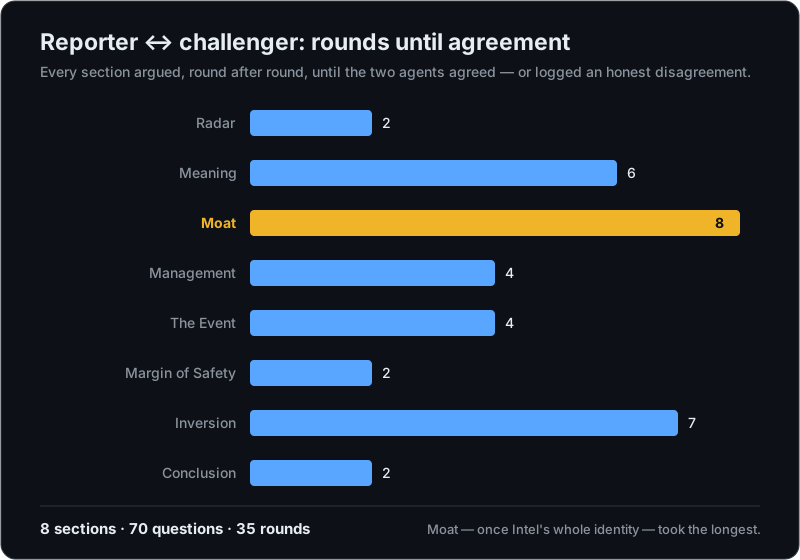
For Intel that argument ran across eight sections, seventy questions, thirty-five rounds in total. The Moat section alone took eight rounds before the two of them would shake hands — which tells you something on its own. The thing that used to be Intel's whole identity, the part everyone is most tempted to wave at confidently, was the part that took the longest to pin down.
The shape of the questions isn't mine. It's the old value-investing checklist — does the business mean something you can actually understand, is there a moat, is management honest and aligned, is there a margin of safety on the price — plus an inversion pass at the end, where the tool argues the bear case against itself on purpose. Four gates and a devil's advocate. Intel walked into all of them.
A small thing I didn't plan and only noticed writing this: the very first company I ever ran through this method, back in 2018 when I was building it by hand in a spreadsheet, was Intel. It's how I checked the spreadsheet was right. Eight years later the finished machine sat down in front of the same company. The case didn't change. The tool just got honest faster.
The receipts
So let me show you what the argument surfaced. Every number here is from the FY2025 10-K, by way of my tool — and where a figure is quoted from the filing's text rather than calculated from its financial statements, I'll say so, because that distinction is the whole point.
Start with the top line, because it's the one the comeback story doesn't want you to look at.
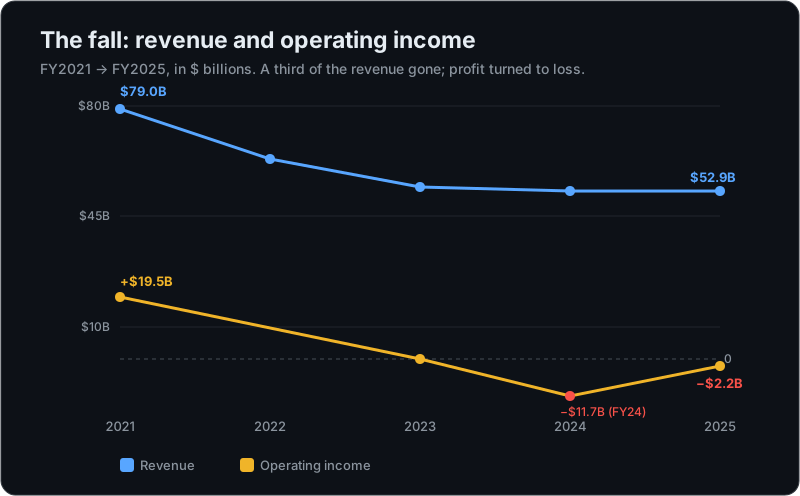
In FY2021, Intel did $79.0 billion in revenue and $19.5 billion in operating income. By FY2025, revenue was $52.9 billion and operating income was negative $2.2 billion. That's not a soft patch. That's thirty-three percent of the revenue simply gone — and twenty-two billion dollars of operating profit turned into a loss over four years. In between, operating income passed through roughly breakeven in 2023 and an $11.7 billion loss in 2024. The line didn't dip. It walked to the edge of the table and stepped right off — and then looked back at you from the floor as if asking whether you noticed.
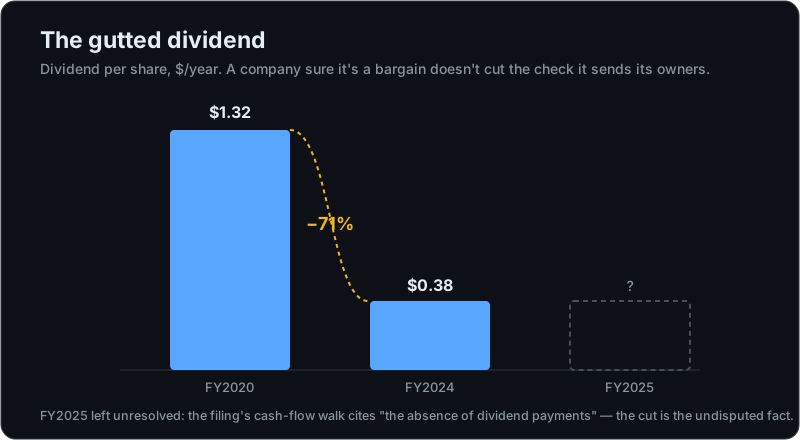
The dividend tells the same story — but this one you'd feel in your mailbox. Intel used to pay $1.32 a share per year. It cut that to $0.38. A company that genuinely believes it's a screaming bargain does not gut the check it sends its owners. It keeps paying, because it knows the value is there. Cutting the dividend by roughly seventy percent is what a balance sheet under stress does. It's cash going into defense, not into your pocket.
(The filing's own language is worth noting here: it talks about "the absence of dividend payments" in 2025. The exact FY2025 per-share figure is a wrinkle my tool flagged and didn't pretend to untie. The cut is the clean, undisputed fact, and the cut is plenty.)
Then there's the part that, for me, closes the case.
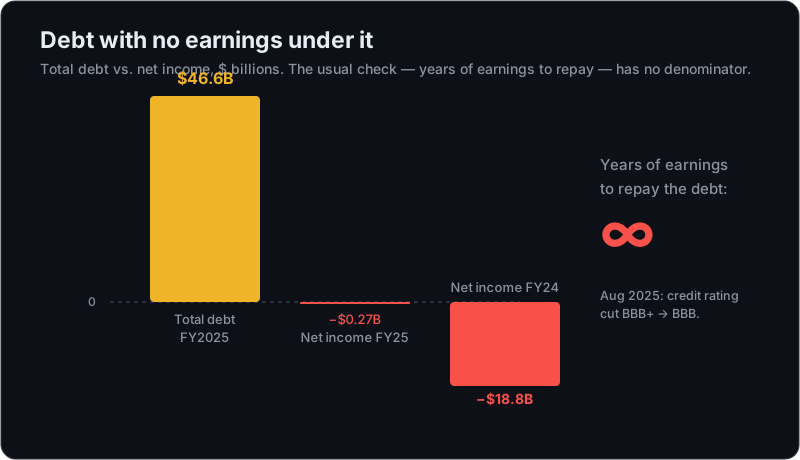
Intel carries about $46.6 billion in total debt. That's a fine amount of debt for a company printing money. Intel is not printing money. It lost $0.27 billion in FY2025, and $18.8 billion the year before. The standard sanity check is simple: how many years of earnings would it take to pay off the debt? Three or fewer, you're comfortable. More than that, and you start sweating.
With Intel, you can't even do the division. There are no earnings to divide by. It's the calculator equivalent of typing something divided by zero and watching your screen flash ERROR at you — except the calculator is forty-six billion dollars tall. The answer isn't "a lot of years." The answer is infinity.
A major rating agency agreed enough to matter: it cut Intel's credit rating from BBB+ to BBB in August 2025, pointing at execution risk and what they politely called "delayed deleveraging" — which is a very calm way of saying the debt isn't moving.
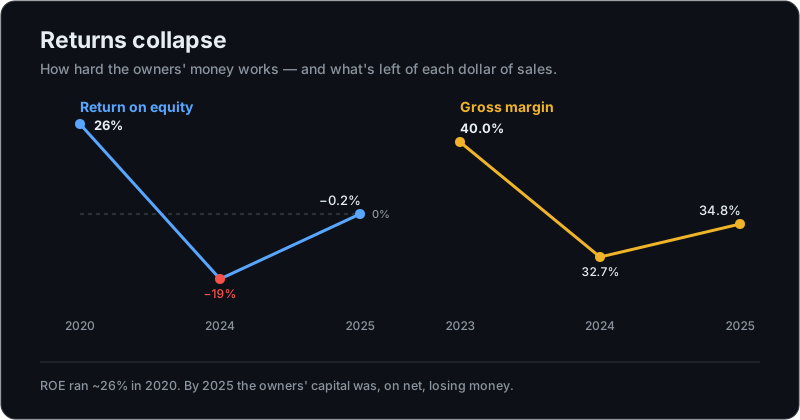
I could keep going, and the tool did. Return on equity — how hard the owners' money is working — ran around 26% back in 2020 and is now roughly −0.2%, having passed through about −19% in 2024. Gross margin slid from 40.0% to 34.8%. Free cash flow has been negative three years running. And the engine under all of it, the Intel Foundry business the whole turnaround is built on, lost $10.3 billion in 2025 after losing $13.3 billion in 2024 — those two figures are straight from the 10-K's own text, not something my tool recomputed, so I'll quote them as the filing's numbers and not dress them up as mine. The factory that's supposed to save the company is, for now, the thing setting the money on fire.
None of this is hidden, by the way. Intel says most of it out loud in the filing itself. It admits it lost market share in both client and data-center markets. It admits it "missed the significant shift in compute demand to GPUs optimized for AI workloads." It admits the foundry strategy is "highly risky and our success highly uncertain." Reading Intel's own 10-K is a bit like watching someone trip over a chair, land flat on the floor, stand up, brush themselves off, and announce in a calm voice: "I should note that I tripped over a chair." My tool just stacks all those admissions next to the arithmetic and refuses to look away.
When the calculator returns nothing
Here's where it gets strange. This is where I learned to actually trust the thing.
The whole point of a value tool is to spit out a number — the sticker price, what the business is honestly worth — and then halve it, because you only buy at a discount deep enough to survive being wrong. That halved number is the margin of safety. The punchline the entire machine is built to deliver.
I asked for Intel's. The machine declined.
Not crashed — declined. Like a vending machine that takes your dollar, hums to itself for a moment, and then just... stares at you. No snack. No refund. Just the vending machine blinking quietly from across the break room while you stand there with your hand out.
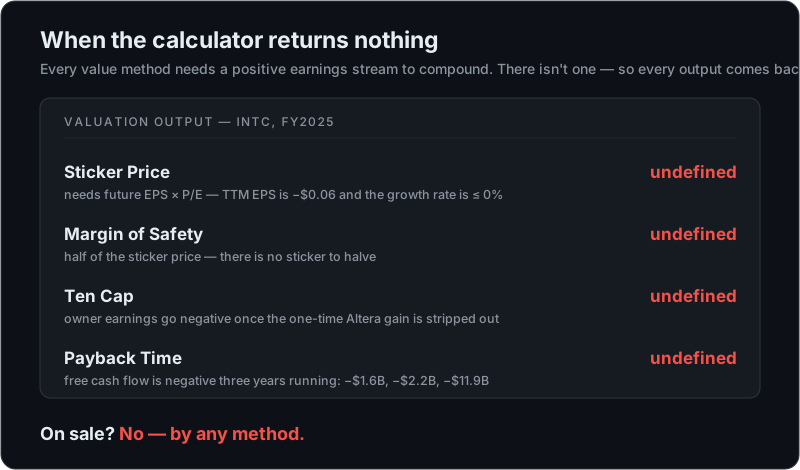
It walked the calculation right up to the edge and then refused to cross it, and it told me exactly why. The sticker price math starts from two things: earnings per share (the company's profit divided up across each share of stock) and a growth rate. Intel's trailing earnings per share is negative — about −$0.06. Its honest growth rate, looking backward across the last several years, is also negative. The company's own internal target that year was for revenue to shrink two percent.
You cannot multiply a negative number at a negative rate and call the result a value. You can't take a meaningful price multiple off negative earnings. Every input the formula needs comes in either negative or undefined. So every output downstream — the sticker price, the margin of safety, the ten-cap, the payback time — comes back blank.
I want to sit on this for a second, because it's the opposite of what we expect from software.
We're trained to think every machine has an answer. Ask it anything and something comes out — a number, a paragraph, a confident little verdict in the right font. That eagerness is exactly the thing I spent months fighting while building this, teaching it that the method's rules beat its own cleverness, that it doesn't get a vote on what's true. The hardest thing to install in an AI is not intelligence. It's the willingness to stop.
A blank, here, is not a bug. It's the most honest output the machine can give. A confident wrong number would tell me to act. The blank tells me the truth — that this business, right now, cannot be valued on the discipline I built the tool to enforce — and trusts me to do the adult thing with that information, which is nothing. (None of this is investment advice, by the way; it's one investor's framework run on public filings, and filings can contain errors. Check the work before you act on it.)
Right then, no now
So put the two facts side by side, because at first they look like a contradiction and they aren't.
I was right to buy Intel at twenty-five. I was right that it would clear a hundred. And today, with the stock near a hundred and thirty and the comeback genuinely real, I would not buy a single share — and neither would my tool let me, because on the FY2025 fundamentals the disciplined price isn't a small number. It's no number at all.
Both of those things are true at once, and the reason they're both true is the entire discipline in one sentence: a value buy is price against value, not direction against momentum. Back in 2018 the price was far below a value I could defend, so I bought. Today there's a price, and a great story, and rising momentum — but there's no defensible value to set the price against. The gap is unmeasurable, and you cannot demand a discount on a number that doesn't exist. The stock can keep climbing. My tool would still say too hard every single day, and it would be right every single day — because it's not pretending to know where the price is going. It's telling me what I can actually justify buying. Those have never been the same thing. The years when they feel like the same thing are the years that cost people their savings.
This is also, quietly, the patience lesson the whole method is built on — the same one running underneath the Gelsinger story. Impatient investors pushed Pat out a year before his plan paid off; they couldn't sit with "not yet." Value investing is the discipline of sitting with "not yet" on purpose. Sometimes "not yet" means waiting for a wonderful business to get cheap. And sometimes it means watching one you used to own run away from you, knowing you were right about it, and still keeping your hands in your pockets — because the price ran past the value and never looked back, and chasing it would mean abandoning the only rule that ever made you money in the first place.
The hard part isn't being wrong. The hard part is being right and still saying no.
The best thing it ever did
We are living through a stretch where the loudest promise about AI is that it will answer everything. Ask, and receive — instantly, fluently, confidently. The whole industry is a race to never say "I don't know."
The most valuable thing my tool has ever done was refuse to answer.
It looked at the one company I have a genuine soft spot for, the one I was right about, the one I wrote a comeback story about with my own name on it — and it would not hand me the number I went in wanting. It showed me the falling revenue, the gutted dividend, the debt with no earnings under it, the calculator coming back blank, and it said, in effect: I can't value this honestly. Here is the receipt for every reason why.
That's not a failure of the machine. That's the machine working exactly as built. I'd rather have a tool that says "I don't know, and here's precisely why I don't know" than one that hands me a confident number on a business it can't actually price. The first one keeps you solvent. The second one is just eagerness wearing a calculator's face.
Intel may yet prove the comeback all the way through. The foundry might win its customer, the losses might turn, the story I wrote might get its happy final chapter. If it does, the fundamentals will say so — in a future 10-K, in numbers my tool can finally compound into a value. On that day I'll run it again, and maybe it'll hand me a price.
Until then it gets to say the bravest thing a machine can say. The thing I built it to be allowed to say.
Too hard.
Sources
- Intel Corporation FY2025 Form 10-K — Intel Corporation. (Primary source. Every financial figure here traces through the analysis tool to this filing — Items 1, 1A, and 7.)
- Five Nodes in Four Years: The Promise That Cost Pat Gelsinger His Job and Saved Intel Anyway — Conny Lazo, May 2026. (The comeback / market-narrative companion to this piece — the $20→$130 run and the ~$130 mid-2026 price.)
- The Machine Is Not Allowed to Sign the Checks — Conny Lazo, June 2026. (The build story of the tool used here — the reporter↔challenger leash, and why it isn't for sale.)
- Rule #1 investing — Phil Town. (The value method the tool encodes: understand the business, the moat, management, and margin of safety; sticker price and the half-price buy. From the books Rule #1 and Payback Time.)